
By Ed Crooks
Published: April 1 2009 03:32 | Last updated: April 1 2009 03:32
Sakhalin-2, the $20bn gas and oil development off the far eastern coast of Russia, was still a financially sound project even after the state wrested control from Royal Dutch Shell in 2006, its chief executive said.
The first cargo of liquefied natural gas from Sakhalin-2 is expected to be delivered to Tokyo on Wednesday. It will be a bittersweet moment for Shell, which was forced to cut its 55 per cent shareholding down to 27.5 per cent to allow Gazprom, the state-controlled Russian gas company, to take a 50 per cent stake.
The project is coming on stream as gas demand is falling worldwide, including in Sakhalin-2s target markets of Japan, South Korea and the US, and there are large volumes of extra LNG coming on to the market, particularly from Qatar.
Some Asian customers were choosing to use flexibility in their contracts to delay deliveries by a year or two but the group still expects to reach full production early next year.
Ian Craig, chief executive of the Sakhalin Energy Investment Company that runs the project, said its economics were still pretty sound, even after the change of ownership and the huge cost overrun that helped provoke the Russian government into action.
The cost of the project doubled from its original budget of $10bn (£7bn) but it has not risen again since the latest revision in 2005.
Mr Craig suggested that, with an estimated 4bn barrels equivalent of oil and gas of ultimately recoverable resources, the investment should be worthwhile, even at an oil price around todays $50 a barrel.
Gazprom had paid the other shareholders the value of their investments when it had joined the project, and had carried its full share of the costs since then, he added. He even argued that the structure of Sakhalin-2 could be emulated by other large-scale energy projects in Russia, such as the development of the Yamal gas fields in the north of the country.
This sort of model, with Gazprom in the lead, and companies like Shell [and others] providing technical expertise and probably some of the financial resources, could work very well there, he said.
The culture at Sakhalin had not greatly changed since Gazprom had become the majority shareholder, he added. The biggest change, Mr Craig said, is that after the board meetings, we drink vodka at dinner now, not just wine.
EDITORS CHOICE
In depth: Oil – Mar-27
The Monday Interview: Jorma Ollila – Mar-22
Shell shapes $32bn production boost – Mar-17
Shell to lend Nigeria $3bn – Feb-20
Copyright The Financial Times Limited 2009
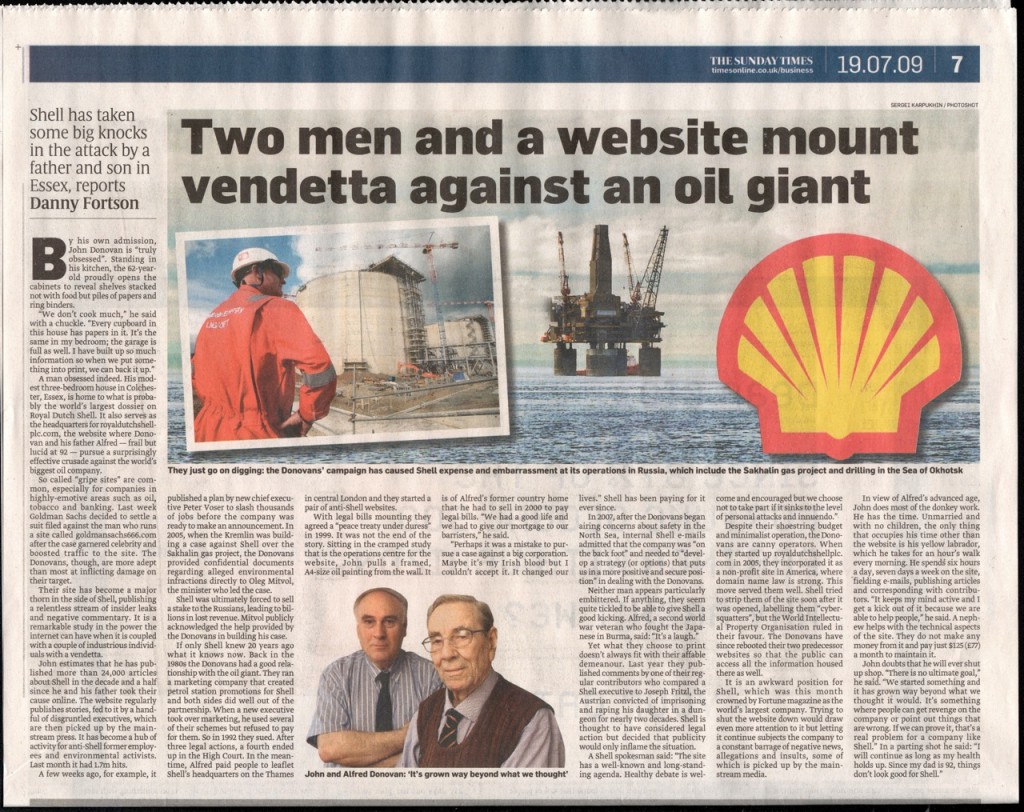
This website and sisters royaldutchshellplc.com, shellnazihistory.com, royaldutchshell.website, johndonovan.website, and shellnews.net, are owned by John Donovan. There is also a Wikipedia segment.


 Royal Dutch Shell conspired directly with Hitler, financed the Nazi Party, was anti-Semitic and sold out its own Dutch Jewish employees to the Nazis. Shell had a close relationship with the Nazis during and after the reign of Sir Henri Deterding, an ardent Nazi, and the founder and decades long leader of the Royal Dutch Shell Group. His burial ceremony, which had all the trappings of a state funeral, was held at his private estate in Mecklenburg, Germany. The spectacle (photographs below) included a funeral procession led by a horse drawn funeral hearse with senior Nazis officials and senior Royal Dutch Shell directors in attendance, Nazi salutes at the graveside, swastika banners on display and wreaths and personal tributes from Adolf Hitler and Reichsmarschall, Hermann Goring. Deterding was an honored associate and supporter of Hitler and a personal friend of Goring.

 Deterding was the guest of Hitler during a four day summit meeting at Berchtesgaden. Sir Henri and Hitler both had ambitions on Russian oil fields. Only an honored personal guest would be rewarded with a private four day meeting at Hitler’s mountain top retreat.


 IN JULY 2007, MR BILL CAMPBELL (ABOVE, A RETIRED GROUP AUDITOR OF SHELL INTERNATIONAL SENT AN EMAIL TO EVERY UK MP AND MEMBER OF THE HOUSE OF LORDS:


 MORE DETAILS:


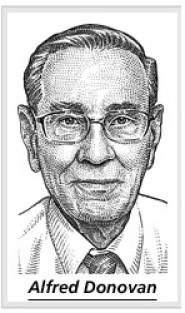 A head-cut image of Alfred Donovan (now deceased) appears courtesy of The Wall Street Journal.