
Thu Nov 27, 2008 12:12pm EST
MOSCOW (Reuters) – Russia’s TNK-BP, half-owned by oil major BP (BP.L: Quote, Profile, Research, Stock Buzz), is cutting downstream business staff at its head office and expects oil production to suffer if oil prices do not recover in 2009, a company executive said on Thursday.
Alexander Kaplan, vice-president of TNK-BP (TNBPI.RTS: Quote, Profile,Research, Stock Buzz), told a news conference the firm would cut its head office’s downstream business staff by 15 percent to 250 people before the end of the year.
He said Russia’s third largest oil producer was working on an assumption oil prices would stick around $60-$70 per barrel next year. Production could suffer if prices fell below $50, he said.
“We have deposits which are under the threat of closure… because every ton of oil produced generates a loss,” he said.
Russian production is heading for a first decline this year after a decade of growth as firms like TNK-BP face deposit depletion and cannot afford launching new fields due to a heavy tax take.
Russian companies have repeatedly called on the government to sharply lower oil export duties as oil prices have been falling in the past months faster than the government-adjusted duties, thus pushing the companies into losses.
Kaplan said: “2008 was the best year in the company’s history…Today we already understand that next year will be very different. It will be tough for us as for any other Russian company.”
“Today we don’t have funds for commercial projects, for (products) output quality improvement. We only have funds to support (operations). It affects refining and to a certain extent – marketing and production,” he added.
Kaplan said the company would have to cut financing of its refineries’ modernization programs if oil prices did not recover.
TNK-BP still plans to go ahead with some big upgrades of its Ryazan, Saratov and Yaroslavl plants, but might not meet deadlines set by the government to switch to tougher European Union products quality standards.
“In fact, we don’t have funds to switch our refineries (to new standards) that have been approved. I think this problem is quite serious. If we don’t meet quality standards, I won’t be able to sell my products,” he said.
He also said TNK-BP had no plans to cut exports in November and December. The Russian government ordered oil firms to resume full shipments after they drastically cut export plans, citing very high export duties.
Kaplan said TNK-BP’s final capital expenditure plan would be approved at a board meeting in December.
(Reporting by Gleb Gorodyankin, writing by Dmitry Zhdannikov)
© Thomson Reuters 2008 All rights reserved


 Royal Dutch Shell conspired directly with Hitler, financed the Nazi Party, was anti-Semitic and sold out its own Dutch Jewish employees to the Nazis. Shell had a close relationship with the Nazis during and after the reign of Sir Henri Deterding, an ardent Nazi, and the founder and decades long leader of the Royal Dutch Shell Group. His burial ceremony, which had all the trappings of a state funeral, was held at his private estate in Mecklenburg, Germany. The spectacle (photographs below) included a funeral procession led by a horse drawn funeral hearse with senior Nazis officials and senior Royal Dutch Shell directors in attendance, Nazi salutes at the graveside, swastika banners on display and wreaths and personal tributes from Adolf Hitler and Reichsmarschall, Hermann Goring. Deterding was an honored associate and supporter of Hitler and a personal friend of Goring.

 Deterding was the guest of Hitler during a four day summit meeting at Berchtesgaden. Sir Henri and Hitler both had ambitions on Russian oil fields. Only an honored personal guest would be rewarded with a private four day meeting at Hitler’s mountain top retreat.


 IN JULY 2007, MR BILL CAMPBELL (ABOVE, A RETIRED GROUP AUDITOR OF SHELL INTERNATIONAL SENT AN EMAIL TO EVERY UK MP AND MEMBER OF THE HOUSE OF LORDS:


 MORE DETAILS:


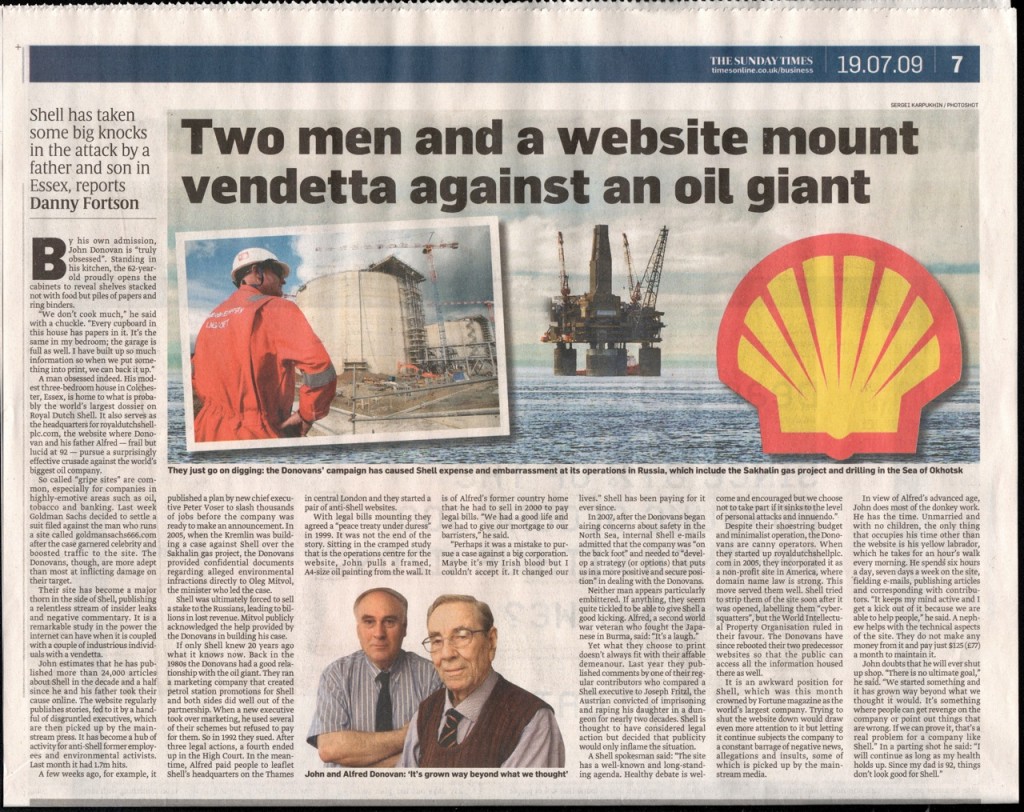
 A head-cut image of Alfred Donovan (now deceased) appears courtesy of The Wall Street Journal.