

Three out of four oil and natural gas companies fell victim to at least one cyber attack last year as hacking efforts against the industry become more frequent and sophisticated.
That’s the finding from a report released Monday by industry consultant Deloitte LLP. Technology advances, such as Royal Dutch Shell Plc’s recent control of operations in Argentina from an operating center in Canada, offer new openings for hackers, the authors wrote.
At the same time, older equipment that must be retrofitted for cybersecurity, including the pumps known as nodding donkeys, make it tougher to defend against sophisticated attacks. Less than half of drillers use any monitoring tools on their upstream operations networks, the report found. Of those, only 14 percent have fully operational security monitoring centers.
When the authors visited the oil fields it “was like walking into the 1980s, with shared passwords and passwords written down on paper,” said Paul Zonneveld, a senior partner at Deloitte in Calgary, by phone.
A 2011 cyber attack dubbed “Night Dragon” stole exploration and bidding data from oil majors including Exxon Mobil Corp. and BP Plc. Past assaults in 2012 and 2014 crippled companies throughout the Middle East and Europe with disk-wiping malware and advanced Trojan Horse attacks.
The report suggested that industry concern over cyberattacks may be low because of a feeling it would be an unlikely target. But with the motives of hackers fast evolving — from cyberterrorism to industry espionage to disrupting operations to stealing field data — risks are rising fast, along with the stakes, the report found.
Complex System
Companies have to defend a complex system comprising assets decades old as well as state-of-the-art digitized technology. To make matters more difficult, these assets are overseen by a wide array of companies and partners and spread across different fields and regions. Protecting the entire system just isn’t feasible, Zonneveld said.
While the cost of cyber crime is estimated to average about $15 million in the industry right now, major assaults can cost hundreds of millions of dollars, and risk deaths and environmental damage.
Company executives are waking up to the threat posed by cybercrime. “The culture needs to change, and that’s happening but it takes time,” said Andrew Slaughter, executive director at the Deloitte Center for Energy Solutions in Houston, in a telephone interview. “This report serves as a call to arms.”
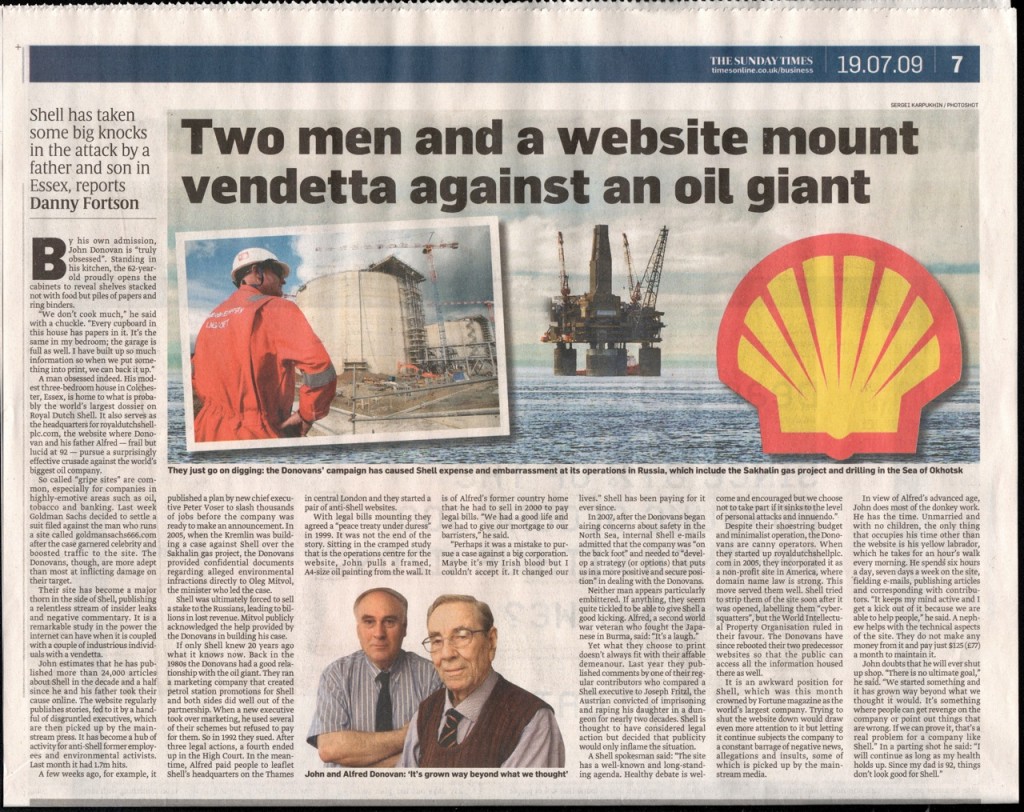
This website and sisters royaldutchshellplc.com, shellnazihistory.com, royaldutchshell.website, johndonovan.website, and shellnews.net, are owned by John Donovan. There is also a Wikipedia segment.


 Royal Dutch Shell conspired directly with Hitler, financed the Nazi Party, was anti-Semitic and sold out its own Dutch Jewish employees to the Nazis. Shell had a close relationship with the Nazis during and after the reign of Sir Henri Deterding, an ardent Nazi, and the founder and decades long leader of the Royal Dutch Shell Group. His burial ceremony, which had all the trappings of a state funeral, was held at his private estate in Mecklenburg, Germany. The spectacle (photographs below) included a funeral procession led by a horse drawn funeral hearse with senior Nazis officials and senior Royal Dutch Shell directors in attendance, Nazi salutes at the graveside, swastika banners on display and wreaths and personal tributes from Adolf Hitler and Reichsmarschall, Hermann Goring. Deterding was an honored associate and supporter of Hitler and a personal friend of Goring.

 Deterding was the guest of Hitler during a four day summit meeting at Berchtesgaden. Sir Henri and Hitler both had ambitions on Russian oil fields. Only an honored personal guest would be rewarded with a private four day meeting at Hitler’s mountain top retreat.


 IN JULY 2007, MR BILL CAMPBELL (ABOVE, A RETIRED GROUP AUDITOR OF SHELL INTERNATIONAL SENT AN EMAIL TO EVERY UK MP AND MEMBER OF THE HOUSE OF LORDS:


 MORE DETAILS:


 A head-cut image of Alfred Donovan (now deceased) appears courtesy of The Wall Street Journal.