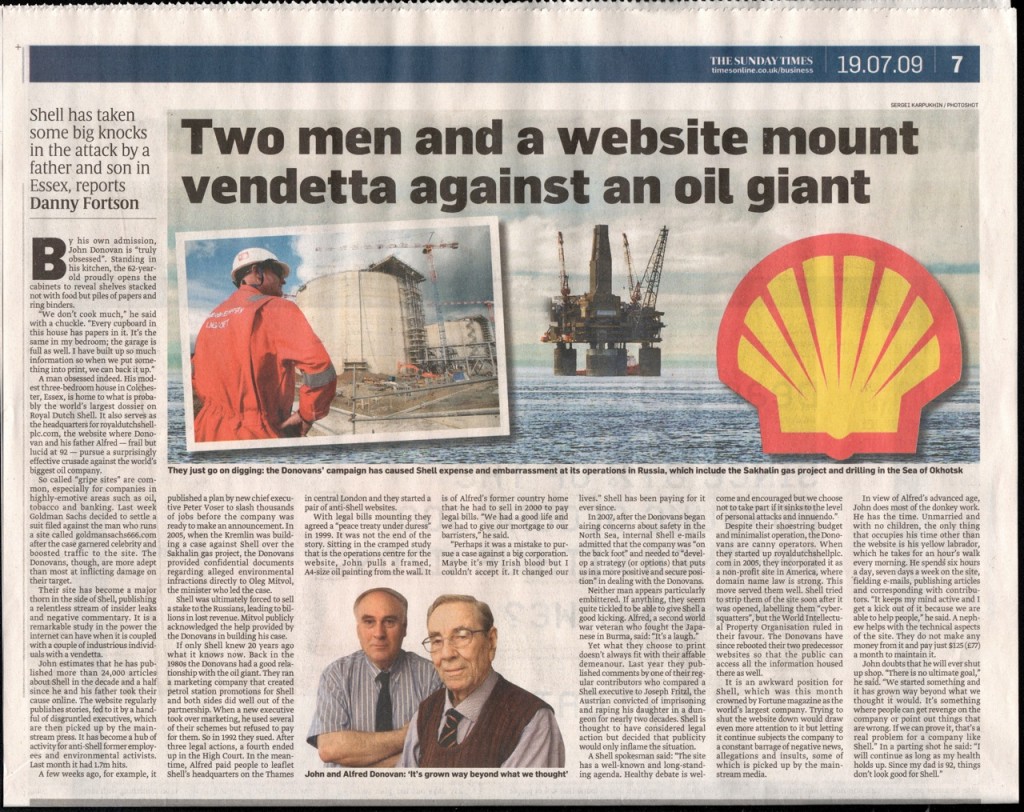
Robert Blaauw, Royal Dutch Shell Plc’s senior Arctic adviser, says his company is interested in the Arctic not for today but for 2050 — when power use will have doubled and two-thirds of energy will still come from fossil fuels.


By John Lippert – Oct 2, 2013 10:47 PM GMT+0100
Extracts from extensive Bloomberg Markets Magazine Article
The Arctic has heated up twice as fast as the rest of the planet in the past three decades. By August 2013, sea ice had lost 76 percent of its volume compared to 1979, according to the University of Washington’s Polar Ice Center. Citing core samples taken from ice sheets, the Intergovernmental Panel on Climate Change, a United Nations group, reported on Sept. 27 that the three main gases blamed for global warming –carbon dioxide, methane and nitrous oxide — are at their highest level in at least 800,000 years.
On Alaska’s Arctic coast, 30-foot-high cliffs that haven’t budged since the last ice age are tumbling into the ocean overnight and village coastlines are eroding, leaving residents in peril. Lightning-sparked forest fires have charred more than 1 million acres (405,000 hectares) in five of the past 10 years. By midcentury, the average area burned by wildfires each year is likely to double, the U.S. Environmental Protection Agency says.
Alaskan Laboratory
Heat waves are getting hotter and longer, and winters are producing more rain and less snow as the carbon-damaged atmosphere soaks up moisture, says Rick Thoman, a climate analyst for the National Weather Service in Fairbanks, Alaska.
“Alaskans are living through climate change in ways people have not experienced in many thousands of years,†he says. “Alaska is a laboratory for everybody in the sense that this is the kind of thing you can expect in your region down the road.â€
Robert Blaauw, Royal Dutch Shell Plc (RDSA)’s senior Arctic adviser, says his company is interested in the Arctic not for today but for 2050 — when power use will have doubled and two-thirds of energy will still come from fossil fuels.
“Shell and the other majors will continue their search for Arctic oil and gas,†Blaauw says.


 Royal Dutch Shell conspired directly with Hitler, financed the Nazi Party, was anti-Semitic and sold out its own Dutch Jewish employees to the Nazis. Shell had a close relationship with the Nazis during and after the reign of Sir Henri Deterding, an ardent Nazi, and the founder and decades long leader of the Royal Dutch Shell Group. His burial ceremony, which had all the trappings of a state funeral, was held at his private estate in Mecklenburg, Germany. The spectacle (photographs below) included a funeral procession led by a horse drawn funeral hearse with senior Nazis officials and senior Royal Dutch Shell directors in attendance, Nazi salutes at the graveside, swastika banners on display and wreaths and personal tributes from Adolf Hitler and Reichsmarschall, Hermann Goring. Deterding was an honored associate and supporter of Hitler and a personal friend of Goring.

 Deterding was the guest of Hitler during a four day summit meeting at Berchtesgaden. Sir Henri and Hitler both had ambitions on Russian oil fields. Only an honored personal guest would be rewarded with a private four day meeting at Hitler’s mountain top retreat.


 IN JULY 2007, MR BILL CAMPBELL (ABOVE, A RETIRED GROUP AUDITOR OF SHELL INTERNATIONAL SENT AN EMAIL TO EVERY UK MP AND MEMBER OF THE HOUSE OF LORDS:


 MORE DETAILS:


 A head-cut image of Alfred Donovan (now deceased) appears courtesy of The Wall Street Journal.