
Exxon Mobil Corp. (XOM) (XOM), the world’s biggest energy company, and Royal Dutch Shell Plc (RDSA) said a U.S.- led transformation of the natural-gas market will boost the global economy even as oil becomes more expensive.
“Natural gas is quickly becoming a key enabler of economic growth and environmental progress around the world,” Rex W. Tillerson, chief executive officer of Exxon, said at a conference today in Kuala Lumpur. “We are living at a historic moment in the evolution of energy markets. How we respond will shape the quality of life for generations to come.”
A shale boom in the U.S. has helped it surpass Russia as the world’s biggest producer of natural gas and brought the country close to energy independence. Gas is poised to overtake coal as the second-most widely used source of energy worldwide by 2025, with demand in Asia projected to grow by more than 50 percent over the next three decades, Tillerson said.
Reserves of gas, a cleaner-burning fuel, are helping rebuild the U.S. economy and enabling China to replace more- polluting coal, Peter Voser, Shell’s chief executive office, said in a separate speech at the World Gas Conference in the Malaysian capital today.
Shell, Exxon, Chevron Corp. (CVX) (CVX) and Woodside Petroleum Ltd. are among companies leading $180 billion of liquefied-natural-gas ventures in Australia that are underpinned by demand from Asia’s biggest economies. China, estimated to hold triple the shale reserves of the U.S., and Australia will see the next wave of the gas revolution as world LNG demand doubles in the next decade, Voser told delegates at the conference.
LNG Sales
ConocoPhillips and Origin Energy Ltd. are among producers in Australia selling LNG near record prices linked to crude. At the same time, benchmark gas prices in the U.S. have slumped to the lowest in a decade amid a supply glut.
Gas futures slid to $1.90 per million Btu on the New York Mercantile Exchange April 19, the lowest since September 2001.
Oil prices are unlikely to collapse as they did in 2008 because long-term fundamentals haven’t changed and supply will struggle to meet a projected increase in global demand, according to Voser.
U.S. crude futures, which slumped to an eight-month low near $81 a barrel yesterday, have declined because of concern over economic growth this year and as geopolitical tension in producing regions subside, the Shell CEO said.
Oil Prices
“The softening of the oil price at the moment is a reflection of some of the geopolitical issues being less dominant and the lower demand outlook,” Voser said. “The long- term fundamentals haven’t changed, which means that most probably, given energy-demand growth in the world in the longer term, supply will struggle to keep pace.”
Oil dropped from a record high of $147.27 a barrel to $32.40 between July and December 2008 as the global recession sapped demand. Futures on the New York Mercantile Exchange tumbled 17 percent last month, the most since December 2008, and traded today as high as $84.92 a barrel.
“We’ve seen a lot of volatility, mainly on the demand side,” Voser said after delivering a keynote address at the industry gathering. “We’ve had some geopolitical dimensions around the Middle East, in Iran and Syria, following the political tensions in Libya a year ago, so I think that’s reflected in the price in the more short to medium term.”
Oil traded as high as $110.55 a barrel March 1 on speculation that international sanctions against Iran threatened supplies from the world’s fourth-biggest producer. Prices have since dropped as Iran resumed talks with the West over its nuclear program while Europe’s debt crisis and China’s slowing economy damped the outlook for oil demand.
To contact the reporters on this story: Dinakar Sethuraman in Kuala Lumpur at [email protected]; Rakteem Katakey in Kuala Lumpur at [email protected]; Yee Kai Pin in Kuala Lumpur at [email protected]
To contact the editors responsible for this story: Amit Prakash at [email protected]; Alexander Kwiatkowski at [email protected]


 Royal Dutch Shell conspired directly with Hitler, financed the Nazi Party, was anti-Semitic and sold out its own Dutch Jewish employees to the Nazis. Shell had a close relationship with the Nazis during and after the reign of Sir Henri Deterding, an ardent Nazi, and the founder and decades long leader of the Royal Dutch Shell Group. His burial ceremony, which had all the trappings of a state funeral, was held at his private estate in Mecklenburg, Germany. The spectacle (photographs below) included a funeral procession led by a horse drawn funeral hearse with senior Nazis officials and senior Royal Dutch Shell directors in attendance, Nazi salutes at the graveside, swastika banners on display and wreaths and personal tributes from Adolf Hitler and Reichsmarschall, Hermann Goring. Deterding was an honored associate and supporter of Hitler and a personal friend of Goring.

 Deterding was the guest of Hitler during a four day summit meeting at Berchtesgaden. Sir Henri and Hitler both had ambitions on Russian oil fields. Only an honored personal guest would be rewarded with a private four day meeting at Hitler’s mountain top retreat.


 IN JULY 2007, MR BILL CAMPBELL (ABOVE, A RETIRED GROUP AUDITOR OF SHELL INTERNATIONAL SENT AN EMAIL TO EVERY UK MP AND MEMBER OF THE HOUSE OF LORDS:


 MORE DETAILS:


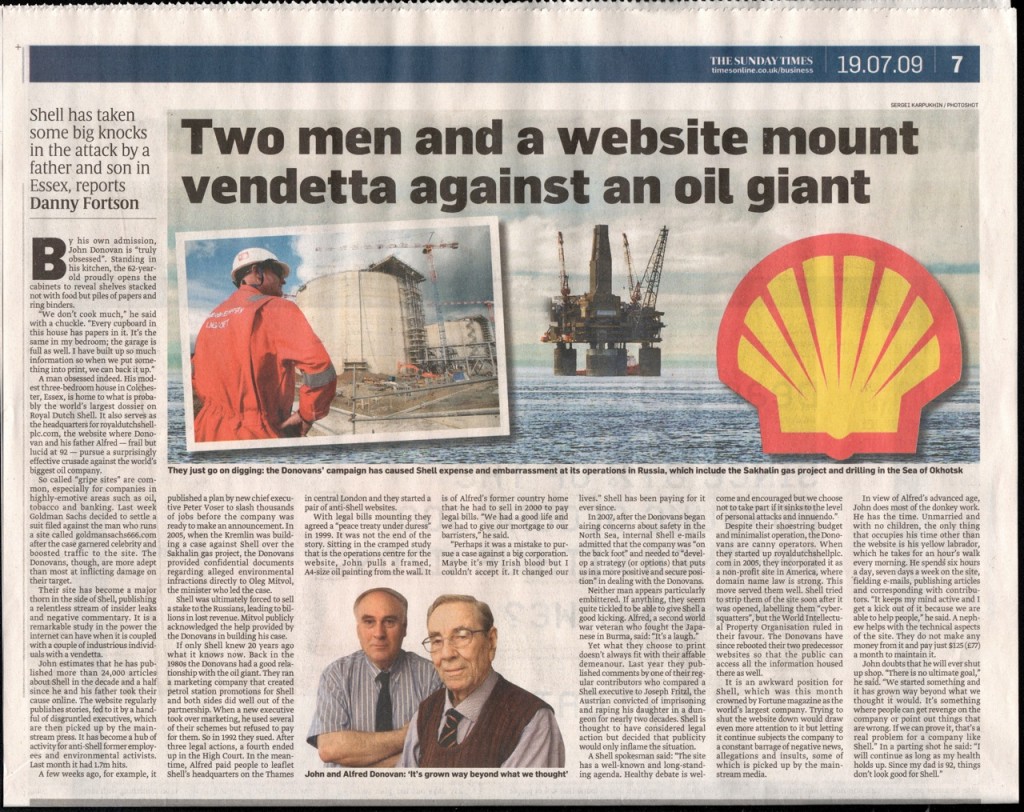
 A head-cut image of Alfred Donovan (now deceased) appears courtesy of The Wall Street Journal.