
By a Guest Contributor
Royal Dutch Shell may have a serious problem if they are found to be guilty of violating international ‘human rights’ law, etc. Perhaps this is why the British and Dutch governments have moved to try and shut down a decision on the part of the US Supreme Court that would allow the original case to proceed.
It would appear to me, given your article on the effects of Shell’s pesticide pollution, that Shell could also find itself facing charges of ‘crimes against humanity’, etc., for the continued sale and marketing of pesticides they knew were dangerous to man and animal, and which were very long lived in the environment. I am referring to the case in Brazil where Shell clearly knew what kind of harm they were doing to their workers, the local environment, and through the sale of pesticides whose sale and manufacture had been banned in the mid-1970’s within the US and other countries.
Had an individual done as Shell has done, I have little doubt that Brazilian courts would lock the person away for life in one of their coziest prisons.
An adverse ruling in the Kiobel vs Shell case could lead to further prosecution of Shell, and perhaps Shell management, past and present, for actions that could be considered ‘crimes against humanity’, or gross ‘human rights’ violations, etc., etc.
It is going to be interesting to see how this plays out. Other companies, such as Chevron, etc., also appear to have a stake in this ruling as well.
Wouldn’t it be too bad if corporate management were to find itself stripped of legal protection and on the hook for the harm their decisions caused? Nothing like being held accountable for bad decisions.
Personally, I don’t see much difference between Shell’s conduct toward their employees in Brazil and the manner in which firms like IG Farben treated their ‘guest workers’ (slave labor) during WWII. IG Farben management was out to make as much money as possible just like Royal Dutch Shell was in Brazil. In both cases the motivation was basic greed, coupled with complete, absolute utter contempt for the welfare of their staff. If IG Farben management was guilty of ‘crimes against humanity’, then I don’t see how Royal Dutch Shell management can duck a similar charge for their conduct in Brazil, etc.
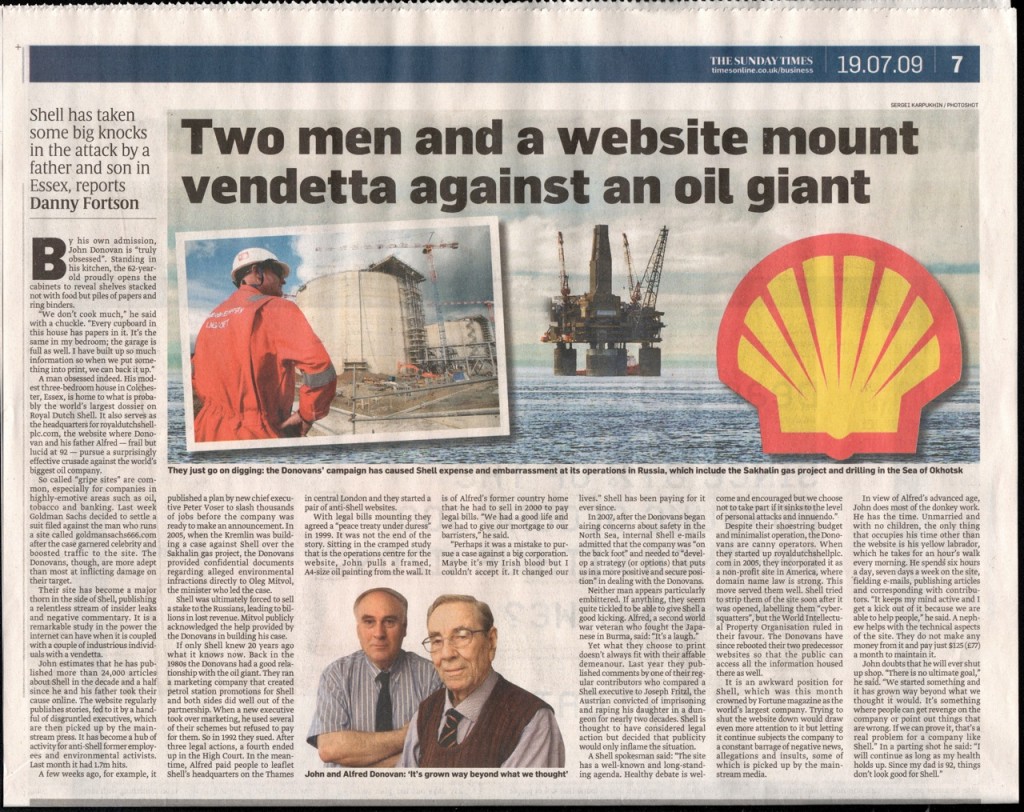
This website and sisters royaldutchshellplc.com, shellnazihistory.com, royaldutchshell.website, johndonovan.website, and shellnews.net, are owned by John Donovan. There is also a Wikipedia segment.


 Royal Dutch Shell conspired directly with Hitler, financed the Nazi Party, was anti-Semitic and sold out its own Dutch Jewish employees to the Nazis. Shell had a close relationship with the Nazis during and after the reign of Sir Henri Deterding, an ardent Nazi, and the founder and decades long leader of the Royal Dutch Shell Group. His burial ceremony, which had all the trappings of a state funeral, was held at his private estate in Mecklenburg, Germany. The spectacle (photographs below) included a funeral procession led by a horse drawn funeral hearse with senior Nazis officials and senior Royal Dutch Shell directors in attendance, Nazi salutes at the graveside, swastika banners on display and wreaths and personal tributes from Adolf Hitler and Reichsmarschall, Hermann Goring. Deterding was an honored associate and supporter of Hitler and a personal friend of Goring.

 Deterding was the guest of Hitler during a four day summit meeting at Berchtesgaden. Sir Henri and Hitler both had ambitions on Russian oil fields. Only an honored personal guest would be rewarded with a private four day meeting at Hitler’s mountain top retreat.


 IN JULY 2007, MR BILL CAMPBELL (ABOVE, A RETIRED GROUP AUDITOR OF SHELL INTERNATIONAL SENT AN EMAIL TO EVERY UK MP AND MEMBER OF THE HOUSE OF LORDS:


 MORE DETAILS:


 A head-cut image of Alfred Donovan (now deceased) appears courtesy of The Wall Street Journal.