By Javier Blas in London
Published: October 31 2007 19:41 | Last updated: November 1 2007 07:18
Crude oil prices hit a nominal all-time high above $96 a barrel in after-hours trading on Wednesday night after US inventories had suffered another big drop that left them at their lowest level in two years.
The US department of energy reported that crude oil inventories fell 3.9m to 312.7m in the week ending last Friday. That is the lowest level since October 2005, when the US oil industry was recovering from the impact of hurricanes Rita and Katrina.
Nymex December West Texas Intermediate jumped $4.15 to settle at $94.53 a barrel, swinging more than $5 from the day’s intraday low and beating the record of $93.80 reached on Monday. It had hit $94.74 in intraday trading and reached $96.24 in after-hours trading.
Japanese oil inventories also fell last week and are at 97.9m barrels, their lowest since early 2006 and 16 per cent below last year’s level.
The International Energy Agency, the western countries’ energy watchdog, has warned that crude oil inventories’ declines showed the market needed more supplies.
ICE December Brent hit a record of $90.74 a barrel before closing $3.19 higher at $90.63 a barrel. The weakness of the dollar helped push prices higher.
The sharp rally came a day after Goldman Sachs, Wall Street’s most bullish investment bank on the commodity, recommended investors take oil market profits, which pushed down prices more than $3 a barrel.
The cost of buying insurance against WTI oil surging to $100 a barrel in the next two weeks through call options – contracts that give the right to buy oil at a predetermined price – jumped 150 per cent to 93 cents per barrel. Trading in call options has been one of the key drivers of the recent price spike, analysts said.
The inventory fall was particularly acute at the market-sensitive location of Cushing, Oklahoma, the delivery point for the Nymex contract, were crude oil stocks fell 3.1m barrels on the week to 15.1m, almost 35 per cent below the level this time last year.
Paul Horsnell, head of commodities research at Barclays Capital in London, warned that relative to their five-year average pattern, US crude oil inventories have been falling at close to 1m barrels a day over the past two weeks.
Corn and soyabean prices increased sharply in concert with the oil price rally as they are important ingredients for the biofuel industry.
Copyright The Financial Times Limited 2007
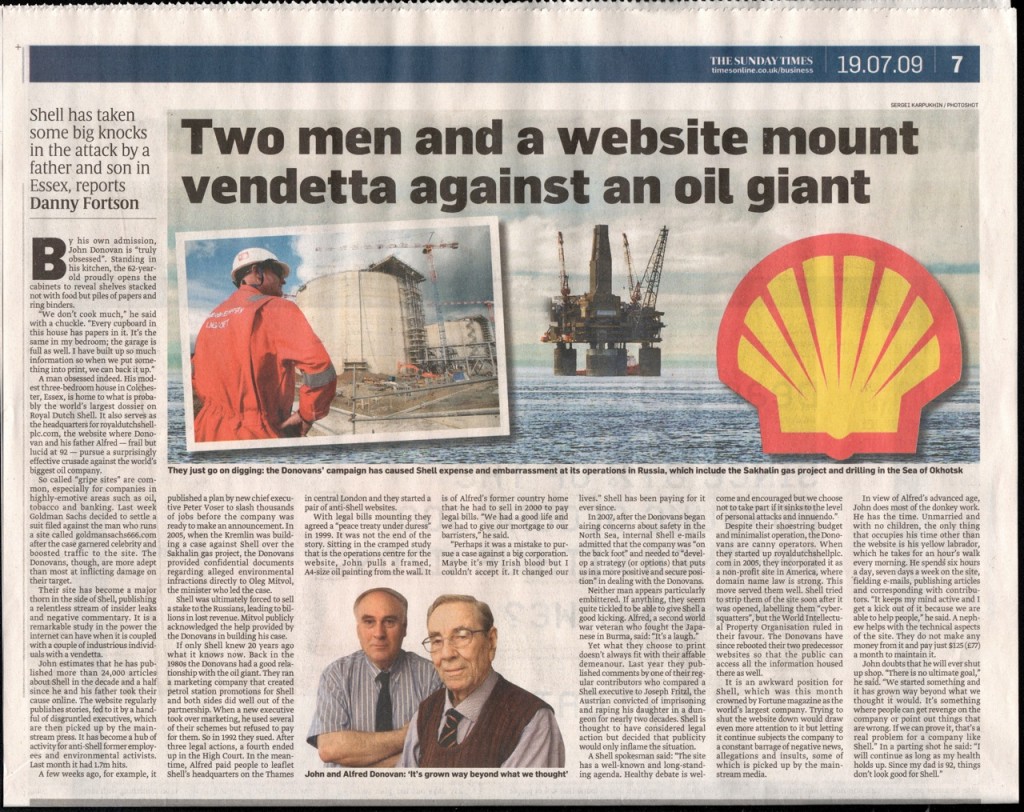
This website and sisters royaldutchshellplc.com, shellnazihistory.com, royaldutchshell.website, johndonovan.website, and shellnews.net, are owned by John Donovan. There is also a Wikipedia segment.


 Royal Dutch Shell conspired directly with Hitler, financed the Nazi Party, was anti-Semitic and sold out its own Dutch Jewish employees to the Nazis. Shell had a close relationship with the Nazis during and after the reign of Sir Henri Deterding, an ardent Nazi, and the founder and decades long leader of the Royal Dutch Shell Group. His burial ceremony, which had all the trappings of a state funeral, was held at his private estate in Mecklenburg, Germany. The spectacle (photographs below) included a funeral procession led by a horse drawn funeral hearse with senior Nazis officials and senior Royal Dutch Shell directors in attendance, Nazi salutes at the graveside, swastika banners on display and wreaths and personal tributes from Adolf Hitler and Reichsmarschall, Hermann Goring. Deterding was an honored associate and supporter of Hitler and a personal friend of Goring.

 Deterding was the guest of Hitler during a four day summit meeting at Berchtesgaden. Sir Henri and Hitler both had ambitions on Russian oil fields. Only an honored personal guest would be rewarded with a private four day meeting at Hitler’s mountain top retreat.


 IN JULY 2007, MR BILL CAMPBELL (ABOVE, A RETIRED GROUP AUDITOR OF SHELL INTERNATIONAL SENT AN EMAIL TO EVERY UK MP AND MEMBER OF THE HOUSE OF LORDS:


 MORE DETAILS:


 A head-cut image of Alfred Donovan (now deceased) appears courtesy of The Wall Street Journal.