
 Houston, We Have A Problem. Oil Reserves Have Fallen Below 10 Years
Big oil has a big problem. It’s running out of oil.
Years of under-investment in exploration and a decline in project development has blown a hole in the reserves of the major international oil companies (IOCs), a group that includes ExxonMobil, Chevron and Royal Dutch Shell.
Since 2015 the average reserves of the oil majors has fallen by 25% to now stand at less than 10 years of annual production.
Reserves in the ground is a critical measure of an oil company with a decline seen as a negative by investors.
The worst interpretation of falling reserves is that it might be an existential threat to the long-term survival of an oil company.
“A Looming Challenge”
Citi, an investment bank, noted the industry-wide decline of reserves in a research note published last week under the headline: “Falling IOC Reserves A Looming Challenge”.
The basis of the bank’s analysis was a review of the latest annual reports of the oil majors to provide a full picture of oil and gas reserves across the industry as at the end of last year.
“That picture is one where reserve life fell yet again,” Citi said.
9.5 Years Of Reserves, Down 25%
“The IOC average of 9.5 years is now 25% below where the industry was prior to the oil price collapse in 2015.”
The bank said that while Securities and Exchange Commission measurements had some failings they provided a clear picture of an industry that is struggling to make itself competitive in a world of lower oil prices.
“There is no bypassing this relationship between reserves and earnings, hence we think analysis of reserves trends is a highly important indicator of the health of a business,” Citi said.
Arguments that reserves are less relevant in an industry facing a transition away from oil and gas misses the point that it is cash flow from oil which is paying for investment in new energy sources such as wind and solar.
“In the recent words of one IOC chief executive ‘black pays for green’ a reference to the 80% of CFFO (cash flow from operations) that is generated from oil and gas activities, and likely to still be more than 70% by 2030,” Citi said.
“A reserve life of under 10 years gives an important reference on these time frames.”
Citi said there were two clear groups forming across the oil sector with six IOCs tightly grouped around reserve life of around 10.5 years. They are: Total, BP, Chevron, ENI, ConocoPhillips and ExxonMobil.
There are three IOCs in another group (Repsol, Equinor and Shell) which have reserves around eight years.


 Royal Dutch Shell conspired directly with Hitler, financed the Nazi Party, was anti-Semitic and sold out its own Dutch Jewish employees to the Nazis. Shell had a close relationship with the Nazis during and after the reign of Sir Henri Deterding, an ardent Nazi, and the founder and decades long leader of the Royal Dutch Shell Group. His burial ceremony, which had all the trappings of a state funeral, was held at his private estate in Mecklenburg, Germany. The spectacle (photographs below) included a funeral procession led by a horse drawn funeral hearse with senior Nazis officials and senior Royal Dutch Shell directors in attendance, Nazi salutes at the graveside, swastika banners on display and wreaths and personal tributes from Adolf Hitler and Reichsmarschall, Hermann Goring. Deterding was an honored associate and supporter of Hitler and a personal friend of Goring.

 Deterding was the guest of Hitler during a four day summit meeting at Berchtesgaden. Sir Henri and Hitler both had ambitions on Russian oil fields. Only an honored personal guest would be rewarded with a private four day meeting at Hitler’s mountain top retreat.


 IN JULY 2007, MR BILL CAMPBELL (ABOVE, A RETIRED GROUP AUDITOR OF SHELL INTERNATIONAL SENT AN EMAIL TO EVERY UK MP AND MEMBER OF THE HOUSE OF LORDS:


 MORE DETAILS:


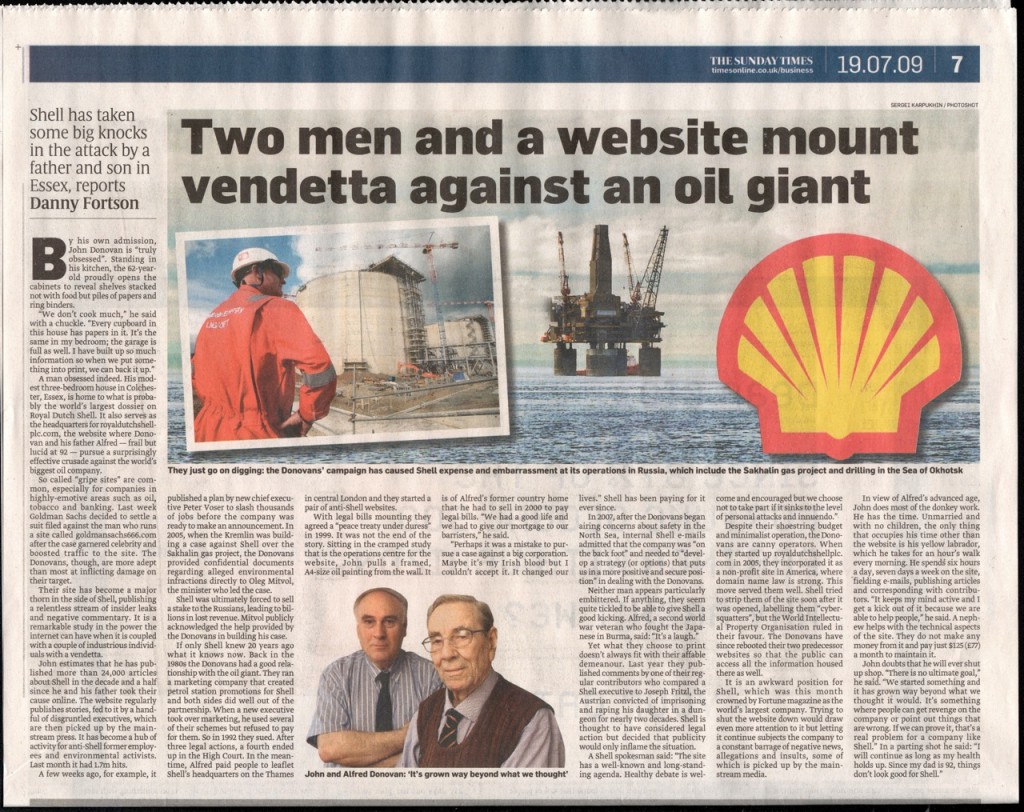
 A head-cut image of Alfred Donovan (now deceased) appears courtesy of The Wall Street Journal.