

TOKYO — An international consortium led by Royal Dutch Shell and includes China National Petroleum Corp., Korea Gas and Japanese trading house Mitsubishi Corp. is moving ahead on a long-stalled liquefied natural gas plant in Canada, as environmental concerns drive Asia toward cleaner energy sources.
Japanese plant engineering company JGC and American counterpart Fluor jointly won orders to design and build the project in the British Columbia community of Kitimat on Canada’s Pacific coast for an estimated $14 billion.
Lower crude oil prices have shelved LNG plant projects worldwide since 2014, including the Shell-led group’s Canadian plan. But the Kitimat project has returned now that it appears economically viable due to a rebound in resource prices.
The Canadian plant should begin liquefying shale gas around 2023 for shipments to China, South Korea and other Asian markets, with annual capacity topping 13 million tons. Transport to Asia by LNG carrier takes eight days from North America’s west coast, compared with 20 days from the Gulf of Mexico and 14 from the Middle East.
The resumption of the large LNG project reflects soaring demand in Asia, which is turning to the energy source and away from coal and oil in efforts to combat global warming. Factories in emerging economies are adopting LNG in place of fuel oil to heat boilers. Imports for power generation are increasing as well.
China, where LNG demand is rising at the fastest pace worldwide, surpassed South Korea in 2017 to become the second-largest importer by volume, up 50% from the previous year. Japan ranks as the leading importer, while demand is also growing in India and Southeast Asia.
The growing use of LNG has sparked concerns of a global shortage by 2022 or 2023 if investment remains in the doldrums. Royal Dutch Shell and other energy companies look to reinforce LNG development and secure sales channels in Asia.
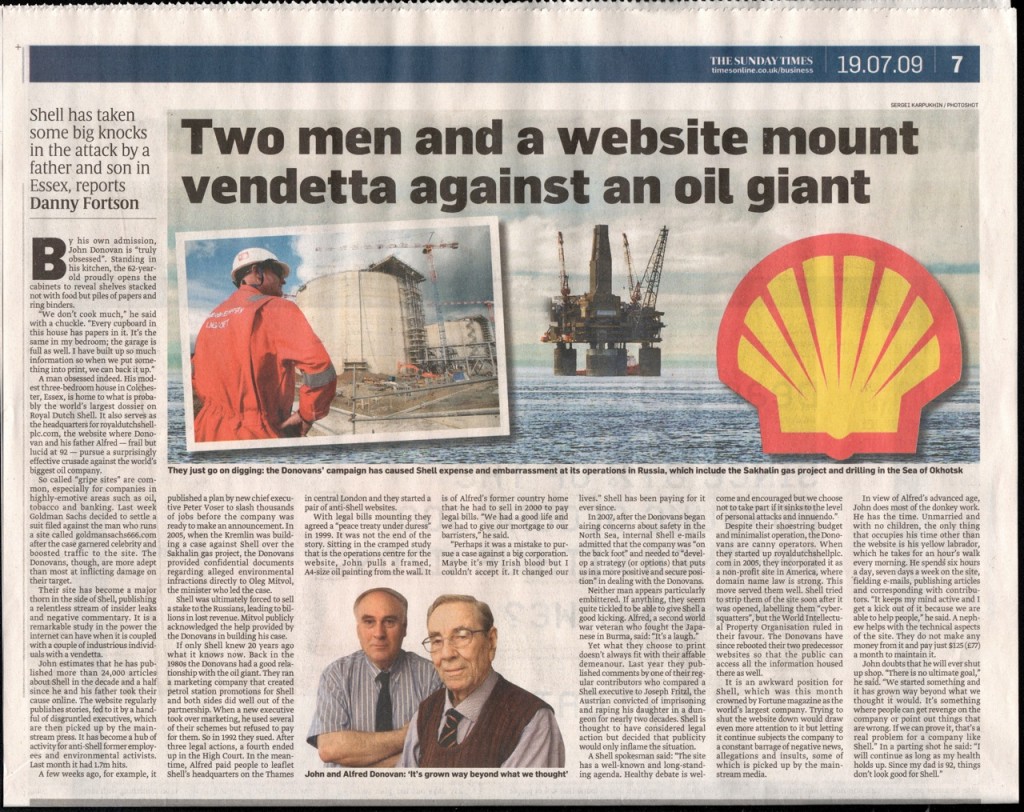
This website and sisters royaldutchshellplc.com, shellnazihistory.com, royaldutchshell.website, johndonovan.website, and shellnews.net, are owned by John Donovan. There is also a Wikipedia segment.


 Royal Dutch Shell conspired directly with Hitler, financed the Nazi Party, was anti-Semitic and sold out its own Dutch Jewish employees to the Nazis. Shell had a close relationship with the Nazis during and after the reign of Sir Henri Deterding, an ardent Nazi, and the founder and decades long leader of the Royal Dutch Shell Group. His burial ceremony, which had all the trappings of a state funeral, was held at his private estate in Mecklenburg, Germany. The spectacle (photographs below) included a funeral procession led by a horse drawn funeral hearse with senior Nazis officials and senior Royal Dutch Shell directors in attendance, Nazi salutes at the graveside, swastika banners on display and wreaths and personal tributes from Adolf Hitler and Reichsmarschall, Hermann Goring. Deterding was an honored associate and supporter of Hitler and a personal friend of Goring.

 Deterding was the guest of Hitler during a four day summit meeting at Berchtesgaden. Sir Henri and Hitler both had ambitions on Russian oil fields. Only an honored personal guest would be rewarded with a private four day meeting at Hitler’s mountain top retreat.


 IN JULY 2007, MR BILL CAMPBELL (ABOVE, A RETIRED GROUP AUDITOR OF SHELL INTERNATIONAL SENT AN EMAIL TO EVERY UK MP AND MEMBER OF THE HOUSE OF LORDS:


 MORE DETAILS:


 A head-cut image of Alfred Donovan (now deceased) appears courtesy of The Wall Street Journal.