

Royal Dutch Shell are likely to take their time over the Brent decommissioning process due to the controversial fallout from a previous disposal attempt, according to one industry analyst.
The energy giant hit the headlines back in 1995 when it first floated plans to dispose of the Brent Spar holding and loading platform by sinking it in the deep waters of the Atlantic.
After getting wind of the plans, environmental group Greenpeace mounted a large-scale media campaign against the dumping of the Shell-owned oil and tanker loading buoy.
Protesters managed to occupy the installation for nearly three weeks before being evicted.
Shell later said the Brent Spar had become of “symbolic significance out of all proportion to its environmental effect”.
The Brent was then mothballed in a Norwegian yard before it was turned into foundations for a ferry terminal
Ben Wilby of global energy consultancy Douglas-Westwood said the supermajor’s recent submission of draft strategies for removing four other platforms from the Brent field was the first “high-profile” example of a disposal since.
And the market analyst said all other North Sea operators would be watching intently as the work gets underway over the coming decade.
Wilby said: “Shell are being particularly cautious about this because of the legacy of the Brent Spar.
“To my knowledge this is the first major, high-profile, decommissioning activity that is going to be undertaken.
“It makes sense that they are being especially cautious as there’s no real precedence to go by.”
The first topside is expected to be lifted by the world’s largest boat, Pioneering Spirit, later this year.
Shell’s entire decommissioning programme for the Brent field is expected to last into 2026.
Wilby added: “The fact that Shell are getting the public consultation out now shows they are fairly comfortable with what they are doing and how it might work
“Operators will still need to look at decommissioning on a case by case basis but once you’ve got a couple of projects under your belt, you know the people to go to in order to get the work done.
“So there’s quite a lot riding on whether this one is a success.”
RELATED ARTICLES
- Shell Brent: All set for topsides lift come the spring
- Shell Brent: OGA hails iconic North Sea field
- Shell Brent: Heroic is the only adjective to describe it


 Royal Dutch Shell conspired directly with Hitler, financed the Nazi Party, was anti-Semitic and sold out its own Dutch Jewish employees to the Nazis. Shell had a close relationship with the Nazis during and after the reign of Sir Henri Deterding, an ardent Nazi, and the founder and decades long leader of the Royal Dutch Shell Group. His burial ceremony, which had all the trappings of a state funeral, was held at his private estate in Mecklenburg, Germany. The spectacle (photographs below) included a funeral procession led by a horse drawn funeral hearse with senior Nazis officials and senior Royal Dutch Shell directors in attendance, Nazi salutes at the graveside, swastika banners on display and wreaths and personal tributes from Adolf Hitler and Reichsmarschall, Hermann Goring. Deterding was an honored associate and supporter of Hitler and a personal friend of Goring.

 Deterding was the guest of Hitler during a four day summit meeting at Berchtesgaden. Sir Henri and Hitler both had ambitions on Russian oil fields. Only an honored personal guest would be rewarded with a private four day meeting at Hitler’s mountain top retreat.


 IN JULY 2007, MR BILL CAMPBELL (ABOVE, A RETIRED GROUP AUDITOR OF SHELL INTERNATIONAL SENT AN EMAIL TO EVERY UK MP AND MEMBER OF THE HOUSE OF LORDS:


 MORE DETAILS:


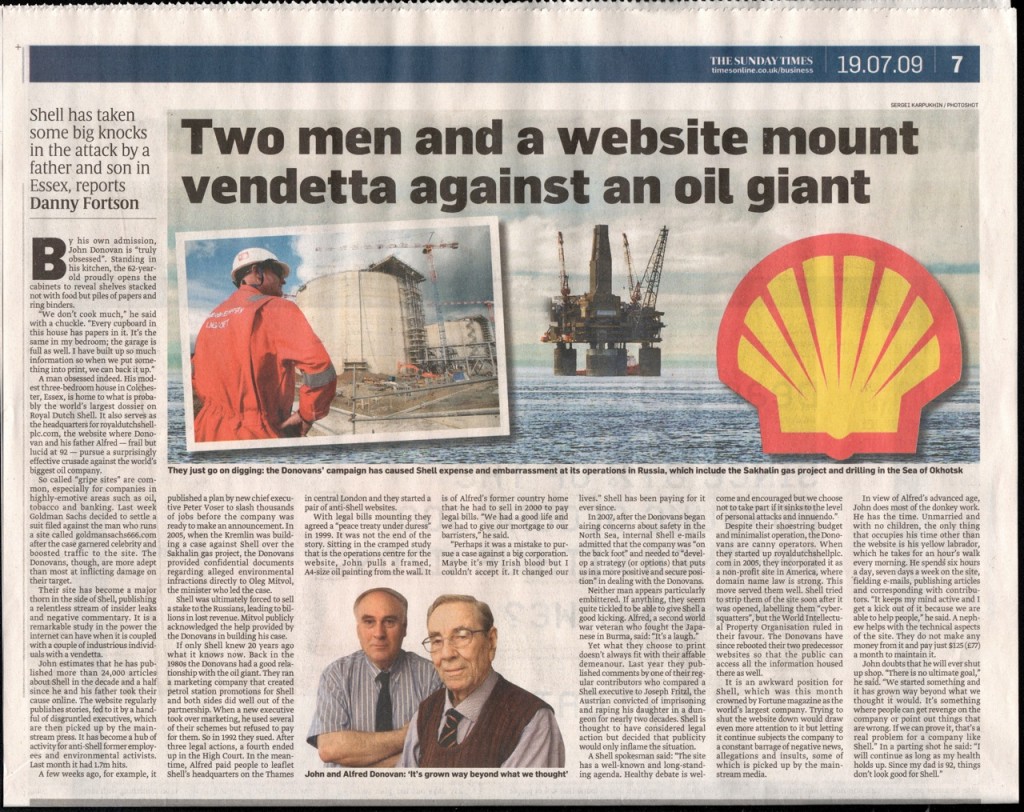
 A head-cut image of Alfred Donovan (now deceased) appears courtesy of The Wall Street Journal.