
Written by Mark Lammey – 30/01/2017 7:48 am
Investors monitoring the fourth quarter results of Shell and BP must look beyond the top line figures to get a good reading of the firms’ vital signs.
Iain Armstrong, divisional director at Brewin Dolphin, said the fourth quarter was notoriously hard to predict as oil and gas deliveries tended to be down.
Mr Armstrong said the two majors’ headline figures could be disappointing, unless strong demand from China gives them a boost.
He also said Shell should be in a position to sell more of its North Sea assets, thanks to improved oil prices and the BG Group acquisition showing signs of fruition.
Shell publishes its fourth quarter results on February 2, while BP’s come out on February 7.
The most telling figures will relate to the firms’ cost base performance, according to Mr Armstrong.
“The fourth quarter is a low delivery season,” he said. “Demand is low because people are driving less, so not as much product is needed.
“The oil price looks great but oil companies do not get the full benefit. You get a very distorted picture in the fourth quarter.
“BP pays out all of its German taxes for the full year in its fourth quarter, which distorts its figures.
“Also, when a company makes job cuts, they don’t feel the benefits for quite some time. The cuts BP made in 2015 won’t be felt until the first quarter of 2017.
“So, the headline figures for BP and Shell might not look great, but you have to look through that. You need to look at their cost base performance. Then you will see a positive story.”
Shell’s Q4 results will be the last set of quarterly figures presented with Simon Henry as chief financial officer.
Mr Henry will give way to Jessica Uhl at the start of March, and Mr Armstrong thinks the new CFO could be more aggressive with the company’s $30billion divestment programme.
Mr Armstrong said: “The beauty of it is that Shell still hasn’t sold many of its upstream assets. If the company had panicked at the start of last year they’d have got next to nothing for their upstream assets, whereas now they can get more because the oil price is 40% higher.
“Also, now that Shell has got BG Group’s Brazilian business, they do not have to worry about growth. It means Shell can get rid of its North Sea business. The North Sea cost base has been cut, but it’s still the most expensive in the world.”
RELATED ARTICLES
- Shell says North Sea operations back on track, 1,000 job losses since 2014
- Shell’s record BG deal starts to pay off as production surges
- Big Oil debt tops out as cost cuts combine with price rally


 Royal Dutch Shell conspired directly with Hitler, financed the Nazi Party, was anti-Semitic and sold out its own Dutch Jewish employees to the Nazis. Shell had a close relationship with the Nazis during and after the reign of Sir Henri Deterding, an ardent Nazi, and the founder and decades long leader of the Royal Dutch Shell Group. His burial ceremony, which had all the trappings of a state funeral, was held at his private estate in Mecklenburg, Germany. The spectacle (photographs below) included a funeral procession led by a horse drawn funeral hearse with senior Nazis officials and senior Royal Dutch Shell directors in attendance, Nazi salutes at the graveside, swastika banners on display and wreaths and personal tributes from Adolf Hitler and Reichsmarschall, Hermann Goring. Deterding was an honored associate and supporter of Hitler and a personal friend of Goring.

 Deterding was the guest of Hitler during a four day summit meeting at Berchtesgaden. Sir Henri and Hitler both had ambitions on Russian oil fields. Only an honored personal guest would be rewarded with a private four day meeting at Hitler’s mountain top retreat.


 IN JULY 2007, MR BILL CAMPBELL (ABOVE, A RETIRED GROUP AUDITOR OF SHELL INTERNATIONAL SENT AN EMAIL TO EVERY UK MP AND MEMBER OF THE HOUSE OF LORDS:


 MORE DETAILS:


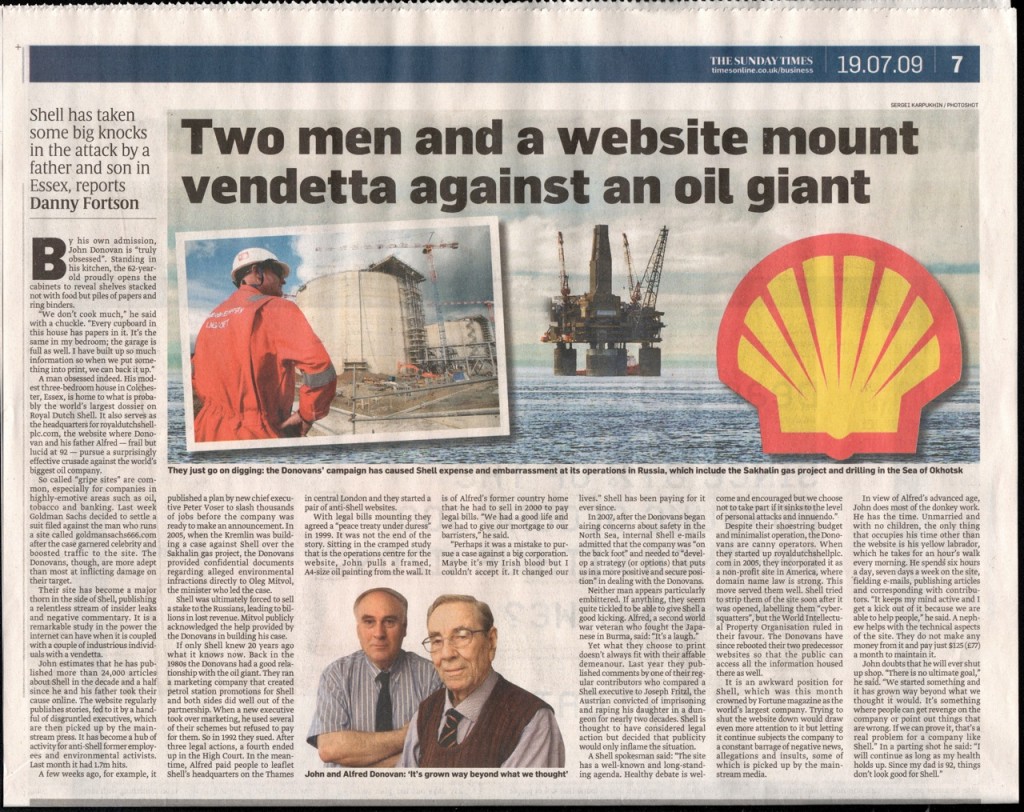
 A head-cut image of Alfred Donovan (now deceased) appears courtesy of The Wall Street Journal.