

Saudi Basic Industries Corp., the Middle East’s biggest petrochemicals producer, agreed to buy out Royal Dutch Shell Plc’s 50 percent stake in a Saudi joint venture for $820 million.
The Saudi Petrochemical Co. venture, known as SADAF, is ending earlier than the planned 2020 expiration, the Hague-based Shell said in an e-mailed statement Sunday. SADAF in Jubail, Saudi Arabia, has six petrochemicals plants with total production of about 4 million metric tons a year, it said.
Shell’s acquisition of BG Group Plc last year has turned its attention to restructuring its business and focusing on existing assets, and is sending “mixed signals about its desired role” in the Middle East, Arab Petroleum Investments Corp., the investment banking arm of Organization of Arab Petroleum Exporting Countries, said in a report last week. Shell in 2015 ended plans to build a $6.5 billion petrochemical plant in Qatar and last year exited a natural gas exploration venture in Abu Dhabi.
Last year, Shell broke up an 18-year refining partnership in the U.S. with Saudi Arabian Oil Co., also known as Aramco, and said in 2014 it was halting investing in a natural gas venture with Aramco in the Kidan area of the Saudi Empty Quarter desert. Shell still has a refining joint venture with Aramco in the kingdom, according to the Shell website.
The SADAF sale will allow Shell to focus on its downstream activities and to make “selective investments to support the growth of its global chemicals business,” it said in the statement. Shell will look at potential opportunities with Riyadh-based Saudi Basic, also known as Sabic, Graham van’t Hoff, executive vice president for chemicals, said in the statement.
Saudi Arabia is targeting petrochemicals as one of the key industries to help transform its economy by developing new manufacturing and reducing reliance on crude oil exports for government revenue. The country has combined low-cost feedstock from domestic natural gas resources with technology from international partners to build joint venture plants.
Sabic plans to expand in the U.S. to tap ample supplies of shale gas there as some of its traditional markets weaken, Chief Executive Officer Yousef al-Benyan said Thursday.
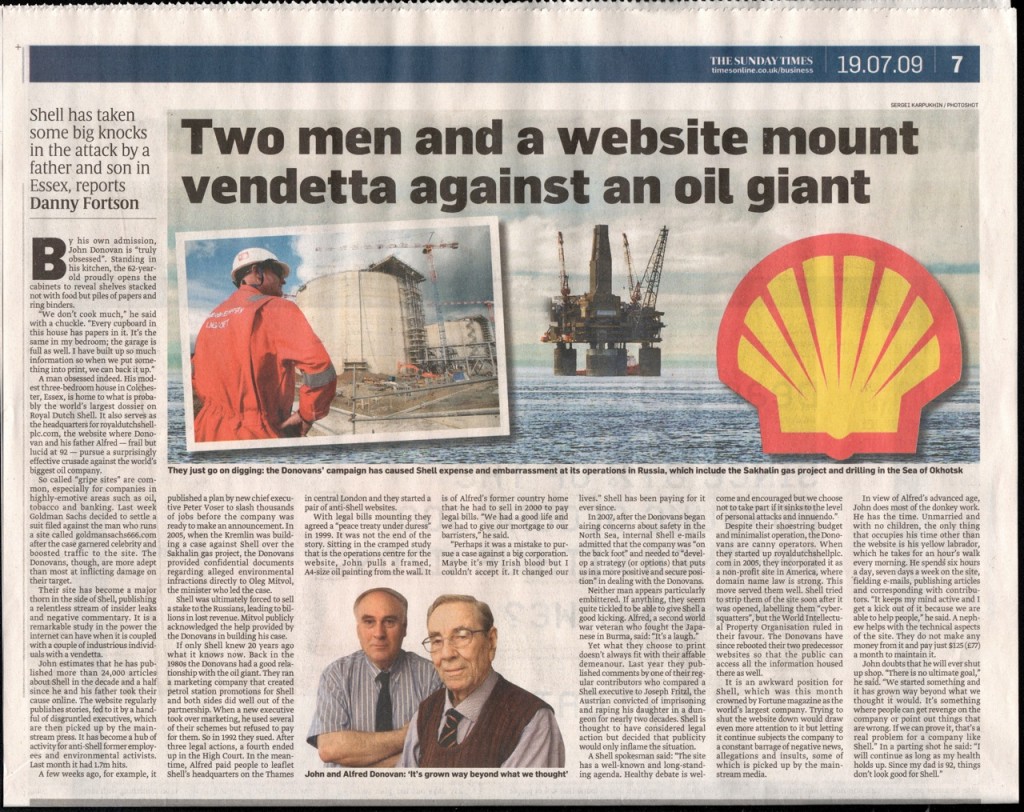
This website and sisters royaldutchshellplc.com, shellnazihistory.com, royaldutchshell.website, johndonovan.website, and shellnews.net, are owned by John Donovan. There is also a Wikipedia segment.


 Royal Dutch Shell conspired directly with Hitler, financed the Nazi Party, was anti-Semitic and sold out its own Dutch Jewish employees to the Nazis. Shell had a close relationship with the Nazis during and after the reign of Sir Henri Deterding, an ardent Nazi, and the founder and decades long leader of the Royal Dutch Shell Group. His burial ceremony, which had all the trappings of a state funeral, was held at his private estate in Mecklenburg, Germany. The spectacle (photographs below) included a funeral procession led by a horse drawn funeral hearse with senior Nazis officials and senior Royal Dutch Shell directors in attendance, Nazi salutes at the graveside, swastika banners on display and wreaths and personal tributes from Adolf Hitler and Reichsmarschall, Hermann Goring. Deterding was an honored associate and supporter of Hitler and a personal friend of Goring.

 Deterding was the guest of Hitler during a four day summit meeting at Berchtesgaden. Sir Henri and Hitler both had ambitions on Russian oil fields. Only an honored personal guest would be rewarded with a private four day meeting at Hitler’s mountain top retreat.


 IN JULY 2007, MR BILL CAMPBELL (ABOVE, A RETIRED GROUP AUDITOR OF SHELL INTERNATIONAL SENT AN EMAIL TO EVERY UK MP AND MEMBER OF THE HOUSE OF LORDS:


 MORE DETAILS:


 A head-cut image of Alfred Donovan (now deceased) appears courtesy of The Wall Street Journal.