
 By Aaron Gray-Block – July 13, 2012 at 17:45
Speaking from within the headquarters of oil major Shell on Friday, the words of Greenpeace Netherlands executive director Sylvia Borren were clear: “My first move as the new CEO of Shell is simple and effective: no drilling for oil in the pristine Arctic.”
With that, Borren had announced a new corporate strategy for Shell.
Borren, symbolically ‘replacing’ Shell chief executive Peter Voser at the helm of the company, said Shell would end its destructive oil drilling and instead invest its billions of dollars in profits into renewable energy.
It requires Shell, which plans to start drilling for oil in the Alaskan Arctic this summer, to realise that climate change and the melting of the Arctic sea ice is not a business opportunity, but rather, a stark warning of a possible future.
The unfortunate reality at the moment is that Shell is desperate to hold on to its old business model and is putting profits above science at all costs. More than that, it is risking our future.
This is why 70 Greenpeace Netherlands activists barricaded the entrances to Shell’s headquarters today, as Borren mapped out a new, sustainable path for Shell, the world’s largest company.
Some 45 minutes later, the blockade was broken, but nine activists remained on top of Shell’s headquarters as they unfurled a banner saying: “Stop Shell, Save the Arctic.” A clear and urgent message.
Some hours later, however, police arrested the nine activists. They also detained Borren and three other activists, removing her from Voser’s office after forcing their way in with a chainsaw!
So today’s action might have ended in multiple arrests, but Greenpeace will not halt its campaign to Save the Arctic. This is a growing global movement that will only build in support. Already, more than 800,000 have pledged their support.
And by using digital media and creative direct action, Greenpeace and the wider public will continue to demonstrate how Shell, a ‘dinosaur’ oil company, is out of touch with the modern world.
Greenpeace is launching a new form of ‘open source activism’, which shares the tactics we have learned over the past 40 years with people who wish to take peaceful, direct action and produce creative content to force Shell onto the defensive both on and offline.
Toolkits containing tips on how to protest peacefully at Shell petrol stations, for example, have been sent to supporters across the world.
And together, we will Save the Arctic.
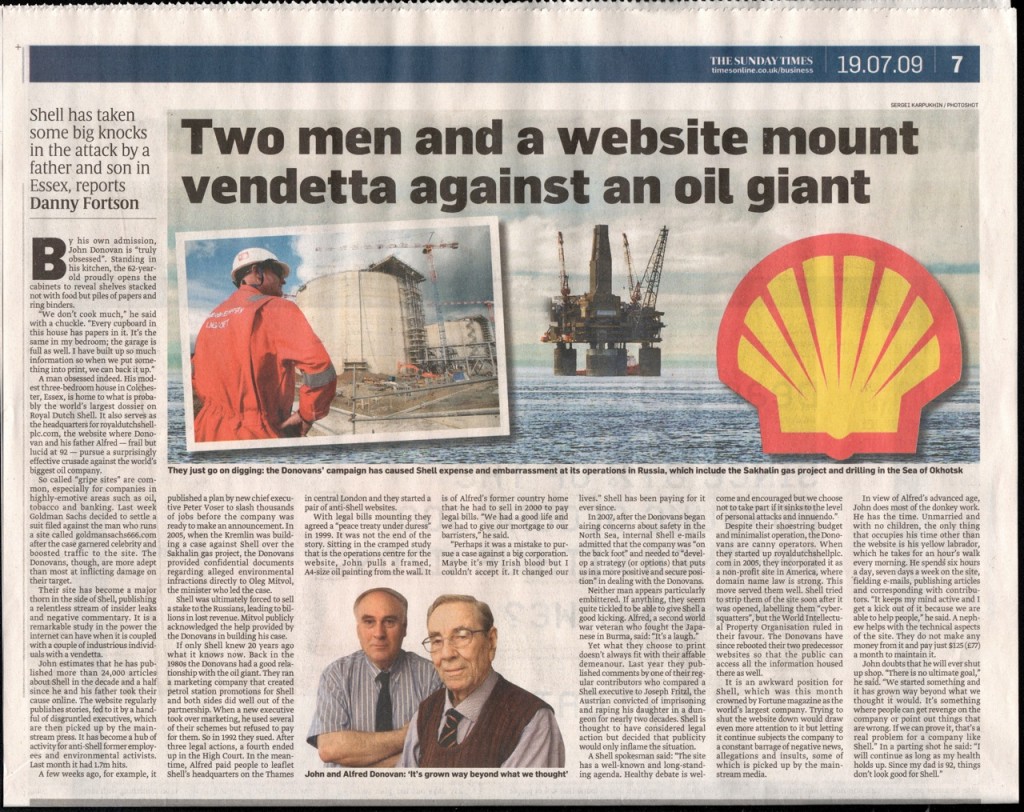
This website and sisters royaldutchshellplc.com, shellnazihistory.com, royaldutchshell.website, johndonovan.website, and shellnews.net, are owned by John Donovan. There is also a Wikipedia segment.


 Royal Dutch Shell conspired directly with Hitler, financed the Nazi Party, was anti-Semitic and sold out its own Dutch Jewish employees to the Nazis. Shell had a close relationship with the Nazis during and after the reign of Sir Henri Deterding, an ardent Nazi, and the founder and decades long leader of the Royal Dutch Shell Group. His burial ceremony, which had all the trappings of a state funeral, was held at his private estate in Mecklenburg, Germany. The spectacle (photographs below) included a funeral procession led by a horse drawn funeral hearse with senior Nazis officials and senior Royal Dutch Shell directors in attendance, Nazi salutes at the graveside, swastika banners on display and wreaths and personal tributes from Adolf Hitler and Reichsmarschall, Hermann Goring. Deterding was an honored associate and supporter of Hitler and a personal friend of Goring.

 Deterding was the guest of Hitler during a four day summit meeting at Berchtesgaden. Sir Henri and Hitler both had ambitions on Russian oil fields. Only an honored personal guest would be rewarded with a private four day meeting at Hitler’s mountain top retreat.


 IN JULY 2007, MR BILL CAMPBELL (ABOVE, A RETIRED GROUP AUDITOR OF SHELL INTERNATIONAL SENT AN EMAIL TO EVERY UK MP AND MEMBER OF THE HOUSE OF LORDS:


 MORE DETAILS:


 A head-cut image of Alfred Donovan (now deceased) appears courtesy of The Wall Street Journal.