AlaskaDispatch
Jill Burke | Sep 3, 2010
Calling his visit a “whirlwind trip through Alaska,” U.S. Interior Secretary Ken Salazar stood before reporters in Anchorage on Friday — dressed in cowboy boots, jeans with notes tucked in a back pocket, a blue collared shirt and a baseball cap — explaining the mission of his two-day visit to Alaska this week as a chance to see key regions of the state first-hand before making decisions about oil and gas development.
Salazar held a town hall meeting in Barrow and flew over the Beaufort Sea coast for a look at current and proposed oil and gas sites. He also toured the National Petroleum Reserve-Alaska and the Arctic National Wildlife Refuge. He held briefings with the Alyeska Pipeline Services Co. about the trans-Alaska oil pipeline, ConocoPhillips about a proposed drilling project in NPR-A, and with Shell Alaska about proposed offshore exploration projects in the Beaufort and Chukchi seas.
Earlier this year ConocoPhillips was denied a permit by the U.S. Army Corps of Engineers, which ruled the company had other, less environmentally disruptive options — like directional drilling — to access its target instead of relying on the construction of a new drilling pad. Salazar indicated Friday that he was getting involved to “see if we can resolve” the concerns of the U.S. Fish and Wildlife Service and the Environmental Protection Agency with the company’s drilling plan and “move forward.”
He also tried to clear up confusion on whether the drilling moratorium issued in the wake of BP’s oil spill in the Gulf of Mexico applies to Alaska. The moratorium does apply, he said, explaining that while Alaska may not be mentioned in the explicit language, he had simultaneously decided not to authorize new drilling or exploration activity in the Arctic, citing a new level of cautiousness in response to the Gulf spill.
“We will not be allowing that program to move forward” until the Interior Department is confident that drilling can be conducted responsibly in the Chukchi and Beaufort seas, he said.
Nationwide, three main questions are driving whether new offshore oil and gas activity will be allowed, Salazar said. Are the regulations for oil well blowout preventers, cementing and casing strict enough to ensure drilling and workplace safety? Can potential oil spills be adequately contained? And are oil spill response plans thorough and realistic?
Salazar said he hasn’t been comfortable with the level of science gathered about the Arctic’s unique environment or the oil and gas resources it may hold. Of specific concern is the lack of information about the pressure levels that might be encountered while tapping an offshore oil reservoir. He’s also concerned about the apparent inability to mount a large-scale response to a severe spill in the Arctic on the scale seen in the Gulf of Mexico in April.
Shell has said it needs a decision by the end of the year in order to plan for a 2011 exploratory season in the Arctic. Salazar, aware of the company’s need for certainty, said efforts were being made to resolve that question within the next several months, but offered no promises on the timeline.
Comment by a former employee of Shell Oil USA
John,
I have a comment about Shell’s drilling plans in the Alaskan offshore Arctic.
Shell packed it in and walked away from this area 20 years ago. Now, they are suddenly in a ‘big rush’ to get back to drilling what will probably be delineation wells for some of their previously abandoned discoveries. What is the rush? Shell sat back and putzed around for 20 years trying to decide what to do in this area, they can now wait a few more years for the appropriate studies to be conducted.
In the mean time, maybe they could arrange to contract for a modern drilling rig to drill these wells.


 Royal Dutch Shell conspired directly with Hitler, financed the Nazi Party, was anti-Semitic and sold out its own Dutch Jewish employees to the Nazis. Shell had a close relationship with the Nazis during and after the reign of Sir Henri Deterding, an ardent Nazi, and the founder and decades long leader of the Royal Dutch Shell Group. His burial ceremony, which had all the trappings of a state funeral, was held at his private estate in Mecklenburg, Germany. The spectacle (photographs below) included a funeral procession led by a horse drawn funeral hearse with senior Nazis officials and senior Royal Dutch Shell directors in attendance, Nazi salutes at the graveside, swastika banners on display and wreaths and personal tributes from Adolf Hitler and Reichsmarschall, Hermann Goring. Deterding was an honored associate and supporter of Hitler and a personal friend of Goring.

 Deterding was the guest of Hitler during a four day summit meeting at Berchtesgaden. Sir Henri and Hitler both had ambitions on Russian oil fields. Only an honored personal guest would be rewarded with a private four day meeting at Hitler’s mountain top retreat.


 IN JULY 2007, MR BILL CAMPBELL (ABOVE, A RETIRED GROUP AUDITOR OF SHELL INTERNATIONAL SENT AN EMAIL TO EVERY UK MP AND MEMBER OF THE HOUSE OF LORDS:


 MORE DETAILS:


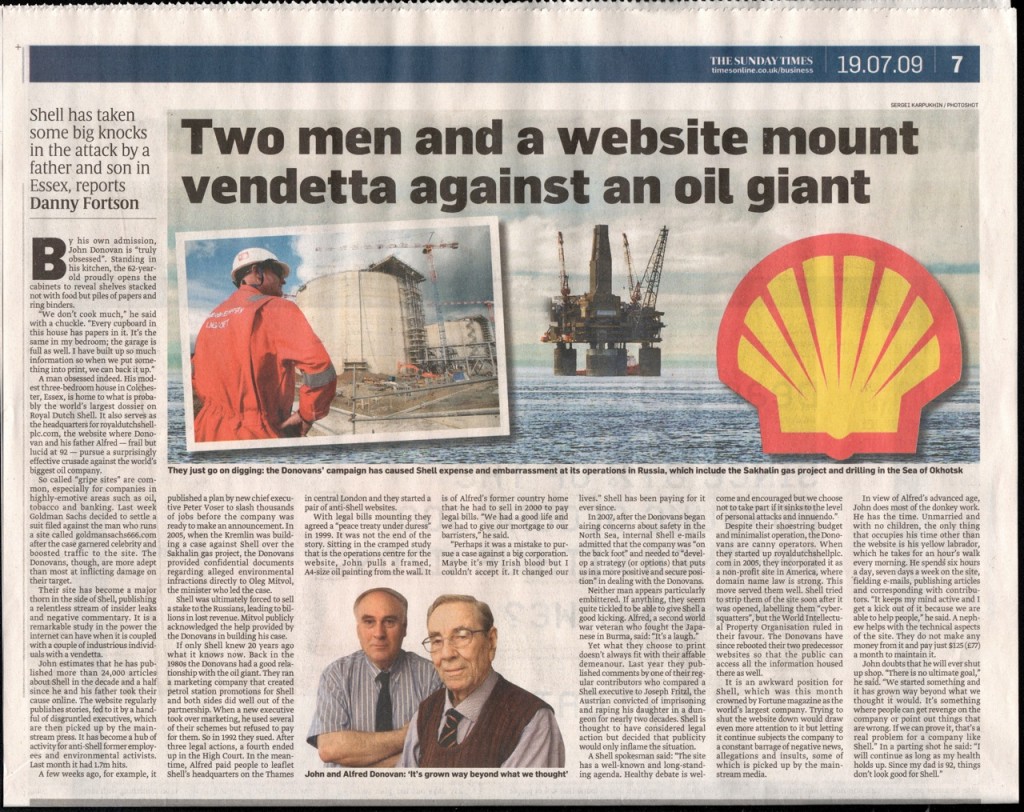
 A head-cut image of Alfred Donovan (now deceased) appears courtesy of The Wall Street Journal.