THE WALL STREET JOURNAL
APRIL 12, 2010
A six-month extension of negotiations proposed by the Iraqi government to develop domestic gas infrastructure in the country’s south may not be enough to settle a deal with Royal Dutch Shell PLC because of financial constraints and opposition from politicians, an Iraqi official familiar with the talks said Monday.
“I don’t think we would be able to sign a deal even with the new six-month extension,” the official told Dow Jones Newswires. “Our main problem is that we are unable to secure finance for the Iraqi contribution in the venture.”
Iraq, facing a budget deficit of around $19 billion this year, needs to contribute between $5 billion and $7 billion to the project.
The proposed $10 billion to $20 billion joint venture between Iraq’s South Gas Company, Shell and Mitsubishi Corp. would initially deliver gas to Iraq’s domestic market, mainly for electricity generation. Later, some would be sold outside the country, possibly in the form of liquefied natural gas, as Iraq seeks to become a major LNG exporter. LNG is gas that is cooled and shipped on tankers.
The two sides failed to finalize the deal last month, after negotiations lasting more than a year, and have agreed to extend the talks for another six months ending Sept. 21, the official said.
A senior Shell executive, however, said that the company is ready to sign the deal and that the problem lies on the Iraqi side.
“We have accepted the Iraqi side’s conditions for the project and we are ready to sign the agreement,” Mounir Bouaziz, a vice-president for Shell International Gas and Power Ltd., told Dow Jones Newswires. Mr. Bouaziz also said that Shell had proposed a solution to the fiscal constraints. He didn’t elaborate.
Shell says one option is to create a floating LNG facility off Basra’s coast, which would be particularly attractive from a security standpoint. Iraq, which has estimated reserves of 110 trillion cubic feet of natural gas, has ambitions to become one of the world’s biggest LNG exporters.
Iraq burns off nearly 1 billion cubic feet a day of this gas in its southern oil fields, because it lacks the infrastructure to utilize it. Capturing it “should create an important and reliable supply of domestic energy, reduce greenhouse-gas emissions and create significant value for Iraq,” Mr. Bouaziz said.
Using its own finances, Iraq has managed to boost gas production by 100 million cubic feet a day from the South Rumaila oil field, bringing total gas production from the Rumaila and Zubair fields to 450 million cubic feet a day, the official said.
Political opposition is the second major obstacle facing the project. Many senior officials and politicians at the Iraqi oil ministry and in government oppose signing the deal, the Iraqi official said.
“Only the minister (Hussein al-Shahristani) and one of his deputies support the deal,” the official said.
Many lawmakers and oil officials, particularly in Basra where the project is to be located, say that Shell didn’t have to compete with other international companies to secure the deal. Shell strenuously denies the allegations and the Oil Ministry said other international companies were invited to compete.
According to the preliminary agreement signed in September 2008, Iraq’s South Gas Co. will control 51% of the project, while Shell will hold 44% and the remaining 5% will be owned by Mitsubishi. Both Shell and Mitsubishi would share the produced gas with the Iraqi state company.
The full agreement, if signed, would be for 25 years and could be extended. Mr. Bouaziz said Shell’s technicians have been on the ground for the last two years and are able to reduce flared gas from these fields by 24%, he said.
Iraq has daily natural-gas production of 1.64 billion cubic feet, 70% of which is flared. Licenses for two gas fields listed in Baghdad’s first licensing auction in June last year weren’t awarded to international companies. Another one was dropped from the list in the second licensing auction held in December.
Write to Hassan Hafidh at [email protected]
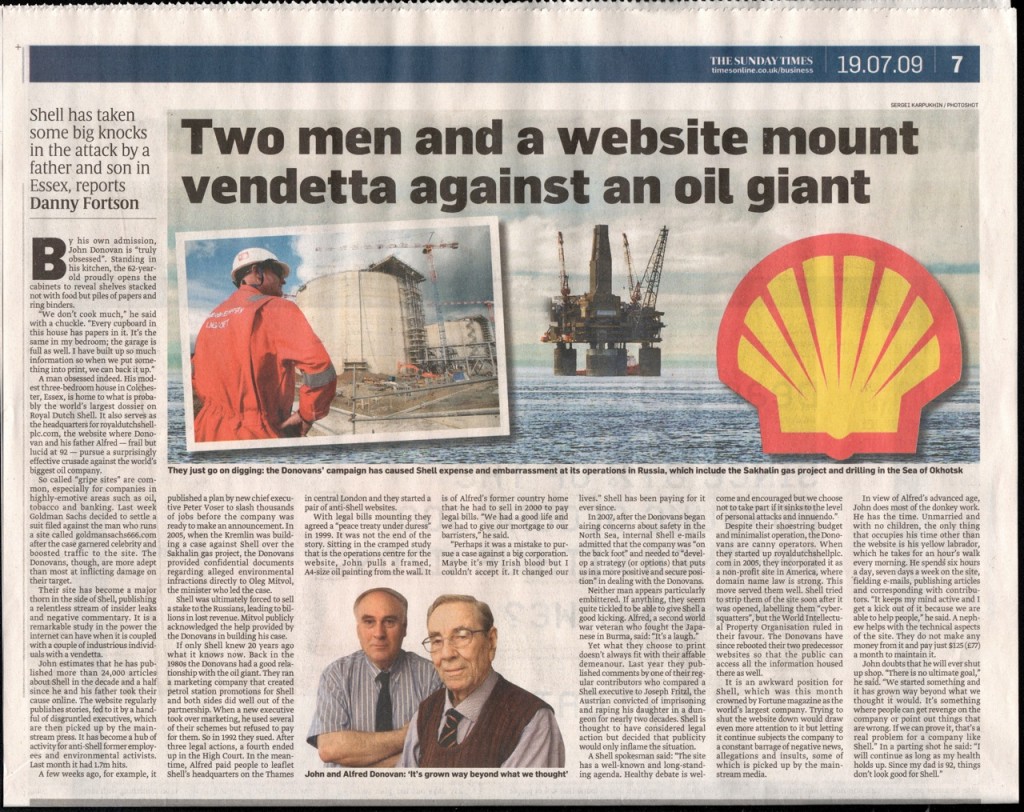
This website and sisters royaldutchshellplc.com, shellnazihistory.com, royaldutchshell.website, johndonovan.website, and shellnews.net, are owned by John Donovan. There is also a Wikipedia segment.


 Royal Dutch Shell conspired directly with Hitler, financed the Nazi Party, was anti-Semitic and sold out its own Dutch Jewish employees to the Nazis. Shell had a close relationship with the Nazis during and after the reign of Sir Henri Deterding, an ardent Nazi, and the founder and decades long leader of the Royal Dutch Shell Group. His burial ceremony, which had all the trappings of a state funeral, was held at his private estate in Mecklenburg, Germany. The spectacle (photographs below) included a funeral procession led by a horse drawn funeral hearse with senior Nazis officials and senior Royal Dutch Shell directors in attendance, Nazi salutes at the graveside, swastika banners on display and wreaths and personal tributes from Adolf Hitler and Reichsmarschall, Hermann Goring. Deterding was an honored associate and supporter of Hitler and a personal friend of Goring.

 Deterding was the guest of Hitler during a four day summit meeting at Berchtesgaden. Sir Henri and Hitler both had ambitions on Russian oil fields. Only an honored personal guest would be rewarded with a private four day meeting at Hitler’s mountain top retreat.


 IN JULY 2007, MR BILL CAMPBELL (ABOVE, A RETIRED GROUP AUDITOR OF SHELL INTERNATIONAL SENT AN EMAIL TO EVERY UK MP AND MEMBER OF THE HOUSE OF LORDS:


 MORE DETAILS:


 A head-cut image of Alfred Donovan (now deceased) appears courtesy of The Wall Street Journal.