Shell rejects windfall tax calls as high oil price boosts profits
By Nick Clark
Friday, 1 August 2008
The Anglo-Dutch oil giant Shell has reported that the soaring price of oil this year had boosted profits in the past quarter, and added that it was set to spend $36bn (£18bn) on acquisitions and drilling by the end of the year.
Shell announced that earnings on the current cost of supplies the basis often used in the industry were up 5 per cent to $7.9bn in the three months to the end of June. Income attributable to shareholders in the past quarter rose a third to $11.5bn over the corresponding period in 2007. Jeroen van der Veer, the outgoing Shell chief executive, said this was “another set of competitive earnings”. He continued: “Good operating performance, combined with increased oil and gas prices, offset the impact of weaker downstream conditions in the second quarter.”
The strong quarter was underpinned by oil prices hitting record levels of $147.50 a barrel last month, which allowed the oil major to charge more than 70 per cent more than it did last year.
However, Mr van der Veer rejected talk of calls for a windfall tax on the oil majors, saying, “I don’t see why it will help consumers in the long term” as it would limit its ability to invest in sourcing supplies in the future. An industry source said the majors didn’t profit hugely from retail sales, making about 1p per litre sold at the pumps.
Fred Lucas, a managing director at Cazenove, said the gas and power, and oil products businesses were better than expected but exploration and production and the chemicals arms weren’t quite as good as had been hoped.
Shell continued its buyback plan in the second quarter, with a further $1.35bn taking the investment in 2008 to $2.4bn “and leaves the group broadly on track to make our forecast $3.8bn buy back for the full year,” said Mr Lucas.
Mr van der Veer, who retires next June, said the group will name its new chief executive early next year. He said: “Don’t waste your time on speculating and wait until the announcement.”
The group also unveiled a $36bn investment plan, which is “one of the largest investments in the industry”. It is planning up to $31bn in organic growth and $10bn worth of acquisitions.
Shell admitted it had suffered strong losses from some serious issues in its Nigerian business this year. In July, it lost an average of 195,000 barrels, after militant groups disrupted its operations. The latest attack took place on Tuesday, when part of one of its pipelines was blown up.
Oil majors worldwide reported solid results yesterday. Exxon Mobil, Eni and Repsol announced soaring profits predominantly driven by the increase in oil prices.


 Royal Dutch Shell conspired directly with Hitler, financed the Nazi Party, was anti-Semitic and sold out its own Dutch Jewish employees to the Nazis. Shell had a close relationship with the Nazis during and after the reign of Sir Henri Deterding, an ardent Nazi, and the founder and decades long leader of the Royal Dutch Shell Group. His burial ceremony, which had all the trappings of a state funeral, was held at his private estate in Mecklenburg, Germany. The spectacle (photographs below) included a funeral procession led by a horse drawn funeral hearse with senior Nazis officials and senior Royal Dutch Shell directors in attendance, Nazi salutes at the graveside, swastika banners on display and wreaths and personal tributes from Adolf Hitler and Reichsmarschall, Hermann Goring. Deterding was an honored associate and supporter of Hitler and a personal friend of Goring.

 Deterding was the guest of Hitler during a four day summit meeting at Berchtesgaden. Sir Henri and Hitler both had ambitions on Russian oil fields. Only an honored personal guest would be rewarded with a private four day meeting at Hitler’s mountain top retreat.


 IN JULY 2007, MR BILL CAMPBELL (ABOVE, A RETIRED GROUP AUDITOR OF SHELL INTERNATIONAL SENT AN EMAIL TO EVERY UK MP AND MEMBER OF THE HOUSE OF LORDS:


 MORE DETAILS:


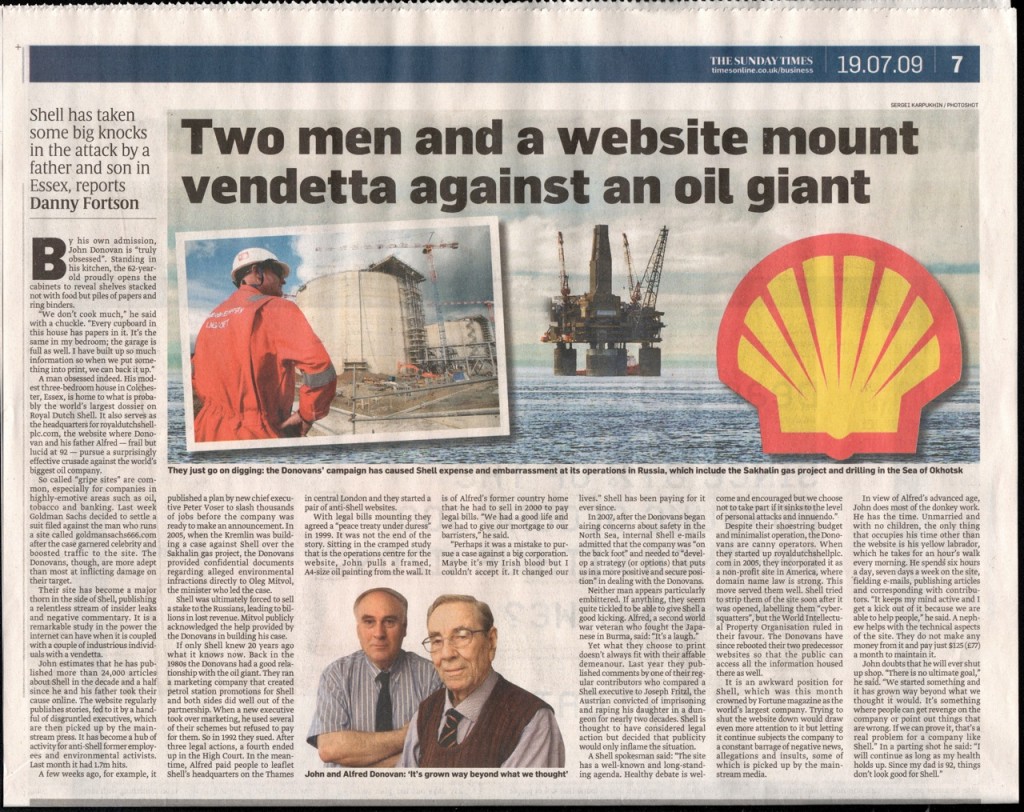
 A head-cut image of Alfred Donovan (now deceased) appears courtesy of The Wall Street Journal.