By John Willman, Business Editor
Published: November 12 2007 02:00 | Last updated: November 12 2007 02:00
BP and BAE Systems are among British companies that slashed their research and development spending last year, according to government figures that show a 9 per cent rise in R&D investment by top UK groups.
The annual R&D Scoreboard, published on Monday by the Department for Innovation, Universities and Skills, says the 850 largest companies, including subsidiaries of foreign groups, spent almost £21bn ($43.6m) on R&D in 2006.
The 75 companies with the most R&D increased their spending by almost 12 per cent – faster than their global competitors.
However, BP cut £55m from its R&D investment, a 21 per cent cut in a year when Royal Dutch Shell boosted its spending by £152m, a 51 per cent rise. BP said the figure for R&D in its annual accounts did not encompass all such expenditure, some of which was embedded in ongoing business.
BAE made a 14 per cent cut of £201m, taking its R&D spending down to £1.2bn. Competitors that boosted their R&D investment included Rolls-Royce, whose £59m was an increase of 17 per cent, and Airbus, a foreign-owned company, that added £102m to its R&D budget, a 30 per cent rise. BAE said it had not seen the scoreboard and was unable to comment.
Another large group cutting its R&D was Unilever, whose £32m cut was the fourth in succession and took the total down to £610m, from £786m in 2002.
The biggest jump in R&D expenditure was reported by BT, which boosted its spending by £392m to £1.1bn – a rise of 54 per cent. This has raised its R&D budget from 2 per cent of sales revenue in 2003 to more than 5 per cent last year and the telecommunications has group has rapidly expanded its network and services businesses.
The 75 largest R&D investors based in the UK raised their spending 12 per cent, led by pharmaceuticals companies such as GlaxoSmithKline and AstraZeneca which collectively invest more than £7.4bn a year. The aerospace and defence sector has the second-highest R&D spending, followed by software and computer services, fixed-line telecommunications and automobiles and parts.
UK aerospace and software companies invested more than they reported as operating profit according to the scoreboard, which says the figures are evidence that they are putting R&D ahead of short-term profits.
The authors say they could find no hard evidence that investment in R&D improved performance.
Copyright The Financial Times Limited 2007
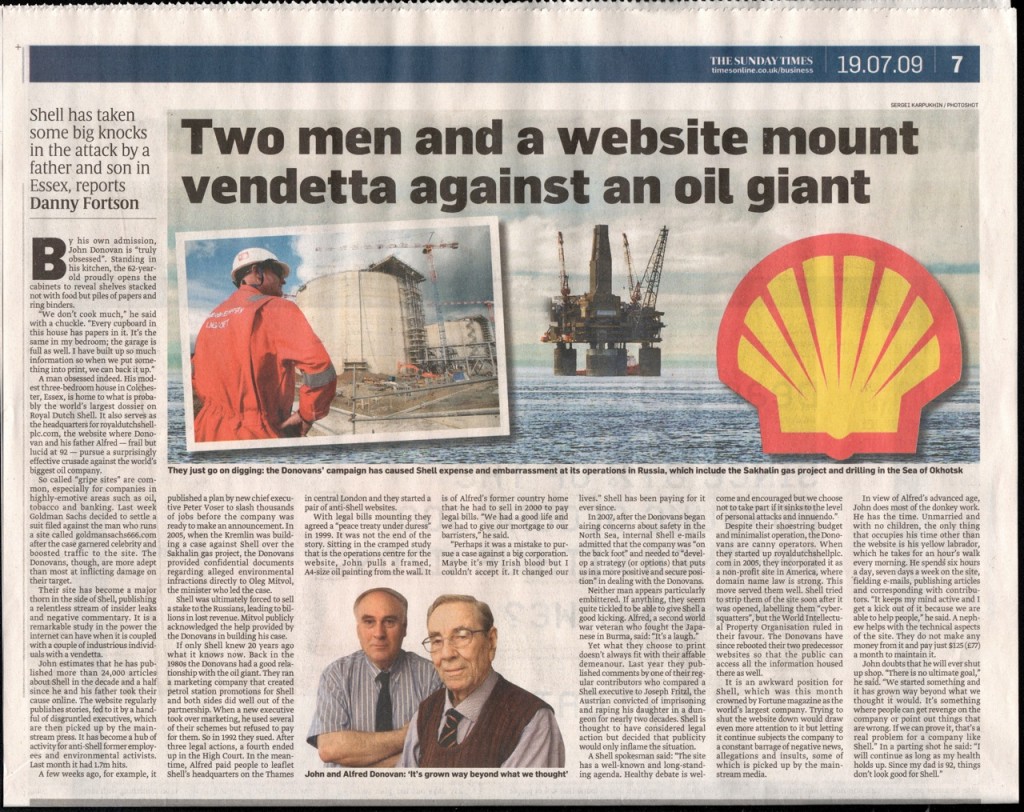
This website and sisters royaldutchshellplc.com, shellnazihistory.com, royaldutchshell.website, johndonovan.website, and shellnews.net, are owned by John Donovan. There is also a Wikipedia segment.


 Royal Dutch Shell conspired directly with Hitler, financed the Nazi Party, was anti-Semitic and sold out its own Dutch Jewish employees to the Nazis. Shell had a close relationship with the Nazis during and after the reign of Sir Henri Deterding, an ardent Nazi, and the founder and decades long leader of the Royal Dutch Shell Group. His burial ceremony, which had all the trappings of a state funeral, was held at his private estate in Mecklenburg, Germany. The spectacle (photographs below) included a funeral procession led by a horse drawn funeral hearse with senior Nazis officials and senior Royal Dutch Shell directors in attendance, Nazi salutes at the graveside, swastika banners on display and wreaths and personal tributes from Adolf Hitler and Reichsmarschall, Hermann Goring. Deterding was an honored associate and supporter of Hitler and a personal friend of Goring.

 Deterding was the guest of Hitler during a four day summit meeting at Berchtesgaden. Sir Henri and Hitler both had ambitions on Russian oil fields. Only an honored personal guest would be rewarded with a private four day meeting at Hitler’s mountain top retreat.


 IN JULY 2007, MR BILL CAMPBELL (ABOVE, A RETIRED GROUP AUDITOR OF SHELL INTERNATIONAL SENT AN EMAIL TO EVERY UK MP AND MEMBER OF THE HOUSE OF LORDS:


 MORE DETAILS:


 A head-cut image of Alfred Donovan (now deceased) appears courtesy of The Wall Street Journal.



[…] decade, BP made a big deal of changing its name from "British Petroleum" to "Beyond Petroleum," paying lip service to their commitment towards developing alternate energy sources– my guess is mostly as a PR move. […]