By Peggy Hollinger in Paris and Dino Mahtani in London
Published: September 6 2007
Total’s ability to resist the pressures on production facing its international rivals was called into question on Wednesday as the French oil major cut output targets by 20 per cent for the four years to 2010.
Christophe de Margerie, the new chief executive who took over in February, said on Wednesday that Total expected only 4 per cent growth between 2006 and 2010, against previous forecasts of 5 per cent.
It is the second time in three months that Total has been forced to rein in production forecasts and prompted a bitter reaction from some analysts, even though the group still expects to outpace rivals BP and Shell.
“We are very disappointed,” said one who refused to be named. “In the end it shows they are just like BP and Shell. They may be less present in declining zones, and have a better cost structure, but they too are losing growth.”
Most majors have been forced to scale back production targets, faced with maturing oil fields, skyrocketing costs, and the growing readiness of oil-rich nations to demand a higher price for access to resources.
A recent study found that while worldwide spending by oil companies had reached record levels, reserve volumes had increased by only 2 per cent.
However Total’s focus on less mature regions and its recent exploration successes had buoyed hopes it would be able to resist some of the pressures facing rivals, which are forecasting production growth of about 2 per cent.
Jason Kenney, head of research for oil and gas at ING, remained confident the group’s profile would deliver results. “They have quite a robust set of assets . . . particularly in deep water, west Africa and Angola,” he said.
Mr de Margerie defended the group’s decision to cut its targets as “transparent and explainable”. He said the high oil price accounted for about half of the reduction in his group’s output forecast, which in future would be based on a price of $60 a barrel, against the $40 used previously.
Higher oil prices mean Total takes less oil from production-sharing contracts, which more or less fix revenues
The group has also been hit by problems in Nigeria, where work has been halted by militant attacks, and in Kazakhstan, where the oil groups are in dispute with the government.
Copyright The Financial Times Limited 2007
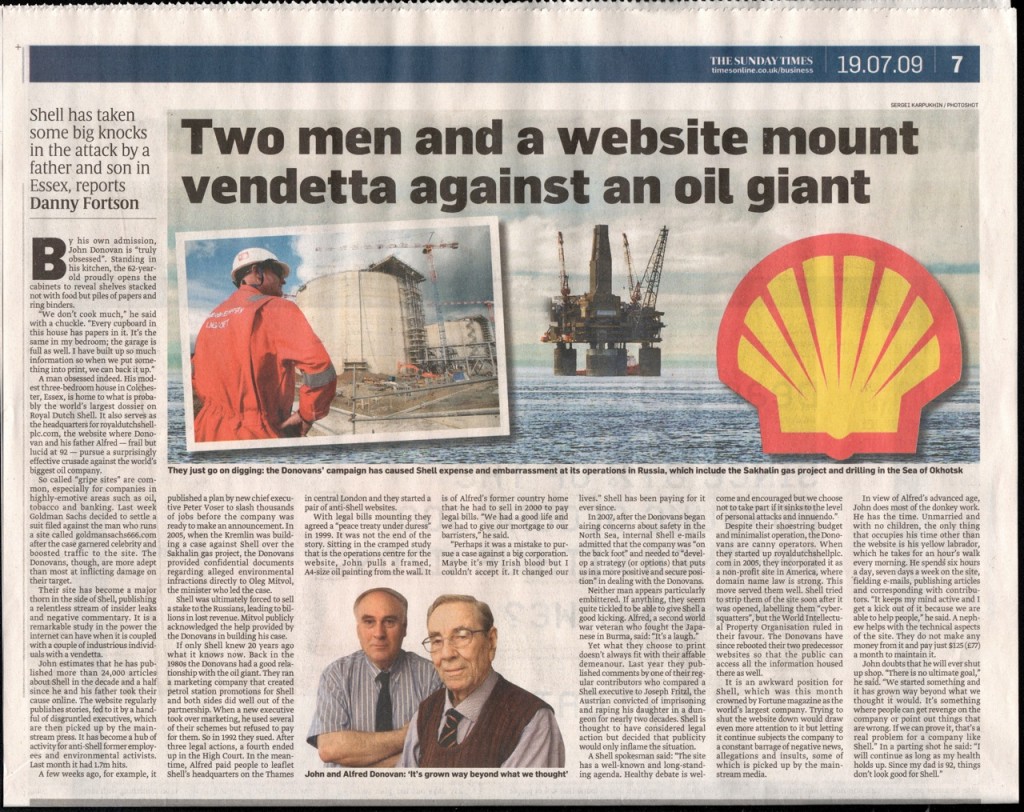
This website and sisters royaldutchshellplc.com, shellnazihistory.com, royaldutchshell.website, johndonovan.website, and shellnews.net, are owned by John Donovan. There is also a Wikipedia segment.


 Royal Dutch Shell conspired directly with Hitler, financed the Nazi Party, was anti-Semitic and sold out its own Dutch Jewish employees to the Nazis. Shell had a close relationship with the Nazis during and after the reign of Sir Henri Deterding, an ardent Nazi, and the founder and decades long leader of the Royal Dutch Shell Group. His burial ceremony, which had all the trappings of a state funeral, was held at his private estate in Mecklenburg, Germany. The spectacle (photographs below) included a funeral procession led by a horse drawn funeral hearse with senior Nazis officials and senior Royal Dutch Shell directors in attendance, Nazi salutes at the graveside, swastika banners on display and wreaths and personal tributes from Adolf Hitler and Reichsmarschall, Hermann Goring. Deterding was an honored associate and supporter of Hitler and a personal friend of Goring.

 Deterding was the guest of Hitler during a four day summit meeting at Berchtesgaden. Sir Henri and Hitler both had ambitions on Russian oil fields. Only an honored personal guest would be rewarded with a private four day meeting at Hitler’s mountain top retreat.


 IN JULY 2007, MR BILL CAMPBELL (ABOVE, A RETIRED GROUP AUDITOR OF SHELL INTERNATIONAL SENT AN EMAIL TO EVERY UK MP AND MEMBER OF THE HOUSE OF LORDS:


 MORE DETAILS:


 A head-cut image of Alfred Donovan (now deceased) appears courtesy of The Wall Street Journal.