THE WALL STREET JOURNAL: Shell, BASF Near Plastics-Venture Sale
By JASON SINGER
Staff Reporter of THE WALL STREET JOURNAL
May 4, 2005; Page A20
Royal Dutch/Shell Group and BASF AG of Germany are close to agreeing on the sale of their joint plastics venture — a giant manufacturer of basic materials used in everything from diapers to auto parts — to an Indian group for more than €4 billion ($5.14 billion), according to people familiar with the matter.
Under terms being discussed, a consortium led by Haldia Petrochemicals, based in Calcutta, would buy Basell NV, transferring ownership of a global company that is integral in the manufacturing processes of thousands of household items.
Haldia is backed by two New York financiers: Chatterjee Group, an investment partnership run by Purnendu Chatterjee, a West Bangal native who has invested in Haldia and serves as deputy chairman of the Indian chemical concern; and Access Industries, which is run by Leonard Blavatnik, a Russian-born billionaire who made his fortune in the Russian oil industry.
A deal could be announced within the next few days, people close to the situation said. Financing and other terms of the complex sale agreement, which covers a wide-ranging collection of operations around the world, has yet to be completed, and the deal still could fall through, these people added.
The consortium beat out rival bids at first from private-equity funds and then a competing bid by Iran’s National Petrochemical Co. The Iranian company, a state-controlled firm, was a politically controversial candidate because a U.S. embargo forbids Iran’s control of U.S. assets and the import of Iranian products into the U.S.
In addition to selling its products to U.S. customers, Basell has a plant in Louisiana. Despite complicated arrangements to separate the U.S. plant from the business, Washington opposed any sale to the Iranians on diplomatic grounds, making a deal difficult for both Shell and BASF, people familiar with the situation said.
Haldia officials couldn’t be reached for comment. Mr. Chatterjee didn’t return calls seeking comment and an Access Industries official declined to comment. Representatives of BASF and Shell, which has headquarters in the United Kingdom and the Netherlands, weren’t available.
Established in October 2000, Basell has manufacturing operations on five continents and sells to more than 4,000 customers in more than 120 countries. The joint venture doesn’t disclose financial details, though it says it has annual revenue of €6.7 billion.
The move comes as demand in the heavily cyclical plastics industry has increased amid a rise in world-wide manufacturing activity. At the same time, rising energy prices — particularly for natural gas, a common plastics feedstock — have put cost pressure on plastics makers. Many of them have successfully passed those costs on to their customers. In April, Basell increased prices by €70 a metric ton on polypropylene and polyethylene grades sold in Europe, citing higher raw materials and energy prices.
Based in Hoofddorp, the Netherlands, Basell is the world’s largest producer of polypropylene, a material used in making bottles, food and beverage packaging, grocery bags and toys, among other things. The company’s products also are finding a growing market in the auto-parts industry.
Haldia Petrochemical also makes polypropylene and polyethylene, Basell’s two main products. The company has plants in Chennai, Delhi and Bombay. The firm is closely held by West Bengal Industrial Development Corp., Chatterjee Group and Tata Group, one of India’s largest conglomerates with $14.25 billion in annual revenue.
Shell and BASF said in July they planned to find a buyer for the Basell joint venture. The move is part of Shell’s vow to sell as much as $12 billion (€9.33 billion) of noncore businesses in the next three years.
For instance, Shell and partner Bechtel Group Inc. of San Francisco recently agreed to sell most of their InterGen NV power-plant business to the private-equity arms of New York insurer American International Group Inc. and the Ontario Teachers’ Pension Plan for $1.75 billion. Shell also is in the process of selling its British liquefied-petroleum-gas unit.
Write to Jason Singer at [email protected]
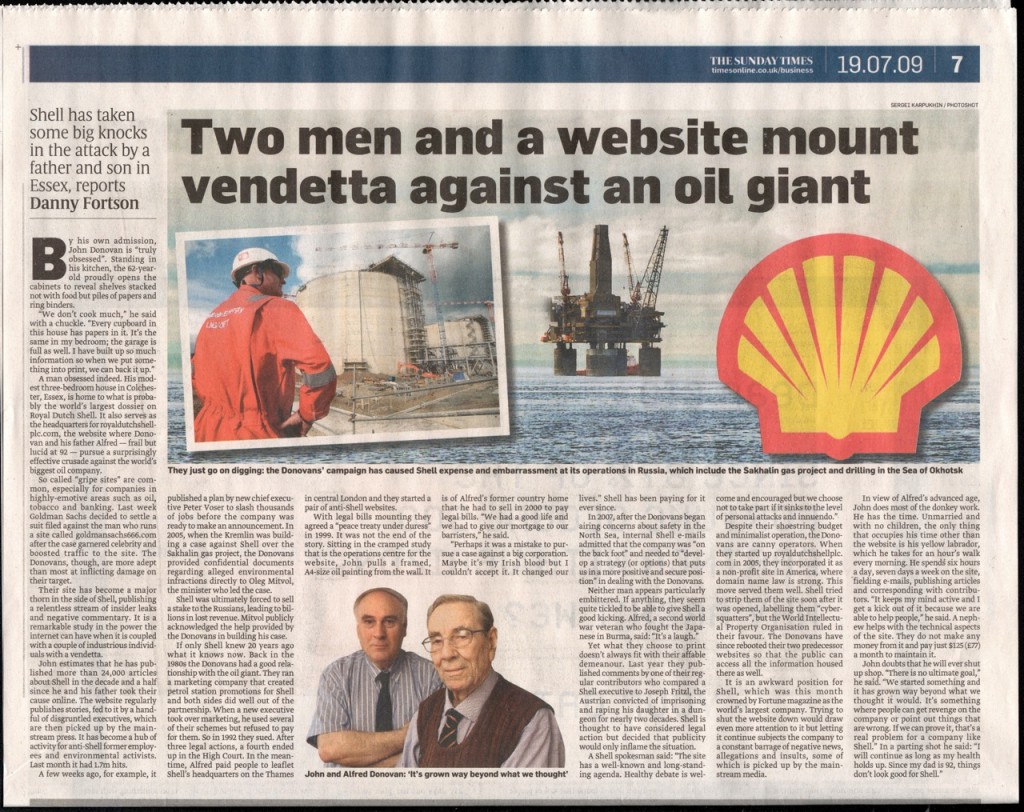
This website and sisters royaldutchshellplc.com, shellnazihistory.com, royaldutchshell.website, johndonovan.website, and shellnews.net, are owned by John Donovan. There is also a Wikipedia segment.


 Royal Dutch Shell conspired directly with Hitler, financed the Nazi Party, was anti-Semitic and sold out its own Dutch Jewish employees to the Nazis. Shell had a close relationship with the Nazis during and after the reign of Sir Henri Deterding, an ardent Nazi, and the founder and decades long leader of the Royal Dutch Shell Group. His burial ceremony, which had all the trappings of a state funeral, was held at his private estate in Mecklenburg, Germany. The spectacle (photographs below) included a funeral procession led by a horse drawn funeral hearse with senior Nazis officials and senior Royal Dutch Shell directors in attendance, Nazi salutes at the graveside, swastika banners on display and wreaths and personal tributes from Adolf Hitler and Reichsmarschall, Hermann Goring. Deterding was an honored associate and supporter of Hitler and a personal friend of Goring.

 Deterding was the guest of Hitler during a four day summit meeting at Berchtesgaden. Sir Henri and Hitler both had ambitions on Russian oil fields. Only an honored personal guest would be rewarded with a private four day meeting at Hitler’s mountain top retreat.


 IN JULY 2007, MR BILL CAMPBELL (ABOVE, A RETIRED GROUP AUDITOR OF SHELL INTERNATIONAL SENT AN EMAIL TO EVERY UK MP AND MEMBER OF THE HOUSE OF LORDS:


 MORE DETAILS:


 A head-cut image of Alfred Donovan (now deceased) appears courtesy of The Wall Street Journal.