

By: Audrey Hudson 8/10/2012 06:24 AM
Shell’s arctic drilling plans have stalled due to a number of obstacles including needed government permits, a slow summer ice melt, an OK from the Coast Guard, and if environmentalists have their way, sea raspberry coral.
The multinational oil and gas company hoped to start drilling five exploratory wells in the Chukchi and Beaufort Seas off the northern Alaskan coast beginning July 1, but the four-month drilling window is closing fast forcing the to company to scale back their plans to just two wells.
Shell has been planning to explore the Arctic for seven years and has spent more than $4 billion on leases, permits, and studies to reap an estimated 20 billion barrels of oil.
Most of the ships are still docked in Dutch Harbor, but a key barge that is needed in case of an oil spill remains in Washington waiting on approval from the Coast Guard, which has said in published reports that important systems still need to be installed on the barge.
Robert Dillon, spokesman for Sen. Lisa Murkowski (R-Alaska) on the Senate Energy and Natural Resources Committee, said the containment vessel is the third backstop in a string of contingencies that would assist in a major blowout.
“The Interior Department said they have to have that approved and on site before they can drill, it’s going through a retrofit and the Coast Guard has still not signed off. So that is still a question mark,” Dillon said.
“Hopefully, they will get it approved and up there in time to drill this summer,” Dillon said.
Shell is also still waiting on permits from the Interior Department to begin drilling, and air quality permits from the Environmental Protection Agency to operate generators.
“[Interior Secretary Ken] Salazar is still holding up the final permit to drill,” Dillon said.
“It’s been a challenge.”
Human Events reported in July that Greenpeace activists are in the Arctic planning to disrupt the operation with a fleet that includes a 237-foot ice-cutter, two submarines and a drone.
Deep sea coral
Now the Washington Post is reporting that a submarine dive has already discovered a dense patch of deep-sea coral that provides needed habitat for larval fish. Greenpeace says the coral are vulnerable to disturbances that will be caused by drilling on the ocean floor. However, the group’s discovery was 10 miles away from Shell’s drilling site.
Michael Macrander, a Shell scientist, told the Post that Greenpeace has decided to “suddenly focus on coral because the public has an immediate knee-jerk reaction” to the word.
Macrander also said that any impact on the coral, including a dropped anchor, would be “local and ephemeral” and the corals could recover within six months to a year.
Murkowski along with Rep. Doc Hastings (R-Wash.), chairman of the House Natural Resources Committee, wrote to key federal government agencies last month asking them to determine if Greenpeace’s activities were lawful and if those activities would create unsafe conditions once the operation begins.
“Allowing intrusions by any group to disrupt or threaten federally permitted operations is a direct threat to the careful planning and safe operations necessary for these activities and puts in jeopardy those workers and our environment, as well as the subsistence interest of Alaska’s native peoples,” the lawmakers said.
The government has not responded to the lawmakers’ concerns.
“We may need to revisit it,” Dillon said.
The company is now counting on operations beginning in early August, which gives them two months to work before they have to vacate this fall for the whaling season guaranteed to the native Alaskan Inupiats.
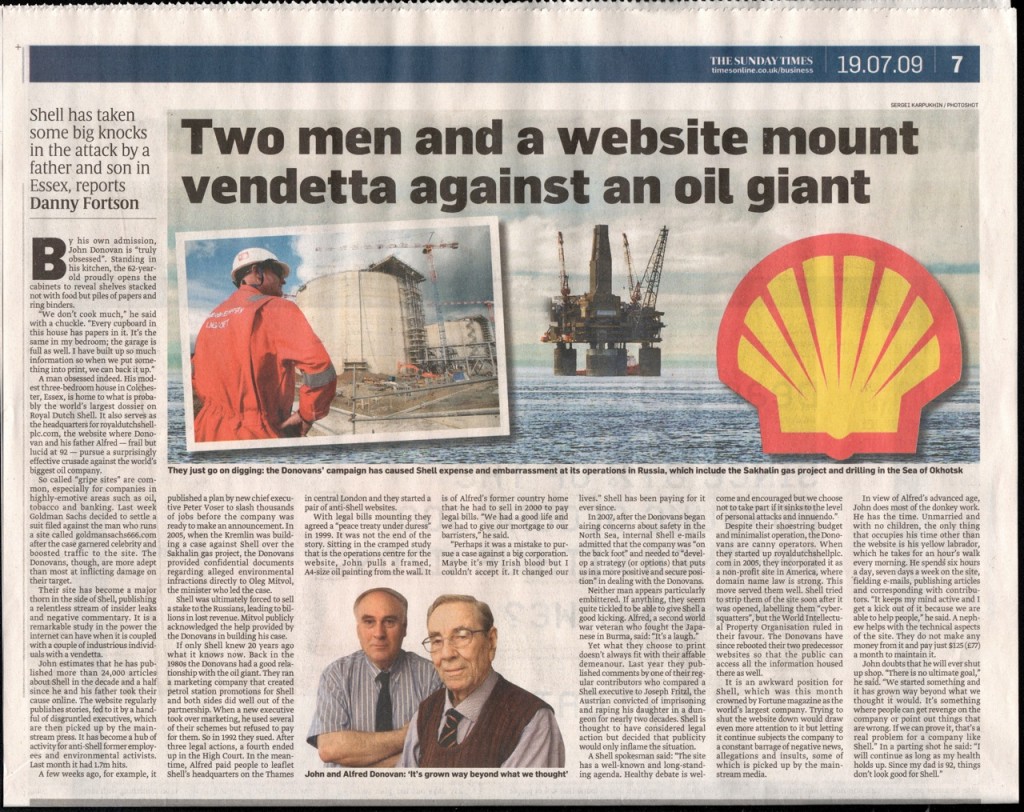
This website and sisters royaldutchshellplc.com, shellnazihistory.com, royaldutchshell.website, johndonovan.website, and shellnews.net, are owned by John Donovan. There is also a Wikipedia segment.


 Royal Dutch Shell conspired directly with Hitler, financed the Nazi Party, was anti-Semitic and sold out its own Dutch Jewish employees to the Nazis. Shell had a close relationship with the Nazis during and after the reign of Sir Henri Deterding, an ardent Nazi, and the founder and decades long leader of the Royal Dutch Shell Group. His burial ceremony, which had all the trappings of a state funeral, was held at his private estate in Mecklenburg, Germany. The spectacle (photographs below) included a funeral procession led by a horse drawn funeral hearse with senior Nazis officials and senior Royal Dutch Shell directors in attendance, Nazi salutes at the graveside, swastika banners on display and wreaths and personal tributes from Adolf Hitler and Reichsmarschall, Hermann Goring. Deterding was an honored associate and supporter of Hitler and a personal friend of Goring.

 Deterding was the guest of Hitler during a four day summit meeting at Berchtesgaden. Sir Henri and Hitler both had ambitions on Russian oil fields. Only an honored personal guest would be rewarded with a private four day meeting at Hitler’s mountain top retreat.


 IN JULY 2007, MR BILL CAMPBELL (ABOVE, A RETIRED GROUP AUDITOR OF SHELL INTERNATIONAL SENT AN EMAIL TO EVERY UK MP AND MEMBER OF THE HOUSE OF LORDS:


 MORE DETAILS:


 A head-cut image of Alfred Donovan (now deceased) appears courtesy of The Wall Street Journal.