
Second Circuit Denies Rehearing En Banc in Kiobel v. Royal Dutch Petroleum Co.
In our posting last September when the decision was announced (here), we discussed the Second Circuits decision in Kiobel, et al. v. Royal Dutch Petroleum Co., et al., 06-4800-cv, 06-4876-cv (2d Cir. 17 Sept. 2010), which held that the Alien Tort Statute, 28 U.S.C. § 1350, does not subject a corporation (as opposed to natural persons) to liability. Now, in two separate filings (here and here) leading to an 5-5 split, the Second Circuit denied the request for the full Court to reahear the case en banc. (For a general discussion of the role of comity in international disputes, see our Topic discussion in our e-book, International Practice: Topics and Trends.)
The Circuits Chief Judge (Jacobs), who was in the majority in the panels decision, took the occasion of the denial of the rehearing en banc to state that he acknowledge[d] that Judge Levals [dissenting] opinion is worked out with a certain scholarly force, and has an academic constituency. Nonetheless, Judge Jacobs, by his concurring opinion in the denial of rehearing en banc, wished to subject Judge Levals conclusion to some tests of reality.
In his opinion that followed, Judge Jacobs addressed the law and possible practical ramifications sketched out in Judge Levals earlier dissent. Judge Jacobs writes that it is fanciful to suppose that slavers and pirates will now rush to incorporate themselves as corporations to take advantage of the Second Circuits ruling and that policy considerations [including of comity] explain why no international consensus has arisen (or is likely to arise) supporting corporate liability and asks rhetorically: Is it plausible that customary international law supports proceedings that would harm other civilized nations and be opposed by themor be tantamount to judicial imperialism? Concluding, Judge Jacobs writes:
The majority opinion [in the ealier panel ruling] demonstrates why ATS suits against corporations are foreclosed. It is a matter of great importance to say so, in order to promote international comity, to administer efficient handling of cases, and to avoid the use of our courts to extort settlements.
In a concluding personal note, Judge Jacobs states:
Judge Leval, passim, reads my words as giving absolution to moral monsters. For the record: even moral monsters are humans, and I would happily see them hanged
Again dissenting, this time from the evenly split Courts denial of rehearing en banc, Judge Leval believed he perceived that Judge Jacobs, and the opeinion of the earlier majority, reveals an intense, multi-faceted policy agenda that underlies the majoritys undertaking to exempt corporations from the law of nations.


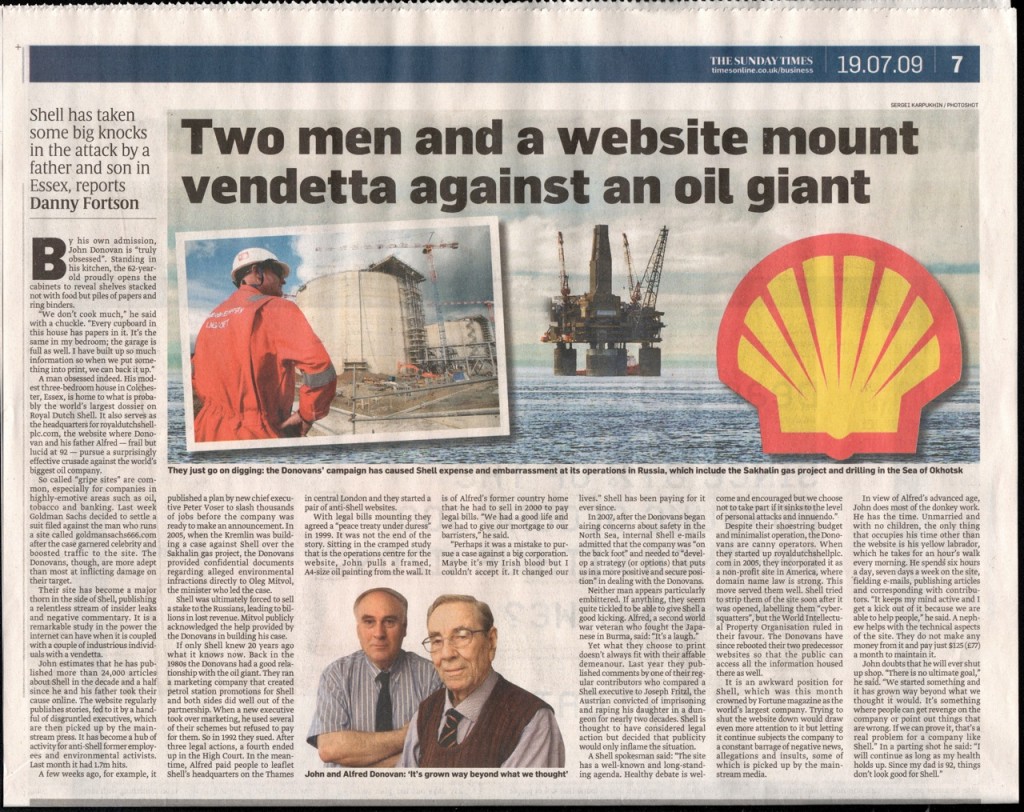
 Royal Dutch Shell conspired directly with Hitler, financed the Nazi Party, was anti-Semitic and sold out its own Dutch Jewish employees to the Nazis. Shell had a close relationship with the Nazis during and after the reign of Sir Henri Deterding, an ardent Nazi, and the founder and decades long leader of the Royal Dutch Shell Group. His burial ceremony, which had all the trappings of a state funeral, was held at his private estate in Mecklenburg, Germany. The spectacle (photographs below) included a funeral procession led by a horse drawn funeral hearse with senior Nazis officials and senior Royal Dutch Shell directors in attendance, Nazi salutes at the graveside, swastika banners on display and wreaths and personal tributes from Adolf Hitler and Reichsmarschall, Hermann Goring. Deterding was an honored associate and supporter of Hitler and a personal friend of Goring.

 Deterding was the guest of Hitler during a four day summit meeting at Berchtesgaden. Sir Henri and Hitler both had ambitions on Russian oil fields. Only an honored personal guest would be rewarded with a private four day meeting at Hitler’s mountain top retreat.


 IN JULY 2007, MR BILL CAMPBELL (ABOVE, A RETIRED GROUP AUDITOR OF SHELL INTERNATIONAL SENT AN EMAIL TO EVERY UK MP AND MEMBER OF THE HOUSE OF LORDS:


 MORE DETAILS:


 A head-cut image of Alfred Donovan (now deceased) appears courtesy of The Wall Street Journal.