
Claims of insider trading ‘ill-advised’
By JAMES WEIR – The Dominion Post | Monday, 26 May 2008
The insider trading claims brought by former Southern Petroleum shareholders against Shell and former Fletcher Challenge Energy director James Patek are “misconceived”, according to the defendants.
About 700 former Southern Petroleum shareholders are seeking tens of millions of dollars from oil giant Shell in New Zealand’s longest running insider trading case. They have been told that the 75 cents paid for their shares in 1996 could have been up to 14 times greater, if all information had been known at the time.
It has been alleged that revelations from a team of experts at a “deep gas” study presentation in New Plymouth in late 1995, relating to the Mangahewa gasfield, prompted Mr Patek to push through the compulsory purchase by Fletcher Challenge of Southern Petroleum minorities in December 1995.
Lawyers for the defendants, however, said Mr Patek did not have non-public, price-sensitive “inside information” about the deep gas study or Mangahewa “at any time during the takeover period”. The information he did get about Mangahewa before and during the takeover was “high level” and mainly came through Southern Petroleum board papers, the High Court was told in submissions from the defendants. He did not have different information from the other Southern directors including independent directors. The Southern board papers were also given to independent advisers.
The allegation that Mr Patek got additional price-sensitive information about the Mangahewa prospect from a presentation on November 2 was “entirely without foundation”, according to the defendants’ lawyer, Sarah Katz.
Travel records showed Mr Patek did not attend the presentation. There was no evidence that advisers Wilf Lammerink or Keith Rawlinson reported to him about the meeting, Ms Katz said. “There is not one document in the voluminous documentation before the court that suggests any such reporting took place.”
Mr Lammerink and Mr Rawlinson would give evidence that they did not report to Mr Patek about that meeting. Neither saw the meeting as being of sufficient significance to warrant an immediate report to the chief executive, given the extent of outstanding issues and uncertainties.
Fletcher Challenge completed the takeover of Southern Petroleum in January 1996. Shell bought Fletcher Energy in 2001, taking over the assets and obligations of Fletcher Challenge Energy Taranaki, formerly Petrocorp Exploration.
Petrocorp said it did not have “inside information” about Mangahewa at any time in September and mid-November 1995. There was no “great breakthrough” during the three months till October 1995 which would have justified a radical rise in the valuation placed on Mangahewa by the independent adviser to Southern Petroleum when considering the takeover. Petrocorp had no strategic involvement with the Southern takeover, which was managed by the Fletcher Challenge executive office in Auckland.
Earlier in 1995, Southern reported a $4.3 million loss after tax. Its shares initially dropped to 60c and later to 44c. At the time, Fletcher controlled 85 per cent of Southern and in July that year Mr Patek said there was no compelling reason for a separate Southern listing, initially suggesting a takeover offer of up to 80c a share.
Southern’s share of the “expected net present value” of Mangahewa was set at $2.23 million, with a 50 per cent probability of proceeding with the field. Southern’s total assets were worth about $10 million. The valuation was upgraded after Southern won five new exploration permits in 1995. The independent advisers assigned a pre-tax value to the new offshore permits of $23.35 million and the onshore ones of $9.65 million.
“The Southern minority shareholders accordingly received full value for the Pohokura prospect, based on the information available as at 1995,” the defendant’s lawyer said. Later discoveries were “simply irrelevant”.
However, the plaintiffs’ witnesses say Pohokura is an offshore extension of the Mangahewa plant. The initial offer for Southern was 63c a share, later raised to 75c.
http://www.stuff.co.nz/stuff/4560210a13.html
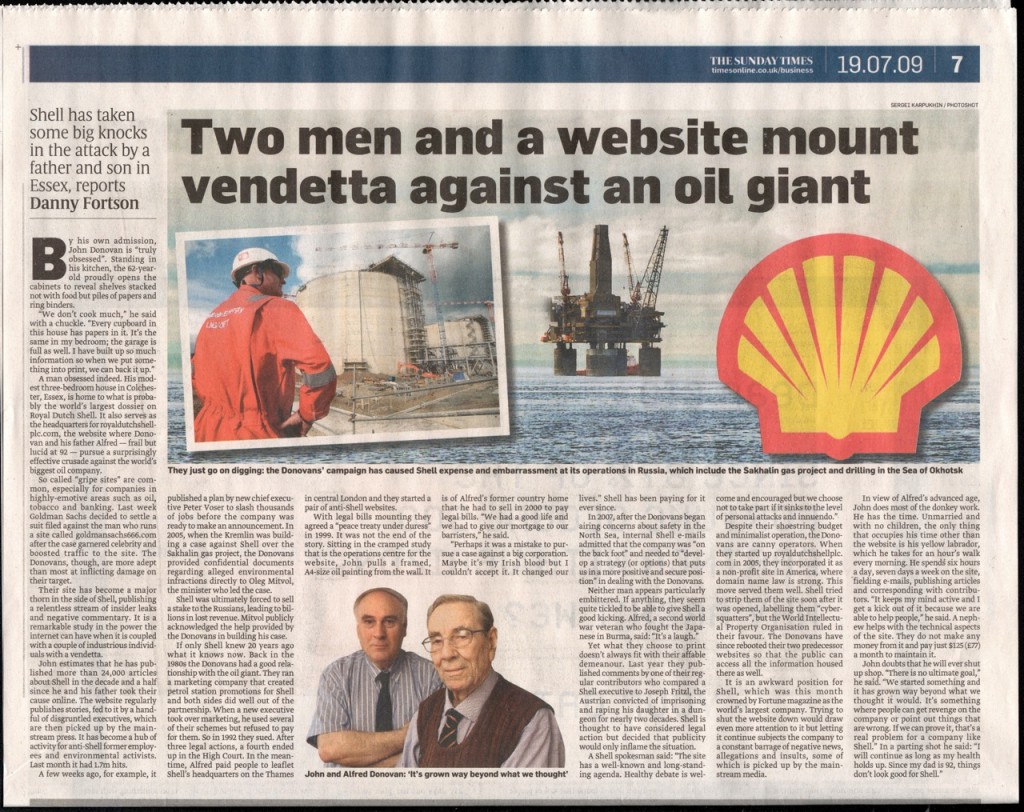
This website and sisters royaldutchshellplc.com, shellnazihistory.com, royaldutchshell.website, johndonovan.website, and shellnews.net, are owned by John Donovan. There is also a Wikipedia segment.


 Royal Dutch Shell conspired directly with Hitler, financed the Nazi Party, was anti-Semitic and sold out its own Dutch Jewish employees to the Nazis. Shell had a close relationship with the Nazis during and after the reign of Sir Henri Deterding, an ardent Nazi, and the founder and decades long leader of the Royal Dutch Shell Group. His burial ceremony, which had all the trappings of a state funeral, was held at his private estate in Mecklenburg, Germany. The spectacle (photographs below) included a funeral procession led by a horse drawn funeral hearse with senior Nazis officials and senior Royal Dutch Shell directors in attendance, Nazi salutes at the graveside, swastika banners on display and wreaths and personal tributes from Adolf Hitler and Reichsmarschall, Hermann Goring. Deterding was an honored associate and supporter of Hitler and a personal friend of Goring.

 Deterding was the guest of Hitler during a four day summit meeting at Berchtesgaden. Sir Henri and Hitler both had ambitions on Russian oil fields. Only an honored personal guest would be rewarded with a private four day meeting at Hitler’s mountain top retreat.


 IN JULY 2007, MR BILL CAMPBELL (ABOVE, A RETIRED GROUP AUDITOR OF SHELL INTERNATIONAL SENT AN EMAIL TO EVERY UK MP AND MEMBER OF THE HOUSE OF LORDS:


 MORE DETAILS:


 A head-cut image of Alfred Donovan (now deceased) appears courtesy of The Wall Street Journal.