
Reuters
Shell CEO says record oil not due to shortage
Thu May 22, 2008 5:24pm BST
By Karen Noack
LONDON (Reuters) – Oil prices at a record high above $135 a barrel are rising due to market sentiment rather than a shortage of supply, Royal Dutch Shell’s chief executive said on Thursday.
U.S. crude oil hit an all-time peak on Thursday, climbing to $135.09, lifted by concern about long-term supply and a host of predictions of further rises from influential investment banks and investors.
“What we say and what we see is there are no physical shortages,” Shell’s Jeroen van der Veer told Reuters television. He runs the world’s second-largest fully publicly traded oil firm by market value.
“There are no tankers waiting in the Middle East, there are no cars waiting at gasoline stations because they are out of stock. This has to do with psychology in the markets and you cannot forecast psychology”.
His view that there are no shortages chimes with that of other oil producers, such as members of the Organization of the Petroleum Exporting Countries. Others, such as the U.S. government, say supply is tight.
While rising prices are boosting profit for the industry, the Shell CEO agreed that high oil costs were a mixed blessing.
“For many consumers in the world, this really starts to hit them. Secondly, we see that you get a kind of public outcry.
“At the same time, the only thing that we can do is use the profits we make to invest for additional supplies.”
Shell has the largest capital spending programme among its main rivals in 2008, having spent $7.6 billion (3.8 billion pounds) in the first three months of the year alone. It was also alone among its peers in boosting output.
Oil’s climb has led to rising costs in the oil industry for services such as drilling rigs and companies are increasing the long-run price assumptions they use for planning their business.
Van der Veer, asked if Shell needed a price around $80 a barrel to break even, declined to give a specific figure but said it had grown more costly to bring on new supply.
“When oil prices went up, you see that the cost for new projects for the whole industry, not only for Shell, became a lot more expensive,” he said.
“In our industry we see quite severe inflation. We don’t know if that will plateau out or go up further.”
(Reporting by Karen Noack, Writing by Alex Lawler; Editing by Peg Mackey)
© Thomson Reuters 2008 All rights reserved.
http://uk.reuters.com/article/oilRpt/idUKL2232289720080522?sp=true
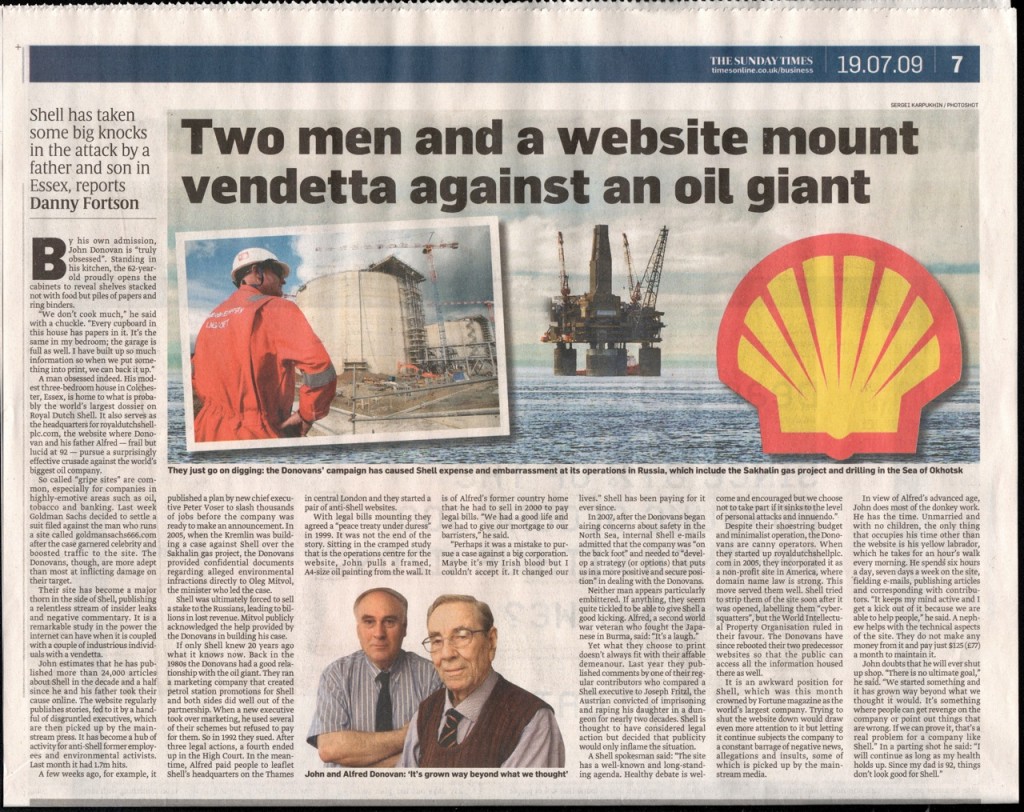
This website and sisters royaldutchshellplc.com, shellnazihistory.com, royaldutchshell.website, johndonovan.website, and shellnews.net, are owned by John Donovan. There is also a Wikipedia segment.


 Royal Dutch Shell conspired directly with Hitler, financed the Nazi Party, was anti-Semitic and sold out its own Dutch Jewish employees to the Nazis. Shell had a close relationship with the Nazis during and after the reign of Sir Henri Deterding, an ardent Nazi, and the founder and decades long leader of the Royal Dutch Shell Group. His burial ceremony, which had all the trappings of a state funeral, was held at his private estate in Mecklenburg, Germany. The spectacle (photographs below) included a funeral procession led by a horse drawn funeral hearse with senior Nazis officials and senior Royal Dutch Shell directors in attendance, Nazi salutes at the graveside, swastika banners on display and wreaths and personal tributes from Adolf Hitler and Reichsmarschall, Hermann Goring. Deterding was an honored associate and supporter of Hitler and a personal friend of Goring.

 Deterding was the guest of Hitler during a four day summit meeting at Berchtesgaden. Sir Henri and Hitler both had ambitions on Russian oil fields. Only an honored personal guest would be rewarded with a private four day meeting at Hitler’s mountain top retreat.


 IN JULY 2007, MR BILL CAMPBELL (ABOVE, A RETIRED GROUP AUDITOR OF SHELL INTERNATIONAL SENT AN EMAIL TO EVERY UK MP AND MEMBER OF THE HOUSE OF LORDS:


 MORE DETAILS:


 A head-cut image of Alfred Donovan (now deceased) appears courtesy of The Wall Street Journal.