
Published: October 22 2007 07:42 | Last updated: October 22 2007 19:52
The prospect of Turkish tanks rolling into northern Iraq – current oil exports: virtually zero – was enough to send crude prices soaring. So what would happen if bombs started dropping on Iran, the world’s fourth largest exporter?
The debate in Washington remains unresolved but the US has clearly made preparations for a potential strike on Iran’s nuclear programme. A wider attack on its oil facilities is highly unlikely, as is an Iranian response of cutting off supplies. Even if this occurred, Iran’s net exports of 2.5m barrels a day could, in theory, be covered by spare capacity in Saudi Arabia and the world’s 4bn barrels of commercial and strategic stocks.
More important would be Iran’s military response – most likely, asymmetric retaliation against US interests. The possibilities, which include attacks on Saudi facilities handling one in 10 of the world’s barrels, may read like the jottings of the “techno-thriller” writer Tom Clancy. But the vulnerability of the region’s oil network is real enough.
The mere threat of such attacks would push oil beyond $100 a barrel. What then? Big economies have so far proved resilient to high oil prices. At 6 per cent, the current share of US disposable income spent on energy is below 1980’s 8 per cent peak. Yet falling oil demand in the US and efforts to run cars on hooch and chip-fat show high prices are biting.
Three-digit oil prices would accelerate this trend, particularly if they sparked a US recession. Economic expansion across the Middle East – an important region in terms of incremental oil demand growth, not just supply – would reverse. A short-term spike, therefore, could well be quickly followed by a sharp drop – as happened with oil after the 1991 Gulf war and with gas after 2005’s hurricanes.
When high and volatile prices have savaged underlying demand, it does not bounce back with supply. Consumer behaviour and energy policies change. War in Iran would undoubtedly spark a “superspike” in oil prices. But for those looking for an investment angle, alternative energy looks a better bet.
Copyright The Financial Times Limited 2007
*Added by John Donovan
This website and sisters royaldutchshellplc.com, shellnazihistory.com, royaldutchshell.website, johndonovan.website, and shellnews.net, are owned by John Donovan. There is also a Wikipedia segment.


 Royal Dutch Shell conspired directly with Hitler, financed the Nazi Party, was anti-Semitic and sold out its own Dutch Jewish employees to the Nazis. Shell had a close relationship with the Nazis during and after the reign of Sir Henri Deterding, an ardent Nazi, and the founder and decades long leader of the Royal Dutch Shell Group. His burial ceremony, which had all the trappings of a state funeral, was held at his private estate in Mecklenburg, Germany. The spectacle (photographs below) included a funeral procession led by a horse drawn funeral hearse with senior Nazis officials and senior Royal Dutch Shell directors in attendance, Nazi salutes at the graveside, swastika banners on display and wreaths and personal tributes from Adolf Hitler and Reichsmarschall, Hermann Goring. Deterding was an honored associate and supporter of Hitler and a personal friend of Goring.

 Deterding was the guest of Hitler during a four day summit meeting at Berchtesgaden. Sir Henri and Hitler both had ambitions on Russian oil fields. Only an honored personal guest would be rewarded with a private four day meeting at Hitler’s mountain top retreat.


 IN JULY 2007, MR BILL CAMPBELL (ABOVE, A RETIRED GROUP AUDITOR OF SHELL INTERNATIONAL SENT AN EMAIL TO EVERY UK MP AND MEMBER OF THE HOUSE OF LORDS:


 MORE DETAILS:


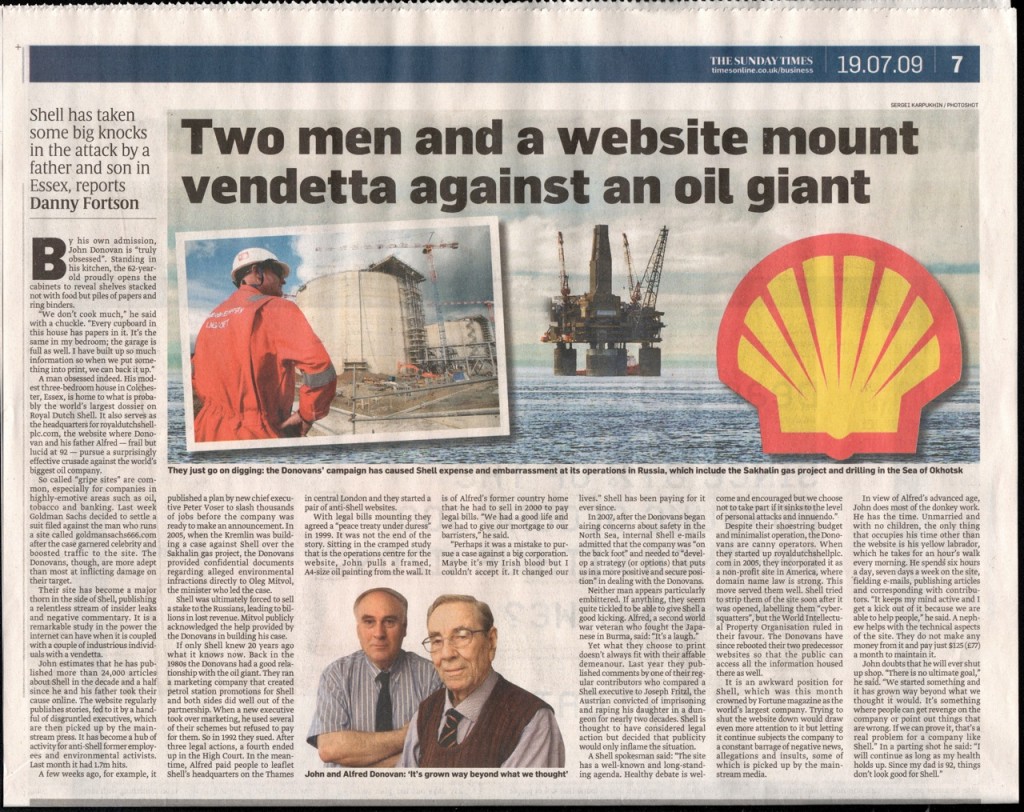
 A head-cut image of Alfred Donovan (now deceased) appears courtesy of The Wall Street Journal.