

Governments Reduce Access
To Aid National Champions
Amid Scramble for Supply
September 24, 2007; Page C10
Big Oil has a big problem. It may not be apparent from the huge profits that oil and gas companies are gushing. But the industry’s future depends on its ability to rove the earth in search of new reservoirs of oil and gas.
Yet as energy resources grow scarce, governments are restricting Western drillers’ access to their fields. They’re fostering their own champions, many of which are flush with capital, have learned from the majors and can easily contract drilling expertise from firms like Schlumberger, a Franco-American oil-services company.
There at least three logical responses by the oil majors to the rise of National Oil Companies, or NOCs. The first, already under way, is to invest in countries where they’re unlikely to see their assets expropriated. The second is to consider buying service firms themselves. Lastly, they could seek megamergers, along the lines of an Exxon-Chevron or BP-Shell, to counter the increasing heft of the NOCs.
None of this will happen overnight. But there are already signs of a flight to friendlier climes by Western producers. It’s easy to see why. Consider some of the past month’s developments: Algeria booted Spain’s Repsol out of a major project, Kazakhstan stepped up the pressure on Italy’s Eni in its huge Caspian find and Exxon Mobil took its fight to the courts against Hugo Chávez’s decision to nationalize assets in Venezuela.
That’s why ConocoPhilips, Royal Dutch Shell and others are increasing investments in countries such as the U.S. and Canada. But this presents complications of its own. It’s far more difficult, and costly, to extract energy from the Gulf of Mexico or Alberta’s oil sands. This has two consequences: It reduces profits for the majors, and it accelerates the transfer of treasure and technology to the oil-service providers.
What’s wrong with that? After all, it’s efficient to outsource the extraction of natural resources to these firms, leaving the valuable task of finding new gushers to the exploration companies. The problem is that as service firms get better at what they do, it becomes easier for the national oil groups to view them as better partners than Big Oil.
In the past, the majors were valued for their capital, their ability to locate new reserves and their project-management skills. But think of it. A country like Algeria has seen its coffers fill with petrodollars in recent years; it doesn’t need capital. And its petroleum engineers have learned project-management skills by working closely with the majors. So if it can hire Schlumberger to do the dirty work to exploit the country’s reserves, why pay Exxon or Repsol a chunk of future royalties? This becomes especially critical as service companies increase their edge. In recent years, they’ve filed twice as many technology patents as the oil majors, according to Weatherford, a service firm.
That’s why nearly all of the majors have discussed acquiring service providers. They haven’t pulled the trigger, though, for good reasons. First, there’s price: Schlumberger trades at 21 times 2008 profit estimates, compared with 14 times for Exxon. Furthermore, the worry is that if Exxon owned Schlumberger, most of Exxon’s rivals would cease to do business with the service provider.
That leaves the majors with a final option: megamergers. With a $510 billion market capitalization, Exxon is no wimp. But if it bought $200 billion Chevron, it would create an energy champion on the scale of a Gazprom or Saudi Aramco. It would also create tons of value. If it extracted synergies from Chevron in line with the 2.5% of costs that it squeezed from Mobil, there would be as much as $12 billion of savings. After taxes, these could be worth $70 billion to shareholders today. A combination of BP and Shell would offer similarly juicy cuts.
Sure, there would be antitrust issues, particularly in the refining business. And with oil prices at $80 a barrel, energy executives may not feel pressure to move anytime soon. But as energy resources dwindle and the world gets smaller for Western producers, it gets easier to see a day when Big Oil gets a lot bigger.
–Rob Cox and Cyrus Sanati
This column is written by breakingviews.com, an online financial commentary site.
*added by John Donovan
This website and sisters royaldutchshellplc.com, shellnazihistory.com, royaldutchshell.website, johndonovan.website, and shellnews.net, are owned by John Donovan. There is also a Wikipedia segment.


 Royal Dutch Shell conspired directly with Hitler, financed the Nazi Party, was anti-Semitic and sold out its own Dutch Jewish employees to the Nazis. Shell had a close relationship with the Nazis during and after the reign of Sir Henri Deterding, an ardent Nazi, and the founder and decades long leader of the Royal Dutch Shell Group. His burial ceremony, which had all the trappings of a state funeral, was held at his private estate in Mecklenburg, Germany. The spectacle (photographs below) included a funeral procession led by a horse drawn funeral hearse with senior Nazis officials and senior Royal Dutch Shell directors in attendance, Nazi salutes at the graveside, swastika banners on display and wreaths and personal tributes from Adolf Hitler and Reichsmarschall, Hermann Goring. Deterding was an honored associate and supporter of Hitler and a personal friend of Goring.

 Deterding was the guest of Hitler during a four day summit meeting at Berchtesgaden. Sir Henri and Hitler both had ambitions on Russian oil fields. Only an honored personal guest would be rewarded with a private four day meeting at Hitler’s mountain top retreat.


 IN JULY 2007, MR BILL CAMPBELL (ABOVE, A RETIRED GROUP AUDITOR OF SHELL INTERNATIONAL SENT AN EMAIL TO EVERY UK MP AND MEMBER OF THE HOUSE OF LORDS:


 MORE DETAILS:


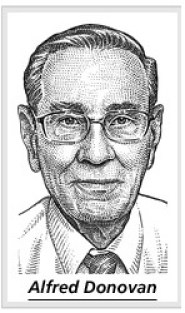 A head-cut image of Alfred Donovan (now deceased) appears courtesy of The Wall Street Journal.



The bigger and the more international a corporation becomes the less vulnerable it is to governmental and supra-governmental regulation. ExxonMobil, ChevronTexaco, BP and Shell are arguably already big enough and geographically diverse enough to be almost beyond the reach of the regulators. I say “almost” because, as Shell has found to its cost, if you operate in the US you can be vulnerable in the US courts even for offences committed elsewhere. But Shell will have learned from the reserves fiasco and no doubt the lawyers have been busy reducing the company’s vulnerability to controls and regulations. The oil companies are amongst businesses most vocal advocates of free enterprise and self-regulation. Indeed Shell’s “Corporate Social Responsibility” initiatives need to be seen in this light. The premise is that if you demonstrate your corporate rectitude and your strong internal controls and rules then the external regulators will leave you alone. This was the route followed for years by the tobacco giants and it worked – although in the end their hands were eventually tied in civilised countries by the application of anti-advertising laws.
One of the key advantages to the oil giants of further consolidation (aside from the opportunity to exercise monopoly power) is to make it even more difficult for regulators to control them. But imagine the scenario if not only did Shell and BP (or Exxon and Chevron) merge but they brought Saudi Aramco into the family as well! How would anyone be able to regulate an energy giant of this size – especially if their Head Office was in Riyadh rather than Houston, London or The Hague!