Reuters – Tuesday, September 4YUZHNO-SAKHALINSK, Russia, Sept 4 – Russia’s gas export monopoly Gazprom said on Tuesday it needs gas from Exxon Mobil’s Sakhalin-1 project for domestic use, mounting pressure on the U.S. major to drop plans to export gas to China.
Gazprom, which controls another major gas project, Sakhalin-2, off the Russian Pacific coast, said Exxon should take into account Russia’s priority to supply the domestic market first.
“Given that nearly all the gas from the Sakhalin-2 project has already been sold under long-term contracts, and other Sakhalin projects are not expected to start production in the middle term, the gas from Sakhalin-1 can be the only source for domestic supplies until at least 2015,” said Vladimir Kozlov, head of Gazprom’s Sakhalin office.
Speaking at the annual oil and gas conference in the island’s capital of Yuzhno-Sakhalinsk, Kozlov said the growing domestic demand for gas in Russia’s four Far Eastern regions will reach 13.1 billion cubic metres by 2010 and further grow to 16.0 and 19.2 bcm by 2015 and 2020 respectively.
Sakhalin-1 alone can supply the regions with 3.2 bcm of gas by 2010, and 11.4 bcm from 2015 to 2020, he added.
“We are in discussions with Gazprom and have regular meetings with them to explore various options and find ways of mutual cooperation,” said James Taylor, Executive Vice President of Exxon Neftegas, Exxon Mobil’s subsidiary in Russia.
Sakhalin-1 is a production sharing agreement, which excludes the project from Gazprom’s legal monopoly on gas exports. It gives Exxon the right to sell the gas to a consumer of its choice, like China, with which the U.S. major reached a preliminary agreement in 2004 on annual supplies of 8 bcm of gas.
“Our main principle is economic profitability. So far, we consider the Chinese direction to be the most attractive from the economic point of view,” said Margarita Tsoy, the firm’s government and public affairs manager.
Gazprom’s influence in the region has significantly grown since last year, when the gas firm bought control of Sakhalin-2 from Royal Dutch Shell and its Japanese partners, who were obliged to sell after a campaign of criticism from Russian officials and threats of crippling licence withdrawals.
The Sakhalin-1 partners also include Russian state-controlled oil company Rosneft , India’s ONGC and the Japanese consortium Sodeco.
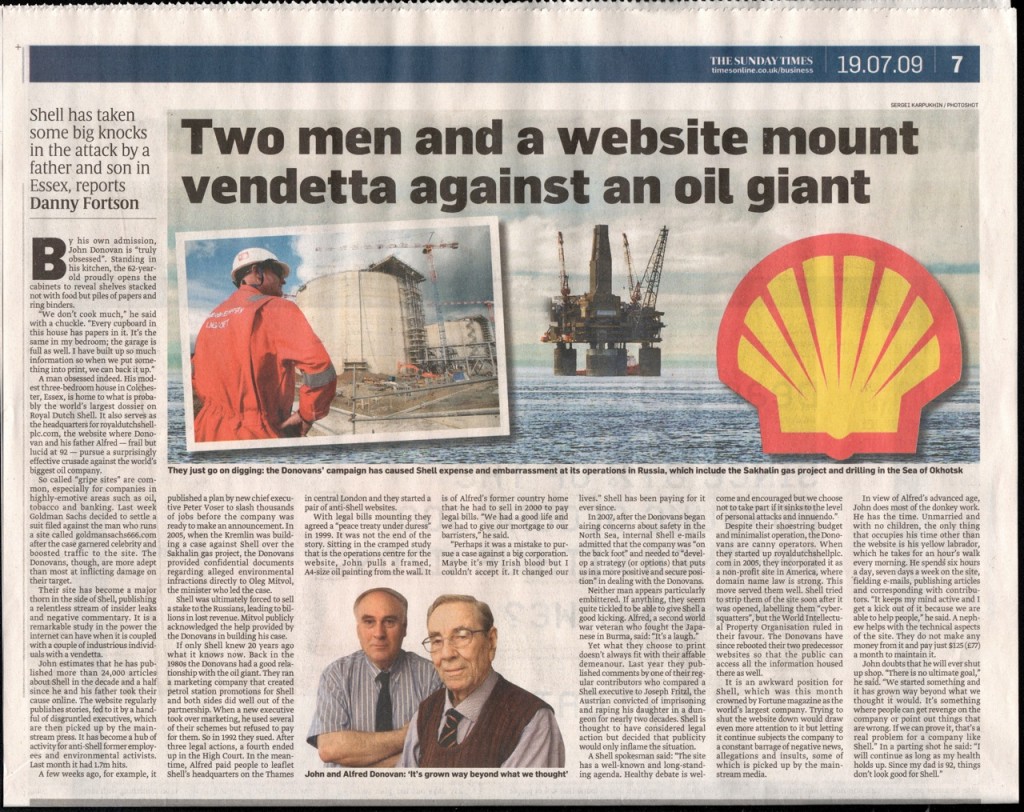
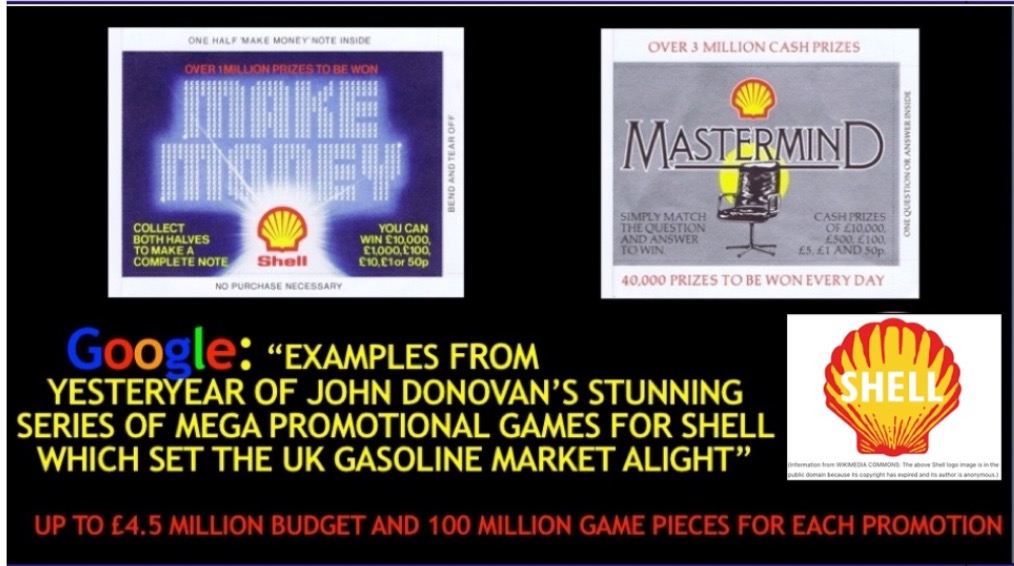
This website and sisters royaldutchshellplc.com, shellnazihistory.com, royaldutchshell.website, johndonovan.website, and shellnews.net, are owned by John Donovan. There is also a Wikipedia segment.


 Royal Dutch Shell conspired directly with Hitler, financed the Nazi Party, was anti-Semitic and sold out its own Dutch Jewish employees to the Nazis. Shell had a close relationship with the Nazis during and after the reign of Sir Henri Deterding, an ardent Nazi, and the founder and decades long leader of the Royal Dutch Shell Group. His burial ceremony, which had all the trappings of a state funeral, was held at his private estate in Mecklenburg, Germany. The spectacle (photographs below) included a funeral procession led by a horse drawn funeral hearse with senior Nazis officials and senior Royal Dutch Shell directors in attendance, Nazi salutes at the graveside, swastika banners on display and wreaths and personal tributes from Adolf Hitler and Reichsmarschall, Hermann Goring. Deterding was an honored associate and supporter of Hitler and a personal friend of Goring.

 Deterding was the guest of Hitler during a four day summit meeting at Berchtesgaden. Sir Henri and Hitler both had ambitions on Russian oil fields. Only an honored personal guest would be rewarded with a private four day meeting at Hitler’s mountain top retreat.


 IN JULY 2007, MR BILL CAMPBELL (ABOVE, A RETIRED GROUP AUDITOR OF SHELL INTERNATIONAL SENT AN EMAIL TO EVERY UK MP AND MEMBER OF THE HOUSE OF LORDS:


 MORE DETAILS:


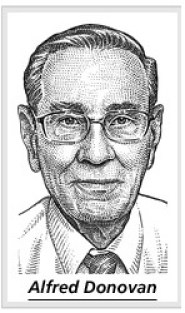 A head-cut image of Alfred Donovan (now deceased) appears courtesy of The Wall Street Journal.