Published: Jul 12, 2007
CALGARY – Oilsands skeptic BP PLC has finally caved after years of ignoring Alberta’s oil-soaked dirt in its influential tally of world energy resources.
The oil giant, one of the few super-majors in the world without a significant oilsands project under development, has long been reluctant to count the number of potential barrels in the unconventional, economically challenged oilsands in its annual Statistical Review Of World Energy.
The London-based company pulled a quiet about-face late last month, however, and its highly regarded publication now lists Canadian oilsands as containing 163.5 billion barrels of undeveloped reserves — oil that could be produced using today’s technologies and in today’s economic climate — among a total of 1.37 trillion barrels worldwide.
Recognition from BP, alone, is a significant change from the past and continues “momentum” that began four years ago when such influential entities as the United States Department of Energy; the Oil & Gas Journal; Cambridge Energy Research Associates and the International Monetary Fund began including Canadian oilsands reserves as mainstream, said Greg Stringham, vice-president of the Canadian Association of Petroleum Producers.
“It’s a big step for BP and it’s a world-renowned publication,” Mr. Stringham said yesterday.
“The earlier steps by others allowed the international community to recognize the movement of the oilsands into mainstream oil and gas production, instead of being off to the side as a frontier development. They created a lot of international interest.
“This keeps that momentum going.”
BP has been the lone holdout in recognizing the oilsands despite more than $125-billion worth of planned investment for the sector by many of its chief rivals, including Royal Dutch Shell Plc.
BP sold much of its oilsands position to Canadian Natural Resources Ltd. in the 1990s, but it retained some land in the Athabasca region, where the oil is buried too deep to mine.
The large U.S. refiner said last year it would spend billions redesigning its refinery in Whiting, Ind., to take Canadian heavy oil from Alberta’s oilsands.
Mark Finley, the head of energy analysis within BP’s economics team, said the company’s tune changed as it got consistent data over time from the Alberta Energy and Utilities Board, the Alberta government regulator that estimates the oilsands hold 178.7 billion barrels of recoverable oil.
In a sign of caution, however, BP also separates out the Canadian reserves and lists its final world tally as “proved reserves and oilsands.”
In a footnote to the list, BP further breaks out an additional 10.3 billion barrels of Canadian oilsands reserves now under active development.
“We’ve always said that the statistical review does not report how much oil is there,” Mr. Finley said.
“We added [oilsands] as a line item because our expectation has never been if the resource is there, it’s always been around the economics of it. “
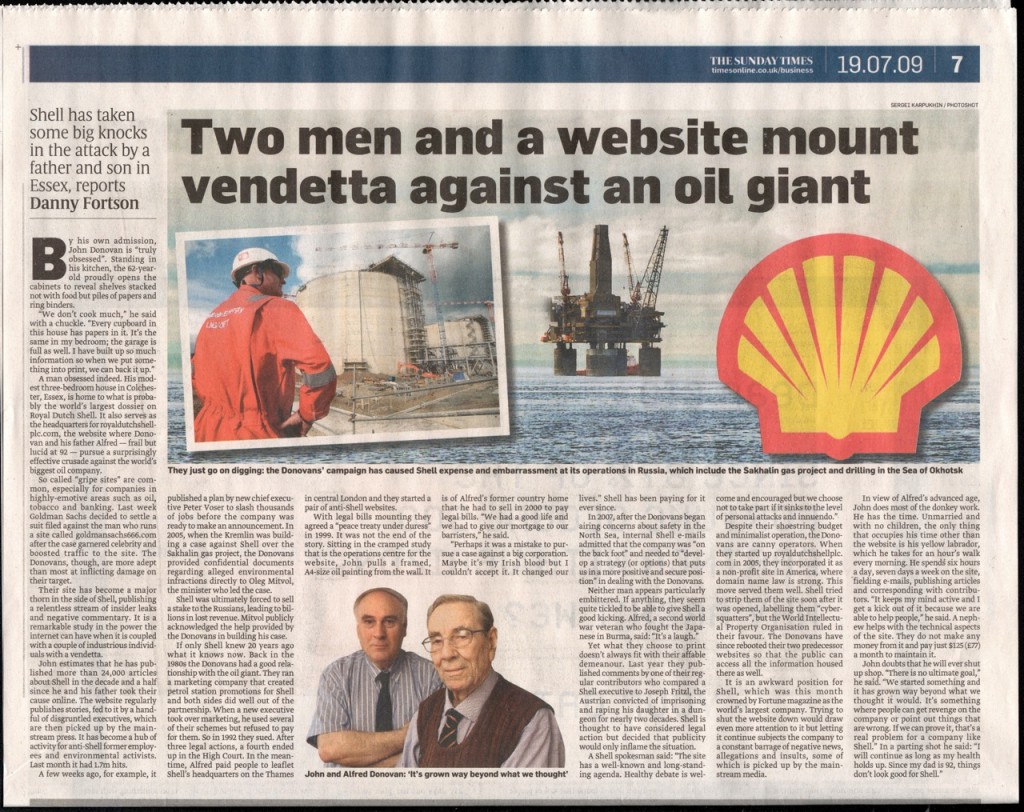
This website and sisters royaldutchshellplc.com, shellnazihistory.com, royaldutchshell.website, johndonovan.website, and shellnews.net, are owned by John Donovan. There is also a Wikipedia segment.


 Royal Dutch Shell conspired directly with Hitler, financed the Nazi Party, was anti-Semitic and sold out its own Dutch Jewish employees to the Nazis. Shell had a close relationship with the Nazis during and after the reign of Sir Henri Deterding, an ardent Nazi, and the founder and decades long leader of the Royal Dutch Shell Group. His burial ceremony, which had all the trappings of a state funeral, was held at his private estate in Mecklenburg, Germany. The spectacle (photographs below) included a funeral procession led by a horse drawn funeral hearse with senior Nazis officials and senior Royal Dutch Shell directors in attendance, Nazi salutes at the graveside, swastika banners on display and wreaths and personal tributes from Adolf Hitler and Reichsmarschall, Hermann Goring. Deterding was an honored associate and supporter of Hitler and a personal friend of Goring.

 Deterding was the guest of Hitler during a four day summit meeting at Berchtesgaden. Sir Henri and Hitler both had ambitions on Russian oil fields. Only an honored personal guest would be rewarded with a private four day meeting at Hitler’s mountain top retreat.


 IN JULY 2007, MR BILL CAMPBELL (ABOVE, A RETIRED GROUP AUDITOR OF SHELL INTERNATIONAL SENT AN EMAIL TO EVERY UK MP AND MEMBER OF THE HOUSE OF LORDS:


 MORE DETAILS:


 A head-cut image of Alfred Donovan (now deceased) appears courtesy of The Wall Street Journal.