EXTRACT: At least 508,000 bpd or about a sixth of Nigeria’s output capacity has been shut in due to militant attacks and pipeline leaks this year, with its largest producer, Royal Dutch Shell (RDSa.L), most affected.
THE ARTICLE
By REUTERS
Published: August 22, 2006
Filed at 11:14 p.m. ET
SINGAPORE (Reuters) – Oil prices edged down to under $73 a barrel on Wednesday, as world powers studied Iran’s offer of more talks to resolve a nuclear dispute that could lead to sanctions against the world’s fourth-largest oil exporter.
U.S. crude (CLc1) for October delivery was 30 cents down at $72.80 a barrel by 0255 GMT, after falling 20 cents on Tuesday. The September contract expired on Tuesday 18 cents up at $72.63 after a three-day rally. London Brent crude (LCOc1) for October slipped 33 cents to $72.91 a barrel.
Iran said its reply on Tuesday to a package of incentives by world powers contained ideas that would allow serious talks about its standoff to start straight away. But it was not clear whether the response went far enough to avert United Nations sanctions.
“The risk to the market is to the downside, since the market has factored in Iran being intransigent,” said Michael Coleman, managing director of Singapore-based hedge fund Aisling Analytics. “Fundamentally, crude should be under pressure.”
The U.N. Security Council has demanded that Iran halt its nuclear work by a deadline of August 31, but there was no sign that Tehran had agreed to a key demand to halt uranium enrichment.
Traders fear that Tehran may use its oil exports of more than 2 million barrels per day (bpd) as a weapon to defend itself in the row. Officials have said sanctions will harm the West more than Iran by sending oil prices even higher.
Iran’s answer was likely to be designed to divide Security Council members Russia and China, both key trade partners of Tehran lukewarm on sanctions, from the United States, France and Britain who have all backed tougher measures.
U.S. crude prices have fallen back from a record $78.40 in July after a ceasefire between Israel and Lebanon eased the risk of violence spreading in the Middle East, which pumps nearly a third of world oil.
But prices remain 19 percent up this year on the fear of disruption to Iran’s exports and reduced Nigerian supplies.
At least 508,000 bpd or about a sixth of Nigeria’s output capacity has been shut in due to militant attacks and pipeline leaks this year, with its largest producer, Royal Dutch Shell (RDSa.L), most affected. Exxon Mobil (XOM.N) said on Tuesday its Nigerian output had not been shut in.
A partial outage in BP’s (BP.L) Prudhoe Bay oilfield, the largest in the United States, was expected to lead to a 1.2 million barrel crude drop last week in U.S. inventory data due later on Wednesday, a Reuters survey showed (EIA/S).
Gasoline stockpiles in the world’s top consumer were expected to fall 1.9 million barrels while distillate fuels were forecast to see another seasonal build ahead of peak winter demand.
“Demand (for gasoline) has been growing robustly at a rate above 1 percent over the past three months, and the near-term dip in prices is likely to buttress demand yet further,” said Barclays Capital.
Traders are keeping an eye on Tropical Storm Debby in the far eastern Atlantic, the fourth of the 2006 hurricane season, though forecasters saw it moving toward Bermuda and not threatening the oil-producing U.S Gulf Coast.
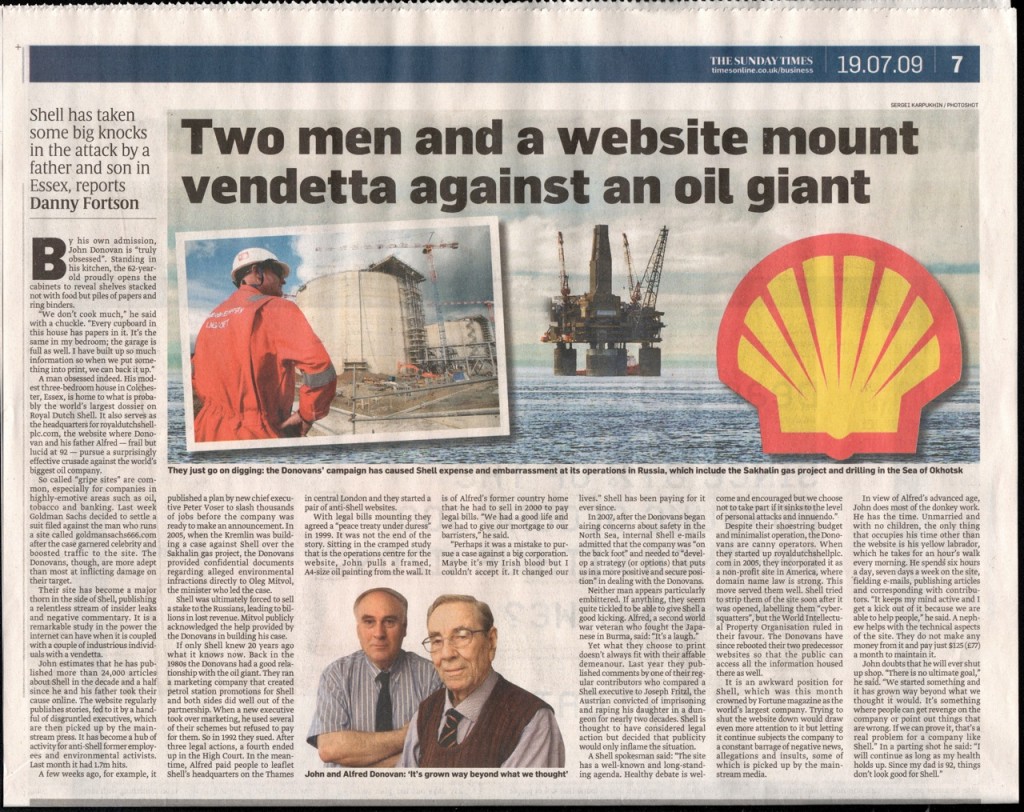
This website and sisters royaldutchshellplc.com, shellnazihistory.com, royaldutchshell.website, johndonovan.website, and shellnews.net, are owned by John Donovan. There is also a Wikipedia segment.


 Royal Dutch Shell conspired directly with Hitler, financed the Nazi Party, was anti-Semitic and sold out its own Dutch Jewish employees to the Nazis. Shell had a close relationship with the Nazis during and after the reign of Sir Henri Deterding, an ardent Nazi, and the founder and decades long leader of the Royal Dutch Shell Group. His burial ceremony, which had all the trappings of a state funeral, was held at his private estate in Mecklenburg, Germany. The spectacle (photographs below) included a funeral procession led by a horse drawn funeral hearse with senior Nazis officials and senior Royal Dutch Shell directors in attendance, Nazi salutes at the graveside, swastika banners on display and wreaths and personal tributes from Adolf Hitler and Reichsmarschall, Hermann Goring. Deterding was an honored associate and supporter of Hitler and a personal friend of Goring.

 Deterding was the guest of Hitler during a four day summit meeting at Berchtesgaden. Sir Henri and Hitler both had ambitions on Russian oil fields. Only an honored personal guest would be rewarded with a private four day meeting at Hitler’s mountain top retreat.


 IN JULY 2007, MR BILL CAMPBELL (ABOVE, A RETIRED GROUP AUDITOR OF SHELL INTERNATIONAL SENT AN EMAIL TO EVERY UK MP AND MEMBER OF THE HOUSE OF LORDS:


 MORE DETAILS:


 A head-cut image of Alfred Donovan (now deceased) appears courtesy of The Wall Street Journal.