By Simon Webb
LONDON (Reuters) – Higher taxes have made operating in the North Sea oil and gas sector tougher for producers but boom times continue, officials and company executives said on Tuesday.
Chancellor Gordon Brown took a bigger slice of record oil company revenues when he hiked taxes on profits by 10 percent in December.
But so far there has been little change in the number of companies trying to cash in on high oil prices by developing smaller North Sea fields that had previously been uneconomical.
“We still believe more companies are coming in than leaving,” said Paul Willcocks, Managing Director at Harrison Lovegrove, which advises on energy acquisitions and divestments.
Willcocks, speaking at a seminar on the North Sea in London, said that he expects an increase in the number of smaller deals for North Sea oil and gas assets of the size of $50-$100 million this year.
U.S. major ConocoPhillips may sell some North Sea assets after $35.6 billion purchase of Burlington in December, Willcocks said.
Canadian producer Talisman may also look to sell some assets as it consolidates last year's $2.1 billion buy of Paladin Resources, he said.
Royal Dutch Shell said on Tuesday that it was putting together a package of marginal undeveloped fields and exploration assets for sale this year.
The UK government has encouraged asset holders, especially oil majors, to sell marginal or undeveloped fields to smaller producers and independents in efforts to maximise output from the declining North Sea oil and gas sector.
CHALLENGING TARGET
Higher taxes have made reaching the government's ambitious output target of 3.0 million barrels of oil equivalent per day in 2010 more challenging, said Joan Macnaughton, Director General of energy at the UK's Department of Trade and Industry.
As things stand, industry projections are for production of 2.6 million boepd in 2010, she said. Output is currently 3.6 million boepd equivalent.
“Of course it will be a challenge to maintain commitment (to the UK North Sea),” she said. “It was a challenge after the last fiscal changes and it will be again this time.”
Producers blamed a surprise tax rise in 2002 for low drilling activity in 2003 and 2004.
Macnaughton said that glitches at UK fields last year may have tipped the UK into being a net oil importer after many years of exporting. But restored output and new projects coming on line should mean the UK will be a net exporter later this year and for a few more years.
The tax changes may delay some projects and will increase exposure among North Sea producers to oil prices, executives said.
“The market is now more sensitive to oil and gas fluctuations,” said Mike Bowyer, UK Vice President of U.S. oil service giant Halliburton .
Shell Chief Executive Jeroen van der Veer called on Monday on the British government to commit to cutting taxes on North Sea oil production if oil prices fall.
He said that would provide the kind of stability needed to guarantee investment in the UK's Continental Shelf.
Executives from oil majors Shell and Total on Tuesday reaffirmed their commitment to the North Sea sector.
“There remain enormous opportunities in the North Sea for everyone,” said Martin Tiffin of French major Total . “Our asset base can take us well beyond 2020.”
UK oil production peaked in 1999 and has been declining since as reservoirs are exhausted at ageing fields. Output declined at 10 percent per year in 2003-2004.
News and information on Shell PLC
DISCLAIMER

This is not a Shell website. That fact should be abundantly plain from the overall content of this home page and our sister Shell-focussed websites, including shellnazihistory.com. Click on the Disclaimer link at top of this page for more information. You Can Be Sure Shell does not endorse or approve of this website. There are no subscription charges nor do we solicit or accept donations. It is an entirely free to use website drawing attention to the negative side of Shell while also publishing positive news about the company. The Shell logo image with the white text used on this website, as per the above example, is in the public domain because its copyright has expired and its author is anonymous. It can be found on WIKIMEDIA COMMONS. Our shellenergy.website publishes Shell Energy customer complaints posted on Trustpilot where there is an ample supply. Use this link for Shell’s own website.
SHELL’S ROLE IN NIGERIAN OPL 245 BRIBERY SCANDAL


Whatever fig leaves they might be trying to use to hide the truth, Shell and Eni paid over $1bn to a company called Malabu for the OPL 245 licence. Even though the payment was channelled through the Nigerian government, it was clear that Shell knew that the ultimate beneficiary was Dan Etete, the former minister of petroleum. Etete is the owner of Malabu, to whom he awarded the licence when he was Nigerian Minister of Petroleum.
The Economist: Safe sex in Nigeria: (Court documents shed light on the manoeuvrings of Shell and ENI to win a huge Nigerian oil block): 15 June 2013
Malabu Oil Deal: I Only Got $1.1 billion bribe from Shell and Eni: 15 June 2013
Reuters: UK police probing Shell, ENI Nigerian oil block deal: 24 July 2013
The Scandal of Nigerian Oil Block OPL 245: 25 Nov 2013
SIGNED STATEMENT OF TRUTH: 10 Dec 2013
JUDICIAL REVIEW APPLICATION: DATED 10 Dec 2013
Nigerian lawmakers recommend revoking Shell, Eni OPL 245 oil block licence: 20 Feb 2014
Royal Dutch Shell Implicated in Nigerian OPL 245 Corruption Scandal: 11 Sept 2014
$190m frozen in UK and Switzerland in OPL 245 bribery case as ENI CEO is named as suspect: 11 Sept 2014
Safe Sex and Corruption in Nigeria - OPL 245: 18 Sept 2014
Eni payments 'used to bribe Nigeria officials': 2 Oct 2014
UK Foreign & Commonwealth Office (FCO) documents released covering meetings between FCO and Shell regarding OPL 245 oil field : 2 Oct 2014
APC questions Jonathan over Malabu Oil $550mn bribery scandal: 12 Oct 2014
OPL 245 Deal:Lawyers jostle to represent Malabu: 28 Oct 2014
Secrecy order lifted on legal challenge to corrupt Nigerian oil deal (OPL 245): 7 Nov 2014
Shell knew of fraud and moneylaundering activities during purchase of an oilfield in Nigeria: 30 Jan 2015
Nigeria: Malabu - Court Fixes Application to Halt Suit for March 12: 6 Feb 2015
Related article by Business Insider UK: The extraordinary story of Nigeria's $20 billion oil money 'leakage' 6 Feb 2015
Nigeria: ENI Misled Shareholders Over Nigeria Corruption Scandal – – Global Witness: 1 JUNE 2015
EFCC quizzes former minister, Etete, over alleged oil deal: 29 JUNE 2015
Nigerian Probes Uncover $12bn Oil Fraud: 10 NOV 2015
COURT REFUSES TO UNFREEZE FUNDS FROM “SMASH AND GRAB” RAID ON NIGERIAN OIL BLOCK: 15 DEC 2015
$1.1bn Malabu Scam: Leaked emails show Shell, Eni, Jonathan’s aides conspired to divert money to Etete: 19 Dec 2015
Shell, Eni in fresh trouble as Nigeria begins moves to withdraw OPL 245 from Malabu, Dan Etete: 25 JAN 2015
Shell, Eni In Fresh Trouble As Nigeria Begins Moves To Withdraw OPL 245: 26 JAN 2016/a>
9 Billion Barrels of Crude At Risk In Massive Nigerian Oil Shakeup: 28 JAN 2016
Nigerian President Steps Up Fight Against Corruption: 28 JAN 2016
Premuim Times: Turf War Over $1.3 Billion OPL 245 Shell/Eni Malabu Scam: 8 FEB 2016
Face-off over Malabu Shell/Eni oil bloc scam: 15 FEB 2016
Reuters Article: Shell says Dutch investigators visit Shell HQ in Nigeria oil probe: 30 March 2016
Reuters Article: Italian prosecutors probe Shell over Nigeria oil deal - source: 30 March 2016
Wall Street Journal Article: Shell Meets Investigators About Role in Nigeria Deal: 30 March 2016
Daily Mail Article: Shell dragged into Nigeria oil corruption probe: 30 March 2016
Premium Times Article: Malabu $1.3 billion scandal: Dutch investigators question Shell officials: 30 March 2016
FT Article: Shell headquarters visited by corruption investigators: 30 March 2016
Guardian Newspaper Article: Shell faces corruption probe over $1bn oil deal in Nigeria: 30 March 2016
BBC News Article: Shell Nigeria deal probed in Italy: 31 March 2016
News Article: Which Members of the Royal Dutch Shell Executive Committee Approved the OPL 245 Scam?: 31 March 2016
UPI Article: Shell target of Nigerian corruption probe?: 31 March 2016
New York Times Article: Italy Probes Shell's Role in Purchase of Nigerian Oil Block: 31 March 2016
Sahara Reports Article: $180m Halliburton Probe: EFCC Boss, AGF In U.S.: 1 April 2016
Ecologist: Shell investigated over $1 billion corrupt oil deal: 4 April 2016
Sahara Reports Article: $200 Million Diverted To Italian Accounts In Malabu Scandal, Italian Sources Say: 9 April 2016
THE NATION: Malabu Oil deal: EFCC quizzes SNEPCO boss over $1,092b settlement cash: 20 April 2016
PREMIUM TIMES: $1.1billion Malabu scam: Italian oil giant, ENI, admits wrongdoing: 14 May 2016
News24Nigeria: Former Head of State, ex Senate President named in Malabu oil deal scam: 29 August 2016
Vanguard: Malabu Oil Deal: New facts implicate more Nigerians: 2 September 2016
London Evening Standard: OPL 245: Murky saga of an ex-minister and ‘siphoned-off’ oil millions: 7 September 2016
allAfrica.com: Nigeria: U.S.$1.1 Billion Malabu Oil Deal – Investigations Are Ongoing, Says AGF: 14 October 2016
THE NATION: Malabu malady: 24 October 2016John Donovan’s ebooks

EBOOK TITLE: “SIR HENRI DETERDING AND THE NAZI HISTORY OF ROYAL DUTCH SHELL” – AVAILABLE ON AMAZON

EBOOK TITLE: “JOHN DONOVAN, SHELL’S NIGHTMARE: MY EPIC FEUD WITH THE UNSCRUPULOUS OIL GIANT ROYAL DUTCH SHELL” – AVAILABLE ON AMAZON.

EBOOK TITLE: “TOXIC FACTS ABOUT SHELL REMOVED FROM WIKIPEDIA – HOW SHELL BECAME THE MOST HATED BRAND IN THE WORLD” – AVAILABLE ON AMAZON.
SHELL “CLOAK AND DAGGER” ACTIVITIES
SHELL PERSECUTION OF DR JOHN HUONG
SHELL SAKHALIN2 DEBACLE
NAZI HISTORY OF ROYAL DUTCH SHELL
 Royal Dutch Shell conspired directly with Hitler, financed the Nazi Party, was anti-Semitic and sold out its own Dutch Jewish employees to the Nazis. Shell had a close relationship with the Nazis during and after the reign of Sir Henri Deterding, an ardent Nazi, and the founder and decades long leader of the Royal Dutch Shell Group. His burial ceremony, which had all the trappings of a state funeral, was held at his private estate in Mecklenburg, Germany. The spectacle (photographs below) included a funeral procession led by a horse drawn funeral hearse with senior Nazis officials and senior Royal Dutch Shell directors in attendance, Nazi salutes at the graveside, swastika banners on display and wreaths and personal tributes from Adolf Hitler and Reichsmarschall, Hermann Goring. Deterding was an honored associate and supporter of Hitler and a personal friend of Goring.

 Deterding was the guest of Hitler during a four day summit meeting at Berchtesgaden. Sir Henri and Hitler both had ambitions on Russian oil fields. Only an honored personal guest would be rewarded with a private four day meeting at Hitler’s mountain top retreat.

MORE INFORMATION
Shell appeased and collaborated with the Nazis. The oil giant instructed its employees in the Netherlands to complete a form giving particulars about their descent, which for some, amounted to a self-declared death warrant. Shell used slave labor and was a close business partner in Germany of I.G. Farben, the notorious Nazi run chemical giant that also used slave labor and supplied the Zyklon-B gas used during the Holocaust to exterminate millions of people, including children. Shell continued the partnership with the Nazis in the years after the retirement of Sir Henri and even after his death. It was money generated on Shell forecourts around the world, profiteering from cartel oil prices, that funded the Nazi party and saved it from financial collapse. Evidence about Shell's Nazi connections can be found in extracts from "A History of Royal Dutch Shell" Volumes 1 and 2 authored by historians paid by Shell, who had unrestricted access to Shell archives. There are 67 pages in total, so takes some time to download.

Photograph (full size here) shows a Swastika flag flying at the head office of Royal Dutch Petroleum, 30 Carel van Bylandtlaan, The Hague, during the Nazi occupation of the in World War II (From Image Database Hague Municipal)

Sir Henri Deterding, the founder of the Royal Dutch Shell Group - known as "The Most Powerful Man in the World" - who became an ardent Nazi and financial supporter of Hitler and the Nazi party.
SHELL ANIMAL EXPERIMENTS
SHELL IP PIRACY

Reading between the lines in various legal documents, it seems that the allegations are that after the technology in question had been disclosed to a Shell company in the USA, the information was passed to Shell in the Netherlands in breach of confidentiality. And Royal Dutch Shell subsequently exploited the technology without payment or credit to the company holding the rights; Newton Research Partners. The inference seems to be that Twister B.V. was founded by Shell partly on trade secrets stolen from Bloom/Newton.
For more information read:
ARTICLE: Shell in the US courts again for alleged theft of trade secrets: 20 June 2014
ARTICLE: Twister B.V. by name, Twister by nature?: 09 August 2014WEBSITE INFORMATION
DISCLAIMER: This is not a Shell website nor is it officially endorsed by or affiliated with Royal Dutch Shell Plc. Originally co-founded by the late Alfred Donovan and his son John, it is now operated by John, Shell's "No.1 Enemy", aided by an expert team, with invaluable support from retired Shell senior executives and officials as guest contributors and leaked information from Shell insiders.

(JOHN DONOVAN, WEBSITE OWNER)
For nearly a decade, we have operated globally under the Royal Dutch Shell Plc top level domain name, dealing on Shell’s reluctant behalf with job applications, business proposals, Shell pension enquiries, shareholder enquiries, complaints, invitations to speak at conferences, an approach from the Dutch Defence Ministry and even terrorist threats. All meant for Shell. Prospect magazine has aptly described this website as being:"An open wound for Shell":
WIPO proceedings by Shell to seize the domain name failed.
NO SUBSCRIPTION CHARGES: All of our watchdog activities monitoring Royal Dutch Shell, including operating this website, are carried out on a non-profit basis. Any advertising revenues generated are used to recover and/or defray operational costs. We are a news aggregator and original content website. All information is available free for educational and research purposes.
SHELL TACIT ENDORSEMENT: WHAT A WELL INFORMED SHELL OFFICIAL SAID ABOUT US: "John and Alfred Donovan well known in UK/Hague. They perceive Shell played them and so have made it their mission to embarrass, belittle and criticize Shell, which they do quite well. Their website, royaldutchshellplc.com is an excellent source of group news and comment and I recommend it far above what our own group internal comms puts out."
WARNING TO SHELL EMPLOYEES: Shell Global Affairs Security "CAS") is spying on Shell employees globally trying to trace who is visiting, posting, or leaking information to this website from Shell premises. Threats, including death threats, have allegedly been made against conscience driven Shell whistleblowers supplying us with information. The worlds biggest leak of employee details as part of a claimed corporate revolution by 116 Shell employees, suggest the espionage operation, threats and draconian litigation have not been entirely successful in cutting off the supply of information to this website. The insider leaks had already cost Shell billions on the Sakhalin Energy project and the loss of SEIC Deputy Chairman, David Greer.
We publish our own carefully researched articles about Shell e.g. "How Royal Dutch Shell saved Hitler and the Nazi Party".
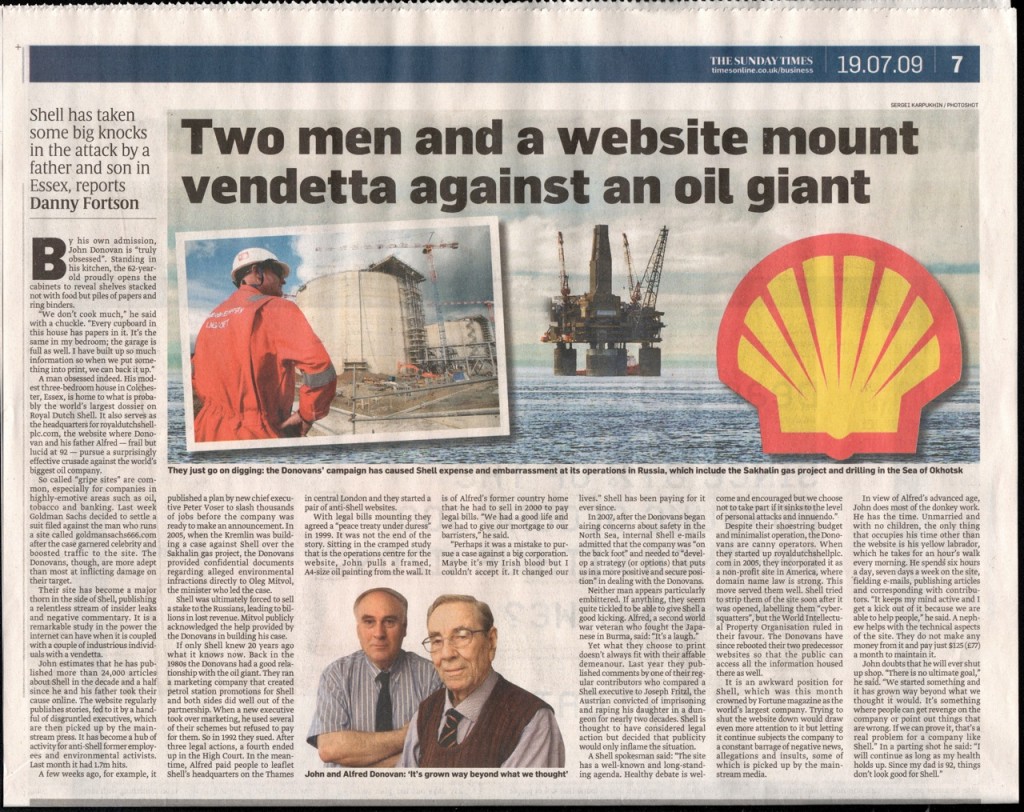
MEDIA COVERAGE: Prospect Magazine, The Sunday Times, and The Guardian, have all published major articles about us: "Rise of the Gripe Site";"Two men and a website mount vendetta against Shell' and "92-year-old's website leaves oil giant Shell-shocked”.
SHELL PETROL STATION images displayed in the website header panel are licensed under the GNU Free Documentation License.
COPYRIGHT NOTICE: Information on copyright issues here.
John Donovan can be contacted at [email protected]SHELL’S $500,000 WEDDING GIFT TO CORRUPT BRUNEI ROYAL FAMILY


EXTRACT FROM ASIAN JOURNAL ARTICLE IN LIST OF LINKS BELOW: "Fireworks will light up the sky for three nights. The local unit of oil giant Royal Dutch Shell has donated 500,000 Brunei dollars (US$292,400; euro 243,700) for the display, and for cultural events to be hosted by popular performers from Malaysia."
DAILY MAIL ONLINE: In April, Brunei shocked world by introducing harsh sharia penal code: Under the code limbs can be severed for theft and people stoned to death: 8 Jan 2015
THE DAILY BEAST: How the Sultan of Brunei Violated His Sharia Law With Me: 6 May 2014
FOX NEWS: Can Beverly Hills force Sultan of Brunei to sell his hotel chain?: 8 May 2014
FRONTPAGE MAG: Will the Sultan of Brunei Stone his Gay Son to Death?: 6 May 2014
THE NEW YORK POST: The sex-obsessed world of Brunei: (Extract from article: Oil is the source of all wealth, and when Shell began pumping in the 1970s, Brunei soon became known as “the Shellfare state.”:10 May 2014
Corrupt Sultan Of Brunei introduces tough Islamic penal code: 30 April 2014
THE BRUNEI TIMES: Brunei steps up to fight corruption: 9 Dec 2013
BRUDIRECT: Bribery Lands M'sian In Jail For 6 Yrs 4 Mths: 29 Nov 2013
THE BRUNEI TIMES: Man pleads not guilty to bribing BSP staff: 31 May 2012
BUSINESS INSIDER: How The Playboy Prince Of Brunei Blew Through $14.8 Billion: 7 June 2011
DAILY RECORD: Nude statue scandal as brother of Sultan of Brunei sues former lawyers: 11 Nov 2010
NEW YORK DAILY NEWS: Prince Jefri Bolkiah, brother of Sultan of Brunei, wants X-rated sex trophies out of court case: 4 Nov 2010
BruDirect.com: Shell Rewards Employees: 17 Feb 2008
THE WALL STREET JOURNAL: Will the Prince Turn Pauper?: 1 March 2008
THE TELEGRAPH: The £8 billion family feud: 14 May 2006
THE TELEGRAPH: Sultan of Brunei's ex-wife and the £2m con: 12 July 2007
THE TELEGRAPH: Sultan of Brunei marries his second, second wife: (WITH FIREWORKS SPONSORED BY AN OIL COMPANY): May 2005
REPORT OF DAVIS POLK & WARDELL TO SHELL AUDIT COMMITTEE: Highly Confidential Shell Internal Document shows Shell Brunei was involved in the Shell Reserves Scandal: (PDF so takes a while to download: 31 March 2004
BRUNEI-ONLINE.COM: Brunei Shell contributes $500,000 for royal wedding ceremonies: 6 Aug 2004
REPORT PUBLISHED BY UK FINANCIAL SERVICES AUTHORITY: Confirms Shell Brunei involvement in Shell Reserves Fraud: (PDF so takes a few moments to load): 24 Aug 2004
ASIAN JOURNAL: Brunei sultan sends Lear jet to fetch Arroyo: 9 Sept 2004
THE INDEPENDENT: The $5m royal wedding: 10 Sept 2004
BLOOMBERG: Brothers Grim: The Scandal In Brunei: 9 Aug 1998BILL CAMPBELL WHISTLEBLOWER EMAIL TO MP’S

 IN JULY 2007, MR BILL CAMPBELL (ABOVE, A RETIRED GROUP AUDITOR OF SHELL INTERNATIONAL SENT AN EMAIL TO EVERY UK MP AND MEMBER OF THE HOUSE OF LORDS:
THIS IS WHAT IT SAID:
Subject: This could be the most important whistleblower email you have ever received.
Some unfortunate Royal Dutch Shell workers have already lost their lives. More lives are at stake.
My name is Bill Campbell. I am a former Group Auditor of Shell International. I am writing to you on a matter of conscience in an effort to avert the inevitability of another major accident in the North Sea. The consequences could potentially impact on families in many constituencies, including your own.
As Royal Dutch Shell and the Health & Safety Executive would acknowledge, I am an expert on safety matters relating to offshore oil and gas platforms. In 1999, I was appointed by Shell to lead a safety audit on the Brent Bravo platform. The audit revealed a platform management culture that basically gave a higher priority to production than the safety of Shell employees. To our astonishment we discovered that a "Touch F*** All" policy was in place. Worse still, safety records were routinely falsified and repairs bodged.
I personally brought the shocking situation to the attention of senior management including Malcolm Brinded, the then Managing Director of Shell Exploration & Production. I revealed that ESDV leak-off tests were purposely falsified, not once but many times and that Brent Bravo platform management had admitted responsibility for the dangerous practices being followed. In response to my team ringing alarm bells, management pledged to rectify the serious problems which had been uncovered.
When I later complained that the pledges were not being kept, I was removed from my oversight function.
Four years later, a massive gas leak occurred on the platform. Two workers lost their lives. I have no doubt at all that the inaction of the relevant Asset Manager, the General Manager, the Oil Director and Malcolm Brinded, contributed in some part to the unlawful killing of two persons on Brent Bravo in September 2003.
Shell subsequently pleaded guilty to breaches of the HSE regulations and a record-breaking £900,000 fine was imposed. I thought this would bring about a real change in policy to put the emphasis on safety.
Unfortunately I was wrong. Although I supplied the evidence related to 1999, and the fact that there had been a collapse in controls of integrity from 1999 to 2003 on all 16 of Shell's North Sea offshore installations covered in a post fatality integrity review to the HSE for review by the Procurator Fiscal, none of this evidence was presented before the Sheriff at the subsequent Inquiry. The situation is explained in a letter to the Procurator Fiscal and the Sheriff (on 24th February 2007).
Shell management has engaged in spin to try to pretend that it is getting to grips with its safety problem. However, its atrocious safety record - the worst in the North Sea in terms of accidental deaths and absolute number of enforcement actions – tells a different story. This fact has resulted in a number of newspaper articles.
I have had meetings with senior Shell people including its CEO Mr. Jeroen van der Veer. I regret to say that I have found him to be economical with the truth. He prefers to support cover-up and deceit rather than confronting the underlying problems. Brinded is now Executive Director of Shell Exploration & Production. He believes in burying evidence.
My family and friends would probably prefer me to give up on this matter and enjoy my retirement after so many years working for Shell.
However, by writing to every MP in the UK, no one can ever say that I did not do my best to avert an inevitable further major accident event in the North Sea. When it happens (I pray that I am wrong) I will make this warning communication available to the media together with the vast amount of evidence in my possession.
At least my conscience is clear. I have done everything possible to ring the alarm bells about Shell management and its unscrupulous attitude to the safety of its employees.
Yours sincerely
Bill Campbell
ENDS
(Malcolm Brinded and Jeroen van der Veer are no longer with Shell. The Oil Director referred to in the email is Chris Finlayson, who left Shell to become Chief Executive of British Gas before being fired - his photo immediately below)


THE BRENT BRAVO SCANDAL
BRENT BRAVO: THE EVIDENCE ASSEMBLED BY BILL CAMPBELL
BILL CAMPBELL EVIDENCE BUNDLES A to F - June 2012
BILL CAMPBELL EVIDENCE BUNDLES A to F CONTINUED - June 2012


SHELL RESERVES FRAUD

SIR PHILIP WATTS, THE GROUP CHAIRMAN OF ROYAL DUTCH SHELL GROUP, FORCED TO RESIGN IN 2004
Shell’s reputation was destroyed in 2004 after FIVE consecutive cuts to its hydrocarbon reserves covering 55% of its total reserves. US and UK financial regulators imposed $150 million in fines on Shell for securities fraud. Shell was also rocked by class action lawsuits.
Sir Philip Watts and Walter van de Vijver (whose headcut images appear courtesy of The Wall Street Journal) were among the Shell executives forced to resign. More details at the foot of this column.


 MORE DETAILS:
The Shell reserves scandal brought about the end of the Royal Dutch Shell Group in its original form as an Anglo-Dutch partnership. Shell Transport & Trading Co and Royal Dutch Petroleum were unified into a single Dutch owned company - Royal Dutch Shell Plc. Sir Philip turned to religion and is now a very wealthy priest after receiving a payoff/pension package from Shell reportedly worth $18.5 million. Walter van de Vijver in contrast was the victim of a sadistic sacking by his Shell senior management backstabbing colleagues.

Daily Telegraph: Shell drops ‘bombshell’ on reserves: 9 January 2004
The Times: How Shell blew a hole in a 100-year reputation: 10 January 2004
The West Australian: Investors howl for Shell’s blood: 12 January 2004
London Evening Standard: Shell bosses lied to the City: 19 April 2004
Houston Chronicle:‘Sick and tired about lying’ at Shell: 19 April 2004
Bloomberg: Shell Loses AAA Credit Rating: 19 April 2004
BBC News: Shell bosses ‘fooled the market’: 19 April 2004
The Guardian: Trail of emails reveals depths of deceit at the heart of Shell: 20 April 2004
The Guardian: Shell admits it misled investors: 20 April 2004
The Independent: Lies, cover-ups, fat cats and an oil giant in crisis: 20 April 2004
The Scotsman: Shell implodes as emails provide damning evidence: 20 April 2004
The Times: Deceitful Shell ‘needs ten years’ to rebuild exploration business: 20 April 2004
Financial Times: Observer Column: Shell-shocked: Corporate slogans consigned to the dustbin of history no. 94: “You can be sure of Shell.”: 20 April 2004
Minneapolis Star Tribune: Dutch/Shell Group exec was ‘sick and tired’ of lying: 20 April 2004
Daily Telegraph: Memos expose Shell’s years of lying: 20 April 2004
The Scotsman: Shell’s reputation left in tatters: 21 April 2004
TheStarOnline: Shell report exposes lies, CFO sacked: 21 April 2004
Daily Telegraph: Shell suffers second cut to credit rating: 21 April 2004
Daily Telegraph: Sacked Shell boss ‘escorted from HQ’: 22 April 2004
The Times:A very British kind of scandal: why Shell is no Enron: 23 April 2004
Daily Telegraph: Shell’s lies over reserves spark FSA investigation: 24 April 2004
The Mail On Sunday: Shell's top bosses named in £8 billion lawsuit after being spared the sack: 25 April 2004
Daily Mail: Shell attacked from all sides: 26 April 2004
Daily Telegraph: Shell gives Watts a £1m golden farewell 23 May 2004
Daily Telegraph: Shell slices still more off proven reserves: 25 May 2004
Daily Telegraph: Watts’ pension pot tops £10m: 28 May 2004
London Evening Standard: Shell ‘has lied for 10 years’: 26 June 2004
Shell Closes Book on 2004 Reserves Scandal as Claims Deadline Passes: 5 November 2010
MONTAGE OF MEDIA COVERAGE

by John Donovan
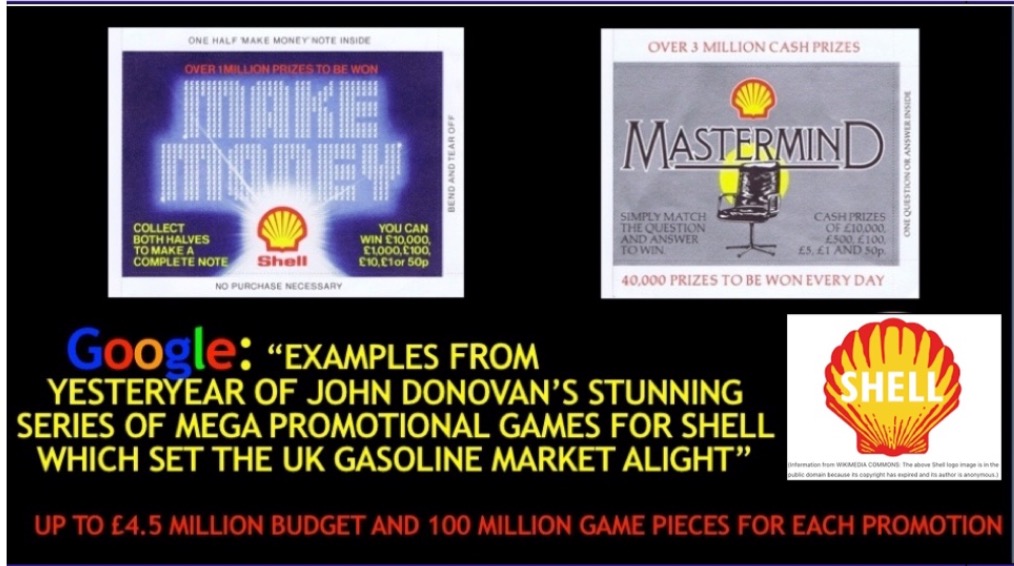
Displayed below are some of the spectacular promotional campaigns my company Don Marketing created for Shell in the 1980s and 1990s. This was before the series of SIX high court actions we brought against Shell for stealing ideas (4) and for defamation (2) - all settled by Shell. This website is a permanent response by me to the malicious underhand tactics, including treachery, espionage and intimidation, used by Shell during and after the bouts of litigation. More information is printed at the foot of this column.


 MORE DETAILS: After a solicitor acting for Shell threatened to make the litigation "drawn out and difficult" with the intention of draining the resources of a financially weaker opponent, my late father (Alfred Donovan) and I decided to mount a wide-ranging campaign as a counter-measure. We jointly founded the Shell Corporate Conscience Pressure Group, which nearly 15% of Shell UK retailers joined. We regularly conducted ethical surveys involving up to 1500 Shell petrol stations. All responses were opened and authenticated by an independent solicitor who supplied Affidavits confirming the results. In whole page announcements in trade magazines (examples above) we challenged Shell to commission and publish the resuits of independent research asking the same questions and offering respondents GUARANTEED anonymity. Shell never took up the invitation. Instead it asked the UK Advertising Standards Authority to investigate our Shell surveys. No problems were found. The head-cut image of Alfred Donovan appears courtesy of The Wall Street Journal.
 SHELL CONTROVERSIES
selection of memorable warnings/articles/images associated with the controversial track record of Royal Dutch Shell.


WARNING: DO NOT DISCLOSE YOUR IDEAS TO SHELL GameChanger OR SHELL Ideas360 WITHOUT TAKING EVERY POSSIBLE PRECAUTION. Shell management has ample funds to pay for intellectual property but prefers to steal it from small businesses and in our experience, gives its full backing to dishonest managers willing to do its bidding. We have sued Shell repeatedly in the High Court for the theft of our Intellectual Property. It is doubtful if anyone can match our dire experience in dealing with this ruthless unscrupulous serial poacher of other parties ideas. Expect threats, legal machinations and sinister action from Shell and its spooks if you object to having your ideas stolen.


LINKS TO SOME RELATED ARTICLES:
ARTICLE: Shell in the US courts again for alleged theft of trade secrets: 20 June 2014
ARTICLE: Shell GameChanger - Scam, or Genuine Game Changer?: 10 June 2014
ARTICLE: Is it safe to disclose ideas to Shell GameChanger?: 7 June 2014
ARTICLE: Royal Dutch Shell plc Brings Crowdsourcing to the Energy Markets: 20 April 2014
ARTICLE: High Court papers unveil ‘secret’ Shell writ losses: 23 April 1998
ARTICLE: Another warning to inventors of the alleged dangers when dealing with Shell : 12 March 2008
ARTICLE: Shell in deepwater, accused of more IP theft: 13 August 2008
ARTICLE: ENERTAG PATENTS: MORE ROYAL DUTCH SHELL IP CHICANERY?: 4 November 2009
ARTICLE: Shell investigates alleged IP theft at Geelong Refinery: 21 April 2012
ARTICLE: Another alleged case of IP theft hits Royal Dutch Shell: 20 May 2012
ARTICLE: Shell Oil Must Pay $153.6 Mln Award to Union Carbide: 17 June 2012

Some years ago extensive documentary evidence was brought to the attention of Malcolm Brinded above, when he was Chairman of Shell UK, proving beyond any doubt that Shell executives had conspired to rig a tender for a major contract. A number of innocent firms were deliberately lured into signing confidentiality agreements and disclosing Intellectual Property to Shell under false pretences, in a carefully contrived plot. The firm which was awarded the contract never took part in the tender. One objective of the Machiavellian plan was to stop/delay IP trade secrets owned by the participants in the tender from being disclosed to Shell's rivals. This was achieved by outright deception, without paying a cent to the firms involved, who wrongly believed they were participating in an honest tender. Instead of sacking the ring leader, AJL - who had a personal relationship with the firm which miraculously won the race in which it never ran - Shell senior directors, including Brinded, gave AJL their full backing. Some of the Shell executives involved, including for example, Tim Hannagan, still hold high positions inside Shell - in his case, Global Brand and Visual Identity Manager. If Shell does not accept that this is a true, provable account of what happened, then it should sue for libel. How on earth is such predatory conduct compatible with Shell's claimed business principles?
FOR MORE INFORMATION, READ THIS ARTICLE:
ARTICLE: Irregularities in a Royal Dutch Shell tender process: 31 October 2011

ARTICLE: SEX, DRUGS & CORRUPTION SPONSORED BY SHELL


OVER 500 EXTERNAL PUBLICATIONS CITING OUR SHELL WEBSITES

See our link list of over 500 articles by the FT, Wall Street Journal, Reuters, Bloomberg, Forbes, Dow Jones Newswires, New York Times, CNBC etc, plus UK House of Commons Select Committee Hansard records, information on U.S. Securities & Exchange Commission website etc. all containing references to our Shell focussed websites, or our website founders Alfred and John Donovan. Includes TV documentary features in English and German, newspaper and magazine articles, radio interviews, newsletters etc. Plus academic papers, Stratfor intelligence reports and UK, U.S. and Australian state/parliamentary publications, also citing our Shell websites. Click on this link to see the entire list, all in date order with a link to an index of over 100 books also containing references to our websites and/or our activities.
John Donovan, the website owner
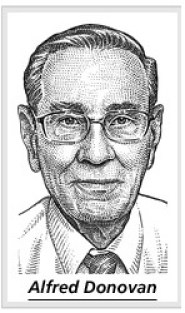 A head-cut image of Alfred Donovan (now deceased) appears courtesy of The Wall Street Journal.
-
MADE REDUNDANT AND ROBBED OF TAX BREAKS BY SHELL

CNBC/REUTERS: UPDATE 1-Shell takes sacked UK workers overseas service tax breaks: 7 JULY 2016
DAILY MAIL ONLINE/REUTERS: Shell takes sacked UK workers overseas service tax breaks: 8 JULY 2016
ENERGYVOICE: Shell depriving ex-workers of tax breaks on redundancy pay – report: 8 JULY 2016
RoyalDutchShellPlc.com: Greedy Shell Takes Redundant Employees Tax Breaks: 8 JULY 2016
RoyalDutchShellPlc.com: SHELL TAX THEFT: 5 AUGUST 2016JOHN DONOVAN, THE OWNER OF THIS AND SEVERAL OTHER SHELL FOCUSSED WEBSITES

SHELL PRELUDE TO DISASTER


The links below are to a series of articles, many triggered by a well-placed whistleblower directly involved in the pioneering Royal Dutch Shell Prelude project. Includes articles by Mr Bill Campbell above, the retired distinguished HSE Group Auditor of Shell International and another retired Shell guru with a track record of spotting potential pitfalls in major Shell projects.
ARTICLE: Voser wisely abandons an unstable ship: 28 December 2013
ARTICLE: Royal Dutch Shell Prelude to disaster?: 10 Jan 2014
ARTICLE: Shell Prelude FLNG: loss of containment of hydrocarbons almost inevitable: 21 Feb 2014
ARTICLE: What should frighten stiff Royal Dutch Shell shareholders: 15 March 2014
ARTICLE: Tales of the Unexpected and Royal Dutch Shell Prelude FLNG: 28 March 2014
ARTICLE: Prelude FLNG: A case of all your eggs in the one basket: 10 July 2014
ARTICLE: Prelude FLNG risks are on par with modern offshore oil and gas facilities say Shell – but are they?: 23 Sept 2014
ARTICLE: Royal Dutch Shell Prelude Project ‘A Step Too Far’: 25 Sept 2014
ARTICLE: SpaceShip Two: Shell Prelude another pioneering venture fraught with risk: 2 November 2014
ARTICLE: WA turns spotlight on FLNG safety: 11 November 2014
ARTICLE: Prelude a giant production and processing barge masquerading as a ship: 11 November 2014
ARTICLE: Sunday Times Article: Prelude a potential white elephant: 11 November 2014
ARTICLE: Damning Verdict on Shell's Prelude FLNG Propaganda: 12 November 2014
ARTICLE: Combustible pioneering behemoths - the Hindenburg and Shell Prelude: 21 November 2014
ARTICLE: Key role of Shell lawyers in pioneering Shell Prelude FLNG: 05 December 2014
ARTICLE: The Future of Natural Gas: LNG vs. FLNG: 26 Feb 2015
ARTICLE: The Sydney Morning Herald: WA inquiry shines spotlight on floating LNG safety fears: 8 May 2015
ARTICLE: THE WEST AUSTRALIAN: Delays slow Prelude's sail-away: 11 April 2016
ARTICLE: THE WEST AUSTRALIAN: Gas industry needs to work harder, innovate: Shell boss: 12 April 2016
ARTICLE: ENERGY VOICE: GE starts production on Shell’s Prelude risers, must withstand a 1-in-10,000-year cyclonic event: 11 April 2016
ARTICLE: THE AUSTRALIAN: Shell chief Ben van Beurden backs FLNG program:13 April 2016
ARTICLE: THE WEST AUSTRALIAN: Enthusiasm cools for Prelude FLNG: 13 April 2016
ARTICLE: BY JOHN DONOVAN: Musings about the OPL 245 Shell/ENI corruption scandal and the sinking confidence in Prelude: 13 April 2016
ARTICLE: BY BILL CAMPBELL: Project Prelude – A case study in the generation of real material debt: 17 April 2016/a>
Hazardex: Shell Australia’s giant Prelude floating LNG project likely to come on stream in 2017: 20 Sept 2016SHELL/EXXON INDUCED DUTCH EARTHQUAKES

DutchNews.nl: Gas group NAM says more serious earthquakes will hit Groningen: 1 October 2014
EnergyVoice.com: Quakes force Dutch lawmakers to cut gas production: 11 March 2015
Bloomberg: Dutch Quakes Toss Wrench Into Gears of Europe Gas Market: 10 March 2015
Devastating report of a scary scenario: 07 March 2015
Dutch government says sorry for quakes caused by Groningen gas field: 02 March 2015
Reuters: Bells toll for Europe's largest gas field: 02 March 2015
Groningen Gas Field Shock: Risk of earthquakes at 4.6 on the Richter scale: 24 Feb 2015
Shell and Exxon ignored seismic dangers at Groningen Gas Field: 18 Feb 2015
REUTERS ARTICLE: Dutch Court hears challenge over Groningen gas production: 1 April 2015
BLOOMBERG: Dutch Court to Rule on Gas Output From Europe’s Biggest Field: 13 April 2015
BLOOMBERG: Dutch court limits fracking on earthquake fears: 14 April 2015
REUTERS ARTICLE: Exxon-Shell gas venture may have to adjust Groningen output after court ruling: 15 April 2015
Shell/Exxon Induced Earthquakes undermine Dutch Gov Revenues: 16 April 2015
A Halt to Groningen Production Could Significantly Impact on Shell’s Remaining Reserves: 17 April 2015
REUTERS ARTICLE: Reinforcing homes in Dutch gas extraction quake zone estimated at 30 bln euros: 20 April 2015
NEW YORK TIMES/REUTERS ARTICLE: Dutch Court Says Gas Producer Must Compensate Homeowners in Quake Zone: 2 Sept 2015
THE WALL STREET JOURNAL: Shell, Exxon Ordered to Pay Groningen Earthquake Compensation: 2 Sept 2015
BLOOMBERG.COM: Riled Locals Fight Output From Europe’s Largest Gas Field: 10 Sept 2015
REUTERS: Groningen gas production challenged in Dutch court: 10 Sept 2015
THE GUARDIAN NEWSPAPER: Shell and Exxon’s €5bn problem: gas drilling that sets off earthquakes and wrecks homes: 10 October 2015
THE NEW YORK TIMES: New Concern Over Quakes in Oklahoma Near a Hub of U.S. Oil: 15 October 2015
Enid News & Eagle: Oklahoma world's No. 1 earthquake area: 11 Nov 2015
BLOOMBERG.COM: Dutch Court to Rule on Gas Output From Europe's Biggest Field: 18 Nov 2015
BLOOMBERG: Exxon's Dutch Gas Gag: 18 Nov 2015
Reuters: Safety risks prompt Dutch court to order cuts at Groningen gas field: 18 Nov 2015
Jurist: Dutch court orders more cuts in gas production: 19 Nov 2015
The Sunday Times: Gas Field quakes hit Dutch dykes: 22 Nov 2015
NAM, the Dutch Gas joint venture by Shell and Exxon investigate impact of earthquakes triggered by Groningen Gas Field activity: 18 February 2016
NL TIMES: SHELL ACCUSED OF BLACKMAILING GRONINGEN ON EARTHQUAKE SAFETY, REPAIRS: 25 April 2016
DutchNews.nl : Shell and Exxon secured 'secret deal' on Groningen gas production: 13 May 2016
Reuters: Dutch agency calls for further cut in Groningen gas production: 22 June 2016
Bloomberg: Dutch Winter Gas Rises to Six-Month High Before Output Decision: 22 June 2016
Reuters: Dutch government lowers Groningen gas output cap: 24 June 2016
NL TIMES: SHELL CEO: REINVEST NATURAL GAS REVENUES IN RENEWABLE ENERGY: 1 SEPT 2016
DutchNews.nl: Shell and ExxonMobil apologise for Groningen earthquake problems: 8 SEPT 2016
Reuters: Dutch see demand for Groningen gas down sharply from 2020: 13 SEPT 2016
Seeking Alpha: Groningen gas demand seen falling sharply: 13 SEPT 2016/a>
MailOnline/Reuters: Dutch government confirms cut in Groningen gas output: 23 Sept 2016
Dutch groups demand tighter curbs on Groningen gas production: 17 Nov 2016ROYAL DUTCH SHELL TAX AVOIDANCE
SHELL DEFECTIVE WONDER FUELS
SHELL’S EVIL ROLE IN THE “JUDICIAL MURDER” OF KEN SARO-WIWA


SHELL “SCREW-UP” IN THE ARCTIC – $7BN DOWN THE DRAIN


ARTICLE: US Interior Sec: We won’t let Shell screw up Arctic drilling: 18 March 2013
ARTICLE: David Lawrence, Shell Exec VP responsible for Arctic Exploration Fired?: 21 March 2013
ARTICLE: ROYAL DUTCH SHELL SCREW UP IN THE ARCTIC: 7 April 2013
ARTICLE: Shell says Kulluk left Dutch Harbor to avoid taxes: 25 May 2013
ALSO SEE THIS RELATED BRILLIANT NEW YORK TIMES ARTICLE: The Wreck of the Kulluk
ARTICLE: BP fights to halt 'bogus' gulf claims: 7 July 2013
ARTICLE: Shell dicing with disaster in US Arctic waters: 18 December 2013
ARTICLE: Financial calamity could engulf Shell in event of an Arctic Disaster: 18 April 2014
ARTICLE: Arctic Drilling: a spectacular failure of good judgment by Shell: 10 October 2014
ARTICLE: Ann Pickard, Shell VP for Arctic drilling, is not a safe pair of hands: 24 May 2015
ARTICLE: Feds rap Shell for poor planning in botched tow of 2012 Arctic drilling rig: 28 May 2015
ARTICLE: Arctic blowout clean-up costs could exceed Shell’s financial resources: 29 May 2015
ARTICLE: Former Shell worker says rush to prepare for Arctic drilling resulted in unsafe conditions: 19 June 2015
ARTICLE: Shell returns to Unalaska with first of 27 strong fleet arriving: 19 June 2015
ARTICLE: Shell's blowout response tests hailed a success: 20 June 2015
REUTERS ARTICLE: Shell pulls the plug on Arctic exploration: 28 Sept 2015
BBC NEWS ARTICLE: Shell has made a costly call to abandon Alaska: 28 Sept 2015
BLOOMBERG.COM ARTICLE: Why Shell Quit Drilling in the Arctic: 28 Sept 2015
FT ARTICLE: Shell's Arctic defeat ends dream of new frontier: 28 Sept 2015
TELEGRAPH ARTICLE: Emma Thompson joins Greenpeace to celebrate Shell scrapping Arctic drilling: 28 Sept 2015
THE ECONOMIST: A rig too far: 3 Oct 2015
ABC News: Shell boss confronts environmental, carbon challenges: 3 Oct 2015NAZI NAMED SHIP HIRED BY SHELL


The campaign waged on this website by John Donovan to persuade Edward Heerema to rename the worlds biggest ship, The Pieter Schelte - which he named after his late father, Pieter Schelte Heerema, a former Officer in the German Waffen-SS - has been successful. On Friday 6 February 2015, Allseas announced that it was changing the ships name, and on 9 February announced the new name - Pioneering Spirit.
FORBES MAGAZINE ARTICLE: Big Oil's $3 Billion Homage To A Nazi War Criminal: 20 Dec 2014
JOHN DONOVAN PETITION ON CHANGE.ORG: Out of respect to the victims of Nazi war crimes, please change the name of your gigantic new ship, the Pieter Schelte, named after your father, a former officer in the murderous Waffen SS and diehard member of the Nazi party: 22 December 2014
ROYAL DUTCH SHELL PLC .com: Lloyd’s Register PR Fanfair Saluting Nazi named mega-ship The Pieter Schelte: 22 Jan 2015
THE JEWISH CHRONICLE: World's biggest ship named after Nazi: 22 Jan 2015
JEWISH BUSINESS NEWS : Jewish Groups Outraged At Launching Of World's Largest Crane Ship Named After SS Officer: 24 Jan 2015
DUTCH FINANCIAL TIMES: Criticism swells of Heerema’s ‘bad name’ heavy lift: 25 Jan 2015
GUARDIAN ONLINE: Jewish outrage as ship named after SS war criminal arrives in Europe: 25 Jan 2015
THE OBSERVER NEWSPAPER: Jewish outrage as world's largest ship, named after SS war criminal, arrives in Europe: 25 Jan 2015
PDF OF OBSERVER ARTICLE DATED SUNDAY 25 Jan 2015
THE MAIL ONLINE: Named after SS Nazi war criminal: World's largest ship sparks outrage as it arrives in Europe just as 70th anniversary of liberation of Auschwitz is marked: 25 Jan 2015
ARTICLE BY DUTCH INVESTIGATIVE JOURNALIST, TONY BIESEMAAT: Nazi rat lines and Pieter Schelte Heerema: 27 Jan 2015
STV (SCOTTISH TV): Energy giant criticised over ship named after Nazi war criminal: 3 Feb 2015
SCOOP.CO.NZ (NEW ZEALAND): Allseas Group’s Nazi-honouring vessel ‘must be banned': 4 Feb 2015
EQUALTIMES.ORG: GET THE WORLD'S BIGGEST SHIP, NAMED AFTER A NAZI SS OFFICER, OUT OF OUR WATERS: 4 Feb 2015
Nazi named ship a bloodstain on the name of Shell: 5 Feb 2015
Allseas Abandons Ship Name: 6 Feb 2015
Pieter Schelte ship name change to Pioneering Spirit fraught with superstitious pitfalls: 10 Feb 2015
DAILY GAZETTE: Man’s fight to change ship’s Nazi-linked name (Pieter Schelte) succeeds: 11 Feb 2015 2015
Man's fight to change ship's Nazi-linked name succeeds: 12 Feb 2015ROYAL DUTCH SHELL EMPLOYEE DATA BREACH


GLOBAL NEWS COVERAGE: FEBRUARY 2010
MORE INFORMATION: Contact details for over 176,000 employees and contractors of Royal Dutch Shell reached John Donovan and some environmental and human rights groups, ostensibly from disaffected Shell staff calling for a “peaceful corporate revolution” at the company. The database, from Shell’s internal directory, contained names and telephone numbers for all the company’s work force worldwide, including some home numbers. It was supplied with a 170 page covering note, explaining that it was being circulated by “116 concerned employees of Shell dispersed throughout the USA, the UK, and the Netherlands”, to highlight the harm done by the company’s operations in Nigeria. John Donovan brought the leak to the attention of Shell. Tests proved that the data was authentic and he destroyed the database after being informed by Mr. Richard Wiseman, the then Chief Ethics & Compliance Officer of Royal Dutch Shell Plc, that the confidential information if publicly disclosed, could put Shell employees and contractors in real danger.SHELL PROPPED UP APARTHEID


ARTICLE: U.S. unions urge boycott of Shell to fight apartheid: 19 Jan 1986
ARTICLE: Shell, South Africa and Apartheid: 16 Oct 2012
ARTICLE: Shell propped up racist apartheid regime in South Africa: 24 Nov 2012
ARTICLE: The Neptune Strategy:Shell, propped up Apartheid in South Africa: 26 Nov 2012
ARTICLE: Shell accused of benefiting from South African apartheid-era land law: 21 March 2013
ARTICLE: THE CAMPAIGN TO END APARTHEID: 12 Dec 2013
RELEVANT PAGES FROM "A HISTORY OF ROYAL DUTCH SHELL, VOLUME 3, PUBLISHED IN 2007. PREPARED BY SHELL'S PAID HISTORIANS. DEALS WITH SHELL'S SUPPORT FOR APARTHEID
SHELL ROLE IN SAUDI ARABIA/AL YAMAMAH BAE ARMS SCANDAL
SHELL OFFICIAL ENDORSEMENT OF THIS WEBSITE
SHELL TOXIC BRANDS
DOMAIN NAME BATTLE
ROYAL DUTCH SHELL INFORMATION


A TV documentary feature about our co-founder John Alfred Donovan, has aired in many countries. A related article was published in 10 languages.