Investment & Pensions Europe: Shell’s Dutch pension talks reach impasse
“The main sticking point is the fact that Shell has changed the pension age from 60 to 65, while all employees will have to start paying part of the pension premiums.”
Wednesday 26 October 2005
IPE.com 26/Oct/05: NETHERLANDS – The year long negotiations between Shell Nederland and the Dutch trade unions FNV Bondgenoten and CNV Chemie have reached an impasse.
The unions have refused to accept a proposal the company has made to the Central Staff Council, where unions and employee representatives discuss issues.
According to the official statement by the unions, Shell will have until October 31 to reassess the situation and change its proposal or it will face strikes at several of its Dutch plants.
The unions don’t agree with the more sober pension arrangements offered by Shell, which has redesigned its arrangements due to government legislation and developments in its own sector.
The main sticking point is the fact that Shell has changed the pension age from 60 to 65, while all employees will have to start paying part of the pension premiums.
Until now, Shell employees with a salary below €60,000 did not have to pay at all. If employees take early retirement, overall pension payments will be lower.
For all its existing employees, Shell has put into place a transitional period, in which employees will have the opportunity to take early retirement based on its total working years.
The staff council and the trade unions have refused to accept the proposals.
According to Egbert Schellenberg of FNV Bondgenoten, Shell employees are refusing to start paying for a pension arrangement, especially if it’s much worse than before.
Unions also reckon that the oil giant has enough cash generating power at present to pay the extra bills itself. If there is a strike at Shell Netherlands, this will be the first since 1979.
Shell spokesman Andre Romeyn told IPE the company was currently assessing the situation.
“The company feels that it is regrettable that the new proposal, which is still better than current arrangements of competitors, has not been accepted.
“Shell is currently considering the contents of the letter, but has said that it regrets the trade unions’ rejection of the proposal for the amended pension scheme.” He said the new arrangements would be affordable in the future.
Earlier this week unions in the UK threatened to strike over pensions at Shell’s rival BP.
By Cyril Widdershoven
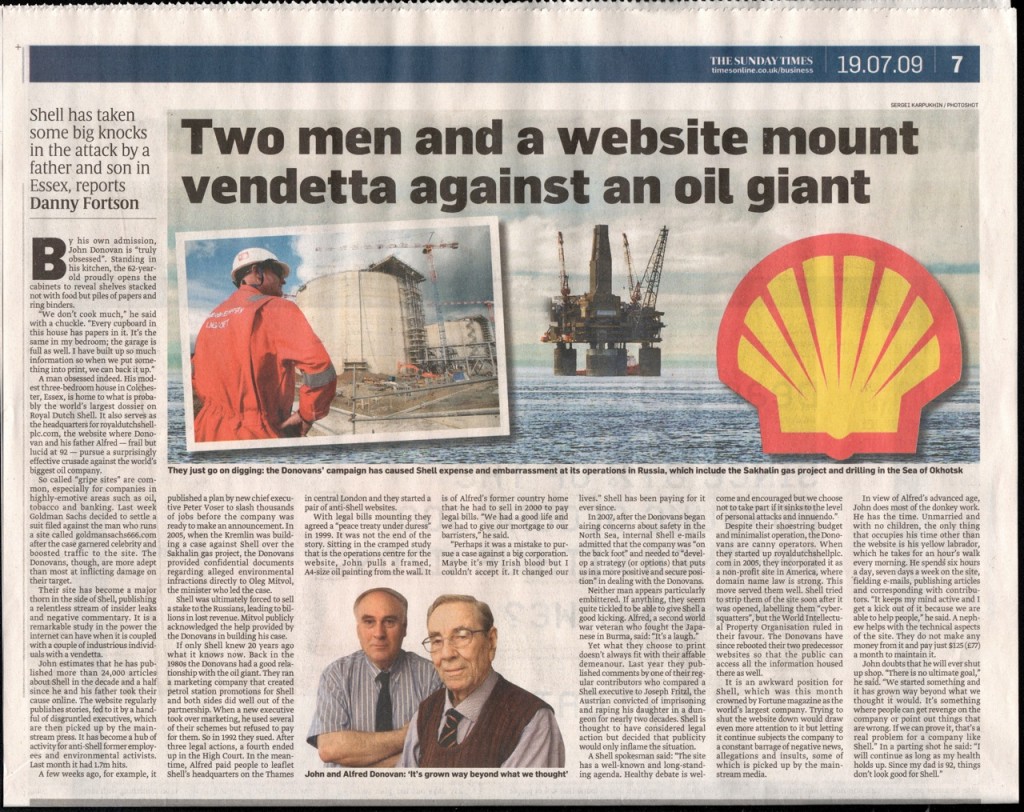
This website and sisters royaldutchshellplc.com, shellnazihistory.com, royaldutchshell.website, johndonovan.website, and shellnews.net, are owned by John Donovan. There is also a Wikipedia segment.


 Royal Dutch Shell conspired directly with Hitler, financed the Nazi Party, was anti-Semitic and sold out its own Dutch Jewish employees to the Nazis. Shell had a close relationship with the Nazis during and after the reign of Sir Henri Deterding, an ardent Nazi, and the founder and decades long leader of the Royal Dutch Shell Group. His burial ceremony, which had all the trappings of a state funeral, was held at his private estate in Mecklenburg, Germany. The spectacle (photographs below) included a funeral procession led by a horse drawn funeral hearse with senior Nazis officials and senior Royal Dutch Shell directors in attendance, Nazi salutes at the graveside, swastika banners on display and wreaths and personal tributes from Adolf Hitler and Reichsmarschall, Hermann Goring. Deterding was an honored associate and supporter of Hitler and a personal friend of Goring.

 Deterding was the guest of Hitler during a four day summit meeting at Berchtesgaden. Sir Henri and Hitler both had ambitions on Russian oil fields. Only an honored personal guest would be rewarded with a private four day meeting at Hitler’s mountain top retreat.


 IN JULY 2007, MR BILL CAMPBELL (ABOVE, A RETIRED GROUP AUDITOR OF SHELL INTERNATIONAL SENT AN EMAIL TO EVERY UK MP AND MEMBER OF THE HOUSE OF LORDS:


 MORE DETAILS:


 A head-cut image of Alfred Donovan (now deceased) appears courtesy of The Wall Street Journal.