The New York Times: Shell Settles Oil Reserve Fraud Case for $150.7 Million
Degenhardt added that the overstatements had occurred “over an extended period.”
Posted 25 August 04
LONDON (Reuters) – Regulators said on Tuesday they would pursue individuals responsible for a reserves scandal at Royal Dutch/Shell Group (RD.AS) (SHEL.L), as the oil giant settled $151 million in fines over the debacle.
“As our investigation continues, we intend to focus on, among other things, the people responsible for Shell’s failures,” said Harold F. Degenhardt, administrator at the Securities and Exchange Commission (SEC) in the United States.
Degenhardt added that the overstatements had occurred “over an extended period.” The SEC added that it had warned Shell before late 2003 that its “reported proved reserves potentially were overstated.”
Meanwhile, the UK’s Financial Services Authority (FSA) said it was continuing “investigations into other aspects” of the reserves scandal.”
The world’s third-largest oil company agreed on Tuesday to finalize settlements with both U.S. and UK regulators over its misstatement of proven oil reserves. Shell will pay the FSA 17 million pounds ($31 million) and the SEC $120 million.
The settlement comes after Shell stunned financial markets in January by slashing its proven oil and gas reserves by a fifth, or 4.47 billion barrels.
The FSA said Shell’s “unprecedented misconduct” resulted in market abuse and the breaching of listing rules.
Shell said it will also spend an additional $5 million to develop and implement a “comprehensive internal compliance program” as part of its deal with the SEC. It said it has improved its systems to prevent “any recurrence of these unfortunate events.”
Several top Shell executives lost their jobs in the wake of the scandal. Shell’s new board, led by Chairman Jeroen van der Veer and managing director Malcolm Brinded, has slowly won shareholders over with promises to improve corporate governance.
Earlier this month, a senior industry source told Reuters that Shell would unify the boards of its Dutch and British holding companies. The group might even consider a full merger of the two, or for one holding company to take over the other.
The company currently has two boards. Royal Dutch owns 60 percent of the overall group, while Shell Transport & Trading holds the remaining 40 percent.
Shell has said it will publish the results of its corporate governance review in November, and that nothing had been ruled out.
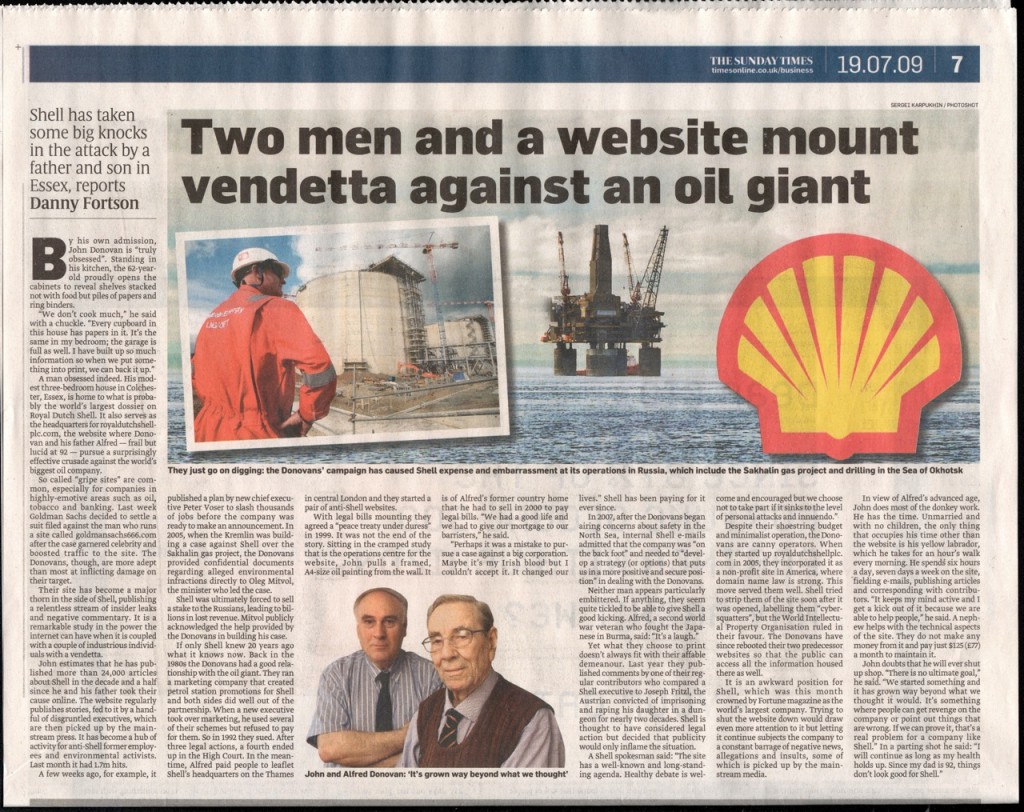
This website and sisters royaldutchshellplc.com, shellnazihistory.com, royaldutchshell.website, johndonovan.website, and shellnews.net, are owned by John Donovan. There is also a Wikipedia segment.


 Royal Dutch Shell conspired directly with Hitler, financed the Nazi Party, was anti-Semitic and sold out its own Dutch Jewish employees to the Nazis. Shell had a close relationship with the Nazis during and after the reign of Sir Henri Deterding, an ardent Nazi, and the founder and decades long leader of the Royal Dutch Shell Group. His burial ceremony, which had all the trappings of a state funeral, was held at his private estate in Mecklenburg, Germany. The spectacle (photographs below) included a funeral procession led by a horse drawn funeral hearse with senior Nazis officials and senior Royal Dutch Shell directors in attendance, Nazi salutes at the graveside, swastika banners on display and wreaths and personal tributes from Adolf Hitler and Reichsmarschall, Hermann Goring. Deterding was an honored associate and supporter of Hitler and a personal friend of Goring.

 Deterding was the guest of Hitler during a four day summit meeting at Berchtesgaden. Sir Henri and Hitler both had ambitions on Russian oil fields. Only an honored personal guest would be rewarded with a private four day meeting at Hitler’s mountain top retreat.


 IN JULY 2007, MR BILL CAMPBELL (ABOVE, A RETIRED GROUP AUDITOR OF SHELL INTERNATIONAL SENT AN EMAIL TO EVERY UK MP AND MEMBER OF THE HOUSE OF LORDS:


 MORE DETAILS:


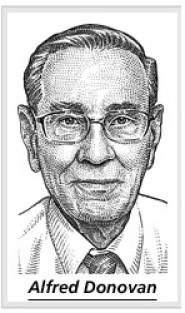 A head-cut image of Alfred Donovan (now deceased) appears courtesy of The Wall Street Journal.