ARTICLE ADDED TO OUR ONLINE ARCHIVE
MARKETING MAGAZINE SALES PROMOTION SURVEY: 6 SEPT 1984
EXTRACTS: So why did Shell, in February of this year, spark off the first promotional battle in petrol marketing for more than a decade? The answer, so the trade suggests, may have some-thing to do with Shell wanting to put the squeeze on those minor majors and the smalIer operators. Shell and the other oil majors had become rather shell-shocked by the bitter price wars of recent years, as marketing men were forced,’ not only to weather fluctuating prices of world oil and currencies, but also to keep an eye on what each competitor was doing.
Over the years, motorists had clearly come to the conclusion that petrol was simply a commodity purchase and there was no reason for brand loyalty. Price became the key factor, and the motoring public was quick to switch its custom to areas where there were many competing filling stations. But in such a competitive market, and with such smalI operating margins on petrol sales, price wars were simply becoming too expensive.
So, in the latter part of last year, price stability became the dominant feature of the market. However, the majors were still vulnerable at the margin to the cheaper prices offered by the smaller operators.
The Shell ‘game plan’ clearly foresaw that its major rivals would be forced to compete along similar lines, thus cancelling out most of the initial market share gains. However, the company obviously reckoned that the smaller operators would be unable or unwilIing to compete as vigourously on non-price promotions, and would thus lose to the majors.
ShelI, to be fair, had other reasons for wanting to boost market share by promotions rather than by price cutting. It had just completed a massive investment in rationalising, refurbishing, and converting its filIing station outlets to self-service, and needed to boost customer traffic to make the investment payoff. ‘We felt it important to re-establish the Shell brand, following more than a decade in which we had not promoted it, either above or below the line, other than through price,’ points out Beach. ‘The company’s advertising during that time was purely corporate in nature.’
Persistence
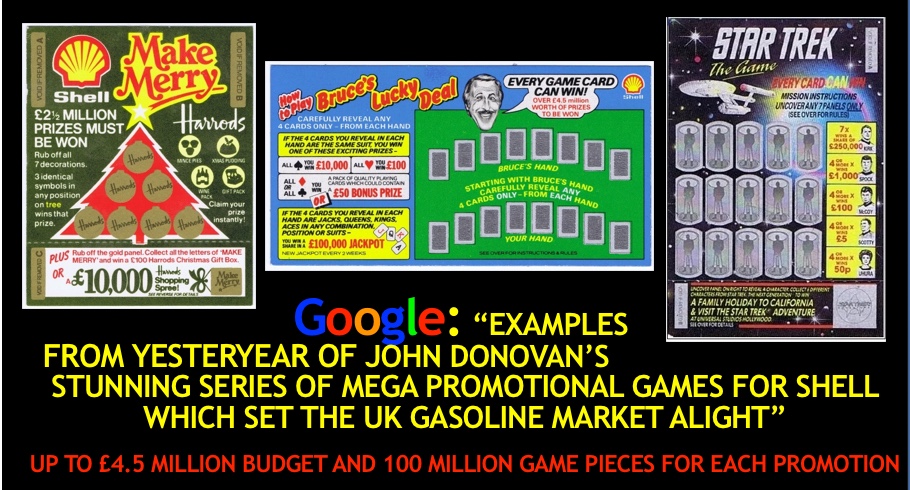
The decision to go for a promotional game had been prompted by the persistence of Don Marketing, the Essex based promotional games company, which had, for more than two years, been pressing on Shell the potential of a game to boost sales. Any doubts that ShelI may have harboured about the popularity of the game with motorists were quickly dispelIed when the promotion received massive press and television publicity, and sales at many petrol stations soared by more than 25%.
Round two, however, is expected to prove a very different affair, with ShelI unlikely to have it alI its own way, as it did at the beginning of round one. At the end of July, ShelI’s new gambit was another promotional game, a sort of ‘son of Make Money’, but this time calIed Mastermind. This game is loosely based on the BBC television series and involves motorists matching up half notes bearing questions and answers to win cash prizes of up to £10,000.
John Chambers of Don Marketing, which was heavily involved in developing and implementing the new game, claims that the question and answer approach ‘is a good way of retaining interest’. He also points out that the new game has a more generous win ratio than the previous ShelI game, with 50% more prizes. The game is due to run until the end of this month or early October, and is being backed up with a £lm national TV and press advertising campaign through Ogilvy and Mather.
Marketing 6 September 1984
Complete original article…
http://www.shellnews.net/PDFs/MarketingSalesProSurvey6Sept84.pdf
This website and sisters royaldutchshellplc.com, shellnazihistory.com, royaldutchshell.website, johndonovan.website, and shellnews.net, are owned by John Donovan. There is also a Wikipedia segment.


 Royal Dutch Shell conspired directly with Hitler, financed the Nazi Party, was anti-Semitic and sold out its own Dutch Jewish employees to the Nazis. Shell had a close relationship with the Nazis during and after the reign of Sir Henri Deterding, an ardent Nazi, and the founder and decades long leader of the Royal Dutch Shell Group. His burial ceremony, which had all the trappings of a state funeral, was held at his private estate in Mecklenburg, Germany. The spectacle (photographs below) included a funeral procession led by a horse drawn funeral hearse with senior Nazis officials and senior Royal Dutch Shell directors in attendance, Nazi salutes at the graveside, swastika banners on display and wreaths and personal tributes from Adolf Hitler and Reichsmarschall, Hermann Goring. Deterding was an honored associate and supporter of Hitler and a personal friend of Goring.

 Deterding was the guest of Hitler during a four day summit meeting at Berchtesgaden. Sir Henri and Hitler both had ambitions on Russian oil fields. Only an honored personal guest would be rewarded with a private four day meeting at Hitler’s mountain top retreat.


 IN JULY 2007, MR BILL CAMPBELL (ABOVE, A RETIRED GROUP AUDITOR OF SHELL INTERNATIONAL SENT AN EMAIL TO EVERY UK MP AND MEMBER OF THE HOUSE OF LORDS:


 MORE DETAILS:


 A head-cut image of Alfred Donovan (now deceased) appears courtesy of The Wall Street Journal.